Gold Market Blog
Gold insights. Clearer decisions.
Practical gold education, market insights and expert guides to help you understand prices, trends and smart investing.


Gold ETFs vs Allocated Physical Gold: The Hidden Differences That Matter for Investors
Gold ETFs and allocated physical gold both give you gold exposure but they are not the same. Counterparty risk, redemption rights, fees, taxes, and what you actually own differ significantly. Here is the complete comparison every gold investor should understand.

Why Gold Remains a Tier-1 Banking Asset: Basel III, Bank Capital and the Physical Gold Standard
Under Basel III rules implemented from 2019, physical (allocated) gold moved from Tier 3 to Tier 1 bank capital, equivalent to cash and AAA sovereign debt. The change reshaped bullion bank operations and increased structural demand for physical gold. Why it matters.

How Governments Audit National Gold Holdings: Procedures, Standards and Why Some Countries Stay Opaque
Some countries audit their gold reserves every year. Others have not done a full audit in 70 years. Procedures vary from full bar-by-bar inspection to seal verification to no independent check at all. How national gold audits actually work, country by country.

Gold Reserves vs Foreign Currency Reserves Explained: Why Central Banks Hold Both
Central banks hold over 36,000 tonnes of gold and roughly 12 trillion dollars in foreign currency reserves. Each plays a different role: gold for sovereignty insurance, foreign currency for trade settlement. How the two interact and why 2022 changed the calculation.

IMF, BIS and the Hidden Global Gold System: How International Institutions Manage Gold Reserves
The IMF, the BIS, and a small group of international institutions quietly coordinate gold-related policy across central banks. Reserve definitions, swap arrangements, settlement rules, and the network most retail investors have never heard of but that shapes every official gold transaction.
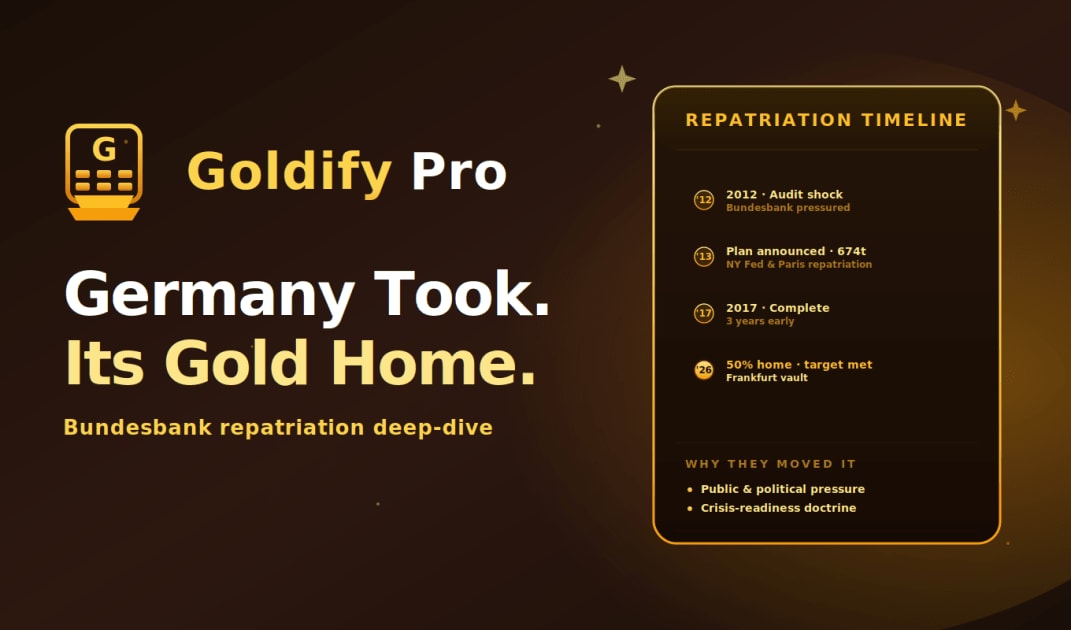
Why Germany Repatriated Its Gold Reserves: The 674-Tonne Operation from New York to Frankfurt
Between 2013 and 2017, the Bundesbank moved 674 tonnes of gold from New York and Paris back to Frankfurt. Officially for operational efficiency, it was the largest peacetime gold repatriation in modern history. The motivations, logistics, and what it meant for the global gold market.
Advertisement

Fort Knox Explained: What's Really Inside America's Largest Gold Reserve
Fort Knox holds approximately 4,580 tonnes of gold, the largest single deposit on earth. It has not been fully audited since 1953. The vault's history, security, contents, and the persistent questions about whether the gold is really all there.

How Central Banks Secretly Influence Gold Markets: Reserve Buying, Leasing and Policy Signals
Central banks rarely announce gold trades in advance. They buy through agents, lease gold to bullion banks, swap with the BIS, and signal policy through delayed reporting. The hidden mechanics of how the most powerful gold market participants actually operate.

Nanotechnology and the Future of Gold Usage: Cancer Treatment, Catalysis, Electronics and Beyond
Gold at the nanoscale behaves differently from bulk gold. Gold nanoparticles are used in cancer therapy, biosensors, catalysis, water purification, and next-gen electronics. Why nanogold works, current commercial applications, and demand projections for the next decade.

Will Quantum Computing Affect Gold Cryptography Markets? Risks for Digital Gold, ETFs and Trading
Quantum computers threaten to break the encryption that secures modern finance. Digital gold, ETFs and bullion ledgers all depend on classical cryptography. How quantum could disrupt gold markets and why physical gold remains the only quantum-safe asset.

Gold Melting and Refining Process Explained Step-by-Step: From Dore to LBMA Good-Delivery Bars
Gold mining produces dore bars that are typically only 70-90 percent pure. Refining transforms them into 99.99 percent investment-grade gold. The four major refining methods, the energy costs, and the step-by-step process from mine to LBMA bar explained.

Why Gold Purity Differs Between Countries: 24K India, 22K Gulf, 18K Europe and the Cultural Map
Indian jewelry is 22 or 24 karat. Gulf jewelry is mostly 21 karat. European jewelry is 18 karat. Chinese investment gold is 99.99 pure. American jewelry is 14 karat. The reasons are cultural, regulatory, climate-driven and economic. The global gold purity map explained.
Why Gold Market Coverage Matters in 2026
Gold is one of the few assets that simultaneously functions as a currency, a commodity, and a financial safe haven. Its price responds to central bank policy, inflation expectations, geopolitical events, and shifts in the US dollar — making it one of the most complex markets to track. The Goldify Pro blog covers these drivers in plain language, helping readers in over 104 countries understand why the gold price moves and what it means for their local currency value.
Whether you follow the live gold rate in Pakistan, track the gold rate in India, or monitor prices across the Gulf, every article here connects real-time market data to the real-world decisions jewellers, investors, and buyers make every day.
From Spot Price to Jewellery — Practical Gold Knowledge
Understanding the international spot price is only half the picture. To apply it to real transactions, you need to convert troy ounces to tolas, grams, or mashas, then adjust for karat purity (24K, 22K, 18K) and local making charges. Our Gold Reference Guide explains every conversion formula and purity standard used in the trade, while our live gold converters apply them in real time using the current spot price.
Blog articles tagged Gold Education and Gold Guide specifically bridge the gap between market data and practical jewellery-trade knowledge — covering topics like hallmarking, polish loss calculation, and how buying at different karat grades affects long-term value retention.
Historical Context — Gold Prices Since 1970
The gold market has lived through oil shocks, the collapse of Bretton Woods, the 2008 financial crisis, COVID-19, and multi-decade inflation cycles. Each of these events left a distinct fingerprint on the gold price chart. Our historical gold price analysis archives daily data back to January 1, 1970 — giving readers the long-run context that's missing from 30-day charts. Blog articles in the Gold Investment and Gold Market categories draw on this data to explain where we are in the current cycle and what prior market episodes suggest about what comes next.
About This Blog · Reader FAQ
About blogs in general
What is a blog?
A blog is a regularly-updated online journal where writers publish articles in reverse chronological order. Unlike static reference sites, a blog adds ongoing commentary — blending reporting, opinion, explainers and how-to guidance written by someone with first-hand expertise.
Why do people read blogs?
Blogs go deeper than news headlines and stay more current than reference books. Readers want context — not just what happened, but why it matters, how it fits the bigger picture, and what to do about it. Good blogs cut through noise and make complex markets legible.
How is a blog different from news?
News reports what happened. Blogs explain what it means. A news article tells you gold hit a new high; a Goldify Pro blog post explains the seasonal, monetary and geopolitical forces that drove it there — and whether that high is likely to hold or reverse.
How often should you read blogs?
For gold pricing, weekly reading is usually enough to stay informed without daily-volatility overload. Save deeper dives — multi-year analyses, buying guides, karat purity explainers — for when you're actually making a financial or jewellery purchase decision.
About Goldify Pro
Why follow Goldify Pro?
Gold prices move every minute, but the reasons behind those moves take longer to explain than a ticker line. Goldify Pro tells you whether a weekly jump was driven by a Fed pivot, a dollar selloff, central-bank buying, or geopolitical tension — and whether it is likely to extend.
What topics does the blog cover?
Six core themes: live gold rates in 100+ currencies with karat and weight conversions; central-bank policy; market structure (LBMA, COMEX, ETFs); technical analysis; macro and crisis history; and industrial applications (gold in satellites, semiconductors, medical devices).
Who writes Goldify Pro's articles?
Every post is written and edited by Salman Saleem, founder of Goldify Pro — a software engineer and family jeweller with over a century of family heritage in the gold trade, analysing XAU/USD spot trends since 2014.
How are live rates and figures sourced?
Live spot prices update every 60 seconds from the international XAU/USD market with real-time FX conversion. Historical figures are cited from LBMA, World Gold Council, IMF, BIS, and USGS. See our editorial policy for how each piece is produced and corrected.
Advertisement
Editorial Policy
Goldify Pro Editorial Team
VerifiedGold market analysts & weight-conversion specialists
Last reviewed: October 22, 2026·Updated continuously
Content verification
Sourcing
Primary sources only. We never republish numbers from secondary aggregators without verifying the original data.
Corrections
Factual errors acknowledged within 24 hours and corrected within 72 hours. Significant changes carry a visible update note.
Independence
No paid placements, no sponsored content, no editorial influence from advertisers or third parties.