Spot Gold vs Retail Gold Prices: Why You Can't Buy at Spot
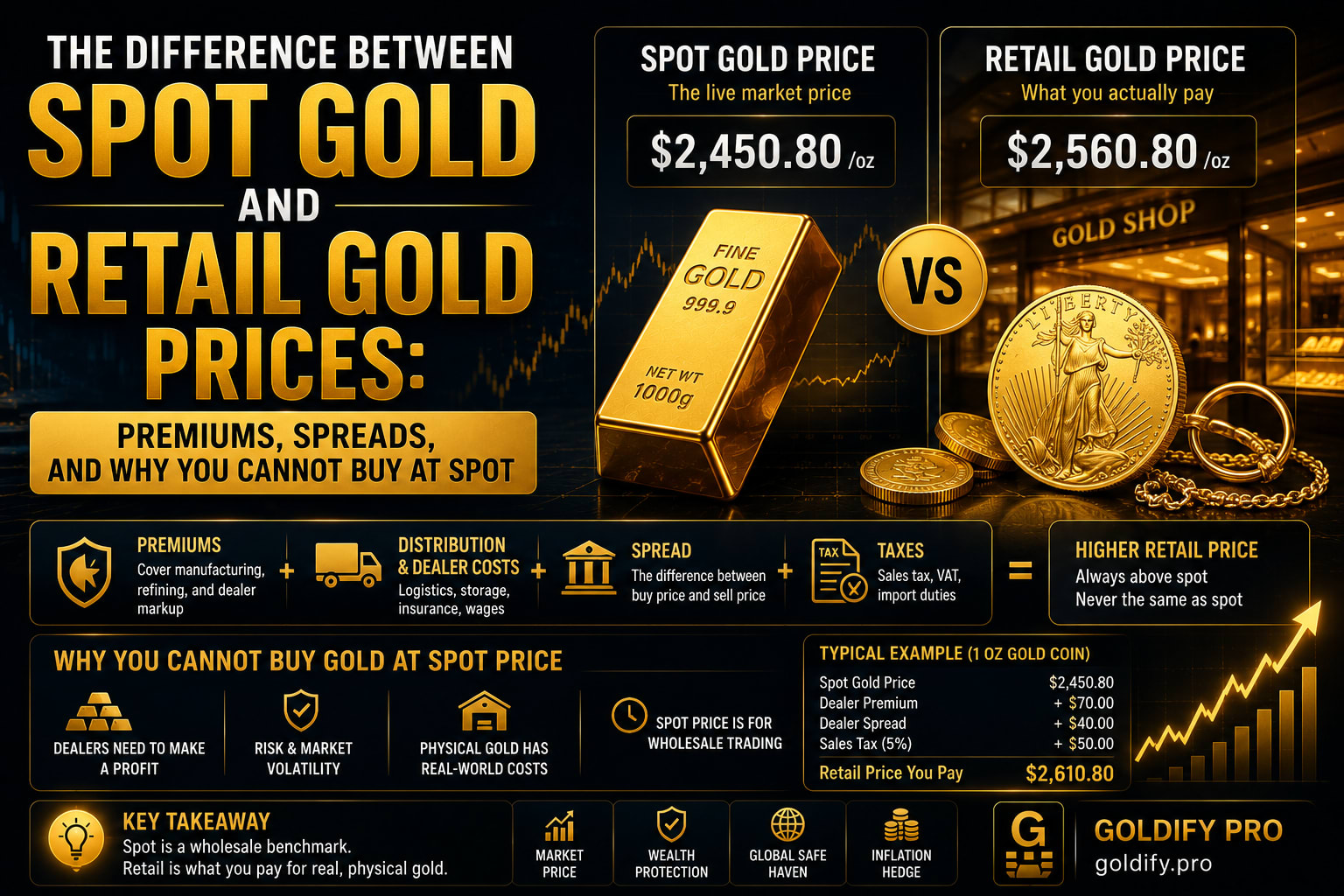
Spot gold is the wholesale benchmark price. Retail gold is what you actually pay at a dealer, typically 3 to 15 percent higher. The difference is real and unavoidable. Why the gap exists, how it varies by product, and how to minimize what you pay above spot.
Advertisement
Open any gold-tracking website and you see one number: spot gold. Walk into a coin dealer and the price is different — usually 3 to 15 percent higher. The gap between these two prices confuses many first-time buyers. Understanding what spot is, what retail prices include, and why you can never actually buy at spot is essential before making any meaningful gold purchase. The premium is real, unavoidable, and varies dramatically by product.
Quick framing
Spot gold is the wholesale price for one troy ounce of pure gold settled in two business days through the LBMA in London. Retail gold is what individual buyers actually pay at dealers, with premiums covering minting, distribution, dealer margin, and marketing costs. No retail buyer ever pays spot price.
What spot gold actually means
Spot gold is the wholesale price for immediate delivery (T+2 settlement) of one troy ounce of pure gold loco-London. It is set continuously by the LBMA over-the-counter market and benchmarked twice daily by the LBMA Gold Price auction. The spot price applies to standard 400-ounce good-delivery bars traded between LBMA member banks. It is the global wholesale reference price.
Advertisement
Why retail prices are always higher
- 1.Manufacturing: turning a 400-ounce bar into a 1-ounce coin costs money. Refining, casting, stamping, packaging all add cost.
- 2.Distribution: refiner to wholesaler to dealer adds two layers of margin.
- 3.Dealer margin: brick-and-mortar shops have rent, staff, security, insurance.
- 4.Marketing and brand premium: sovereign coins (Eagle, Maple, Britannia) carry brand value.
- 5.Liquidity provision: dealers hold inventory; that capital has a cost.
- 6.Risk premium: dealers cannot predict tomorrow's spot, so they pad spreads.
- 7.Taxes (in some jurisdictions): VAT in some EU countries, GST in India and others.
Typical premiums by product
| Product | Premium over spot |
|---|---|
| 12.5 kg LBMA good-delivery bar | Less than 0.5 percent |
| 1 kg gold bar (refiner-branded) | 1 to 3 percent |
| 100g gold bar | 2 to 4 percent |
| 1 oz gold bar (generic) | 3 to 5 percent |
| 1 oz sovereign coin (Eagle, Maple, Krugerrand, Britannia) | 4 to 7 percent |
| 1/2 oz sovereign coin | 5 to 9 percent |
| 1/4 oz sovereign coin | 7 to 12 percent |
| 1/10 oz sovereign coin | 10 to 18 percent |
| 22-karat jewelry | 10 to 30 percent (including workmanship) |
| 18-karat jewelry | 15 to 50 percent (workmanship-driven) |
Why smaller products have bigger percentage premiums
Manufacturing a 1/10-ounce coin costs almost the same as manufacturing a 1-ounce coin: same minting machinery, same handling, same packaging. But the gold value of 1/10 oz is one tenth of 1 oz. So fixed manufacturing costs become a much larger percentage of the gold value. This is why fractional gold coins always carry higher percentage premiums than full-ounce coins or larger bars.
Advertisement
The bid and the ask
Dealers quote two prices: a buy price (the bid, what they pay you when you sell) and a sell price (the ask, what you pay them when you buy). The gap is the dealer spread. For sovereign coins, the buy spread might be 4 percent over spot and the sell spread 1 percent under spot, so the dealer earns 5 percent on a round trip. This spread is the dealer's margin and is unavoidable.
Premium vs spread vs total cost
- Premium: amount above spot on the buy side (what you pay over spot).
- Spread: gap between dealer buy and dealer sell prices.
- Total cost: combined cost of buying and (eventually) selling, divided over your holding period.
- Holding period matters: a 6 percent round-trip spread is cheap over 10 years and expensive over 1 year.
- Brand premium: some coins (Krugerrand, Sovereign) have lower premiums; others (Eagle, Maple) often higher.
- Numismatic premium: collectible coins have premiums driven by rarity, not metal content.
Where to find live spot prices
Live spot gold prices are widely published by major financial sites and dedicated gold platforms. On Goldify Pro, live gold rates appear on the home page and the live-gold-rates page in your local currency, converted from real-time global spot. These are reference prices for understanding how much premium dealers are charging on top.
Advertisement
How to minimize what you pay above spot
- 1.Buy larger sizes: 1 oz coins beat 1/10 oz coins on percentage premium.
- 2.Compare multiple dealers: premiums vary significantly across dealers.
- 3.Avoid weekends and bank holidays: spreads typically widen when markets are closed.
- 4.Skip rare numismatic premiums: stick to bullion coins for cost efficiency.
- 5.Avoid panic-buying periods: premiums spike 5 to 15 percent in crises.
- 6.Use online dealers: lower overhead than brick-and-mortar.
- 7.Check ETF and allocated alternatives: institutional-format gold has the smallest premiums.
- 8.Read the fine print: storage, shipping, insurance can add to total cost.
When spot and retail diverge dramatically
In normal markets, retail premiums move slowly. During panic buying (March 2020 COVID, March 2023 banking crisis), premiums can spike from 5 percent to 15 percent over spot in days. The spike reflects dealer inventory exhaustion and refining bottlenecks. If you must buy during a premium spike, consider ETFs or allocated vault gold which do not have retail premium spikes.
ETFs and the spot price
Gold ETFs (GLD, IAU, PHYS) trade much closer to spot than retail coins. The ETF expense ratio (0.10 to 0.40 percent annually) is much less than retail premiums. ETFs are the cheapest way to get gold price exposure if you do not need physical possession. For physical insurance, retail coins are unavoidable and premiums are part of the cost.
Frequently asked questions
What is the spot gold price?
The wholesale price for immediate (T+2) delivery of one troy ounce of pure gold loco-London. It is the global benchmark price used in financial contracts and is what you see quoted on financial websites.
What is the difference between the gold spot price and the retail price?
The spot price is the wholesale benchmark for 400-ounce bank bars; the retail price is spot plus a premium of roughly 1 to 7 percent for bars and coins, or 10 to 50 percent for jewelry. The premium covers manufacturing, distribution, dealer margin, and in some countries tax. The metal is identical — only the cost structure differs.
Why can I never buy gold at spot?
Because retail buyers do not have access to wholesale 400-ounce good-delivery bars or to LBMA member-bank pricing. Retail products require manufacturing, distribution, and dealer margin that add cost above spot.
Why is there such a big difference between gold buying and selling prices?
Dealers quote a two-way price: they sell to you above spot (the premium) and buy back below spot (the discount). The gap covers fabrication, logistics, verification risk, and dealer margin. For bullion coins the round-trip spread is typically 2 to 6 percent; for jewelry it can exceed 20 percent, because making charges paid at purchase are not returned when you sell — only the metal content is.
Is it normal for the price difference between gold buying and selling to be so large?
For jewelry, yes: making charges of 10 to 25 percent are lost at resale, so a large gap is structural. For investment bars and coins, a round-trip spread above about 6 percent is high in normal markets — compare other dealers before accepting it. Spreads also widen temporarily during panics, weekends, and market closures.
Why do gold prices differ between banks and jewelry stores?
Banks sell certified investment bars at lower premiums (often 1 to 4 percent over spot) but frequently do not buy them back. Jewelry stores price in craftsmanship, design, and brand — 10 to 30 percent or more above metal value — and typically buy back at metal value only. The gold is the same; the business models are different. Buy from banks or bullion dealers for investment, from jewellers for wearing.
Why do gold prices differ across brands and shops?
The metal value is identical everywhere at any moment — it comes from the same global spot price. What differs between brands and shops is the premium: making charges, hallmark certification, buy-back policy, overheads, and brand reputation. A higher-priced brand is charging more for the non-gold parts of the product, not for better gold.
What is the difference between the gold recycling price and the spot price?
Scrap and recycling buyers pay spot minus roughly 2 to 10 percent, covering assay, refining, and their margin. Your item's karat determines its metal content: an 18K piece contains 75 percent of its weight in pure gold, a 22K piece 91.7 percent. Nothing is paid for workmanship or design — only the recoverable metal.
By what percentage are gold bars and jewelry priced above spot?
Bars: typically 1 to 5 percent over spot depending on size — 1 kg bars around 1 to 3 percent, 1-ounce bars 3 to 5 percent, with smaller sizes progressively higher. Sovereign coins: 4 to 7 percent for 1-ounce, up to 18 percent for 1/10-ounce. Jewelry: 10 to 50 percent above metal value once making charges and retail margin are included.
What is the cheapest way to buy gold?
Gold ETFs offer the smallest spread to spot (0.10 to 0.40 percent annual cost). For physical, 1 kg or larger bars have the smallest premiums (1 to 3 percent). Sovereign coins are convenient but more expensive per ounce.
Why do small coins cost more per ounce?
Because manufacturing a small coin costs almost the same as a big one, but the small coin contains less gold. Fixed costs become a bigger percentage of value.
How much premium is reasonable?
For 1 oz bullion coins, 4 to 7 percent in normal markets is reasonable. For 1 kg bars, 1 to 3 percent. Premiums above these ranges suggest checking another dealer or waiting for normal market conditions.
Where can I see today's spot gold price?
The Goldify Pro home page and live-gold-rates page show current spot gold in your local currency. Financial news sites, TradingView, Investing.com, and major gold dealers also publish live spot prices.
Is jewelry gold the same price as bullion gold?
No. Jewelry adds workmanship, design, and brand premiums on top of the gold cost. Resale typically recovers only the gold content, often at 22 or 18 karat rates rather than 24K.
Advertisement
Disclaimer
Forecast and financial-advice disclaimer
Premium structures change with market conditions. Not investment advice. Consult a licensed financial advisor before making material gold purchases.
Editorial disclaimer
Premium figures are typical ranges from major US, UK, and EU dealer publications and World Gold Council data. Live gold rates appear on the Goldify Pro home page and live-gold-rates page.
Originality and AI policy
Researched and written by the Goldify editorial team. Premium and spread data verified against named industry sources. We do not publish unedited AI output.
Advertisement
Tools mentioned in this article
Advertisement


