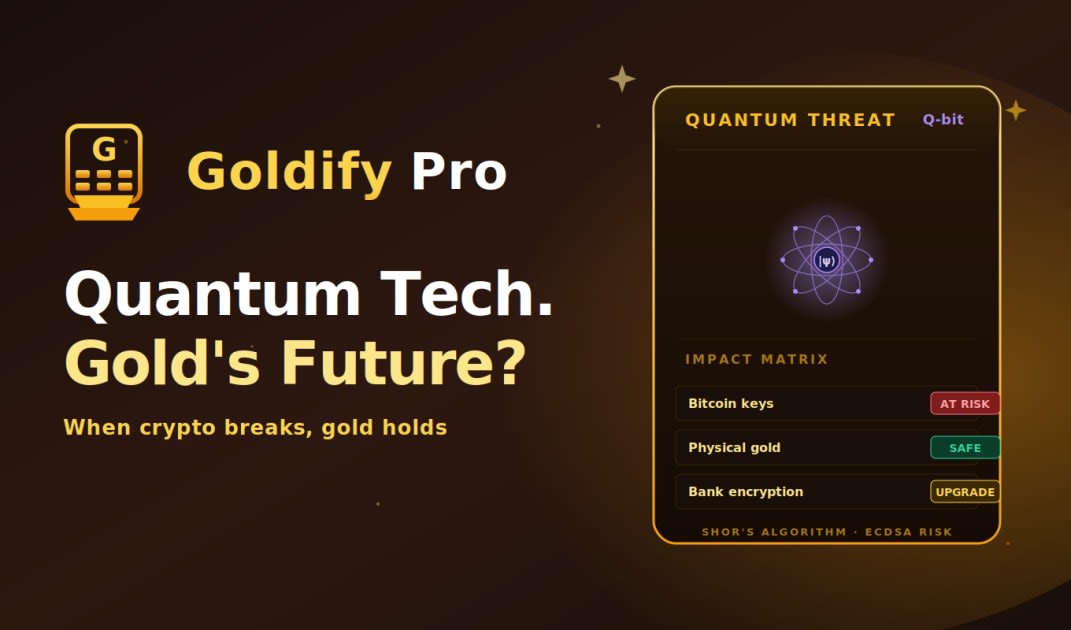
Will Quantum Computing Affect Gold Cryptography Markets? Risks for Digital Gold, ETFs and Trading
Quantum computers threaten to break the encryption that secures modern finance. Digital gold, ETFs and bullion ledgers all depend on classical cryptography. How quantum could disrupt gold markets and why physical gold remains the only quantum-safe asset.
Advertisement
Quantum computers are not yet powerful enough to break modern encryption. But they will be, eventually. When they do, every digital financial system that relies on RSA or elliptic-curve cryptography becomes vulnerable. Digital gold platforms, gold-backed tokens, ETF custody systems, and bullion-bank settlement networks all sit on this cryptographic foundation. The gold market needs to think about what Y2Q (Years to Quantum) means for digital gold ownership and why physical gold is uniquely positioned to survive the transition.
Quick framing
Modern cryptography (RSA, ECDSA) is based on math problems that are hard for classical computers. Quantum computers running Shor's algorithm can solve those problems quickly. Bitcoin, gold-backed tokens, ETF transfer agents, and vault systems all use this cryptography. Once cryptographically-relevant quantum computers exist, all those systems must migrate to post-quantum cryptography or be vulnerable.
How current cryptography works
Modern public-key cryptography relies on math problems that are easy in one direction and hard in reverse. RSA depends on the difficulty of factoring large numbers. ECDSA (elliptic curve digital signature algorithm) depends on the discrete logarithm problem on elliptic curves. Classical computers would need billions of years to break either. Quantum computers running Shor's algorithm could do it in hours. The threat is mathematical, not engineering.
Advertisement
What does Y2Q mean?
Y2Q stands for Years to Quantum and refers to the timeline until cryptographically-relevant quantum computers exist. Current estimates from NIST, IBM Research, and Google Quantum AI suggest 10 to 20 years, though some experts argue it could be sooner. The risk is not theoretical: harvest-now-decrypt-later attacks already collect encrypted data today for decryption when quantum becomes available.
How much quantum power is needed?
| System | Estimated quantum bits needed |
|---|---|
| RSA-2048 (typical web encryption) | ~4,000 logical qubits |
| ECDSA-256 (Bitcoin, ETFs) | ~2,500 logical qubits |
| AES-256 (symmetric encryption) | Much larger; Grover's algorithm only halves effective key length |
| Current state of art (2025) | 1,000+ physical qubits but only 100-200 logical due to error correction |
The gold market's cryptographic dependencies
1. Digital gold platforms
Services like PAX Gold (PAXG), Tether Gold (XAUT), Kinesis, and digital gold platforms on blockchain rails (Ethereum, Solana) use ECDSA signatures to control ownership. If those signatures can be forged by a quantum attacker, an attacker can transfer the underlying gold-backed tokens.
Advertisement
2. Gold ETF custody and transfer agents
Gold ETFs (GLD, IAU, PHYS) hold allocated physical bars in vaults but ownership of shares is tracked digitally with cryptographic systems. The same cryptography that secures equity ownership today secures gold ETF shares. Compromise of the transfer-agent or custody system would create chaos in record-keeping, even if the underlying physical gold is unharmed.
3. Bullion bank settlement
LBMA loco-London settlement, BIS gold-swap accounting, and central-bank reserve transfers all rely on digitally-signed transactions. The physical gold is in vaults but ownership records flow through cryptographic systems.
Advertisement
4. Trading platforms and exchanges
COMEX, Shanghai Gold Exchange, and OTC platforms use encrypted communications and digital signatures for order entry, clearing, and settlement. A successful quantum attack could disrupt trading systems or enable transaction forgery.
Why physical gold is quantum-safe
Physical gold has no digital signature. Ownership is established by physical possession, vault custody, and chain-of-custody paper records. Quantum computers cannot break a vault, forge a hallmark, or change the contents of a chain-of-custody log book. Allocated physical gold in your possession or in a named vault is the only gold ownership format that is fundamentally immune to quantum disruption.
The migration to post-quantum cryptography
NIST has been running a competition since 2016 to standardize post-quantum algorithms. In 2024, NIST finalized three standards: ML-KEM (Kyber) for key encapsulation, ML-DSA (Dilithium) for digital signatures, and SLH-DSA (SPHINCS+) as a hash-based backup. Migration of financial systems to these algorithms is starting now and will take a decade or more. Most digital gold platforms have not begun planning publicly.
Where the gold market stands
- Central banks: starting to plan quantum-safe communication for reserve transfers; physical gold itself remains immune.
- LBMA and bullion banks: post-quantum migration discussions internal but not public.
- Major ETF custodians: classical cryptography in use; migration planning in early stages.
- Digital gold platforms: mostly built on Ethereum or similar, depend on broader ecosystem migration.
- Trading exchanges: post-quantum migration follows broader financial-system timelines.
- Physical gold dealers: unaffected; no cryptographic exposure beyond standard business systems.
Harvest-now-decrypt-later threat
An attacker can record encrypted gold-market data today (transaction signatures, ETF ownership records, central-bank swap details) and decrypt it later when quantum computers become available. This is a real threat for long-lived secrets. Sensitive financial information with multi-decade relevance is already at risk even if quantum computers do not exist yet.
Timeline estimates
| Milestone | Estimated timeline |
|---|---|
| 10 logical qubits (current) | Already achieved 2024 |
| 100 logical qubits | 2027-2030 |
| 1,000 logical qubits | 2030-2035 |
| Cryptographically-relevant (2,500+) | 2035-2045 range |
| Mass-market quantum computing | Beyond 2050 |
What gold investors can do
- 1.Diversify across physical and digital gold formats.
- 2.Hold meaningful allocations in allocated physical gold (vault or home-stored).
- 3.Avoid concentrated exposure in any single digital gold token.
- 4.Monitor post-quantum cryptography migration progress of ETF custodians and exchanges.
- 5.Treat quantum risk as one of several long-term tail risks, not an imminent crisis.
- 6.Review portfolio every few years as quantum capabilities evolve.
Frequently asked questions
When will quantum computers break encryption?
Current estimates range from 2035 to 2045, though some experts argue earlier. Cryptographically-relevant quantum computers need thousands of error-corrected logical qubits; current state of art is 100 to 200 effective qubits.
Can quantum computers steal physical gold?
No. Physical gold has no digital signature. Quantum computers can only break cryptography, not break a vault. Physical possession is quantum-safe by definition.
Will my gold ETF survive quantum computing?
The physical gold backing your ETF is unaffected. The ownership records and transfer systems will need to migrate to post-quantum cryptography. Major ETF providers and custodians are starting to plan this migration.
Is PAXG safe from quantum attacks?
Currently relies on Ethereum, which uses ECDSA, vulnerable to future quantum computers. Ethereum has post-quantum migration plans but no firm timeline. The underlying physical gold reserve is unaffected; the question is record ownership.
What is Shor's algorithm?
A quantum algorithm developed by Peter Shor in 1994 that can factor large integers exponentially faster than classical algorithms. It is the primary threat to RSA and ECC encryption that secures modern finance.
What is post-quantum cryptography?
Cryptographic algorithms designed to resist attacks from both classical and quantum computers. NIST finalized three standards in 2024: ML-KEM, ML-DSA, and SLH-DSA. Migration of existing systems is starting now.
Should I sell my digital gold and buy physical?
Quantum risk is one of several long-term considerations. A balanced approach is to hold meaningful physical positions while continuing to use digital instruments for liquidity. Pure portfolio shifts based on quantum risk alone are premature.
Is Bitcoin or gold more vulnerable to quantum computing?
Bitcoin is more vulnerable because it depends entirely on ECDSA for ownership. Physical gold has no cryptographic dependency. Gold-backed tokens fall in between depending on platform.
Advertisement
Disclaimer
Forecast and financial-advice disclaimer
Quantum timelines are uncertain. This is a speculative emerging-tech topic. Not investment advice. Consult a licensed advisor before adjusting portfolio based on long-tail technology risk.
Editorial disclaimer
Quantum computing capabilities and timelines are drawn from public NIST, IBM, Google Quantum AI and academic sources. Estimates are illustrative ranges. Live gold rates appear on the Goldify Quick Rates page.
Originality and AI policy
Researched and written by the Goldify editorial team. Quantum and cryptography details verified against named NIST and research-lab sources. We do not publish unedited AI output.
Advertisement
Tools mentioned in this article
Advertisement
Continue reading
 Gold Science
Gold in Quantum Technology Research: Qubits, Quantum Sensors, and the Race to Build Quantum Computers
 Gold Science
Why Gold Reflects Infrared Radiation So Efficiently: The Physics Behind the 99 Percent Reflectivity
 Gold Science