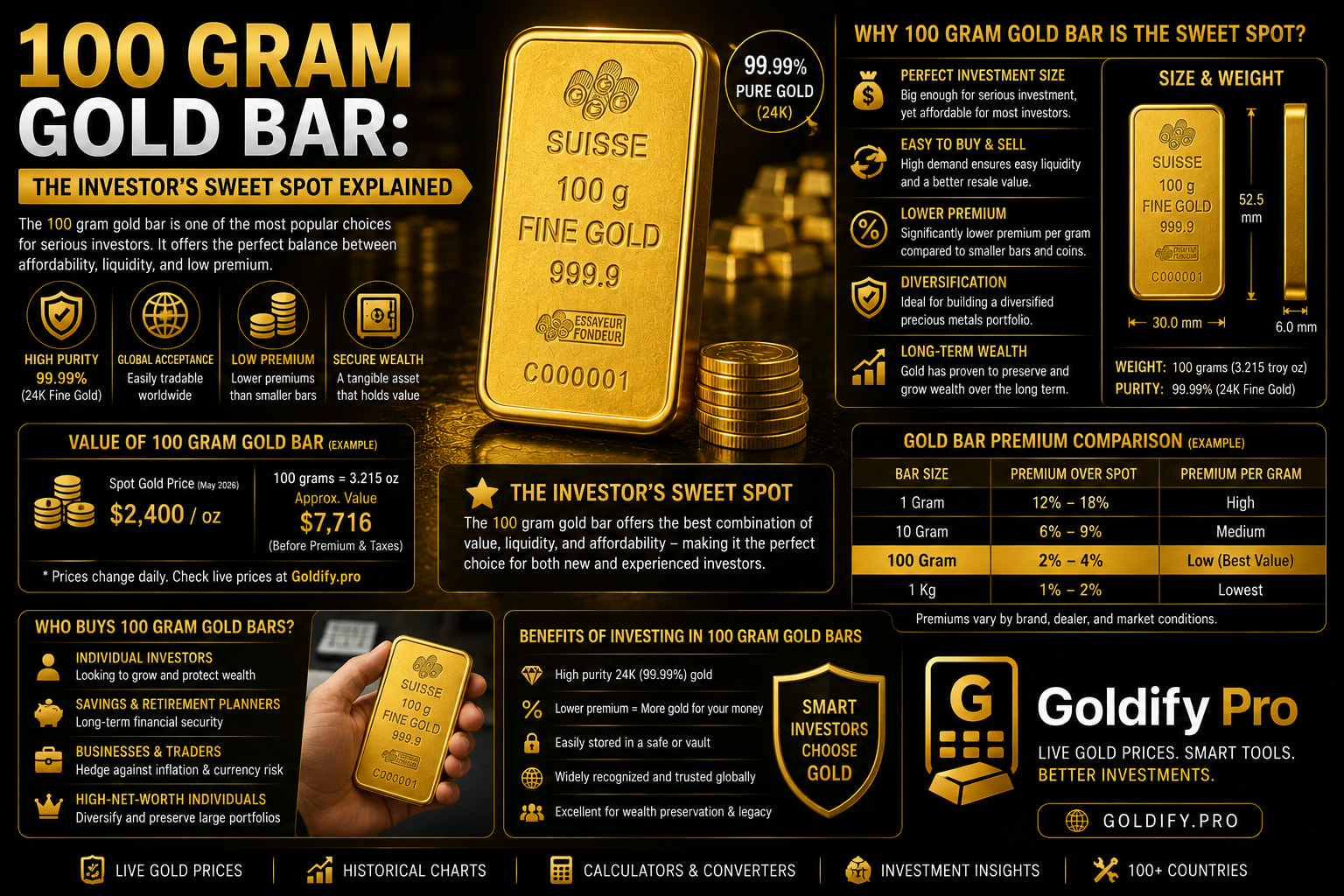
100 Gram Gold Bar: The Investor's Sweet Spot Explained
A 100 gram gold bar holds $13,114 of fine metal at $131.14 per gram, which is 3.2151 troy ounces or 8.573 tola. This guide works the 100 gram gold price through five currencies, gives the real dimensions, and shows why the premium curve flattens at exactly this size.
Advertisement
At the time of writing, gold spot sits at $4,079 per troy ounce, which puts $13,114 of fine metal inside a single 100 gram gold bar. The arithmetic is direct: 100 x $131.14 per gram, with no karat discount, because a bar of this class is 999.9 fine. That same 100 g is 3.2151 troy ounces or 8.573 tola, in a slab you could slide into a passport wallet. This guide works the 100 gram gold price through five markets, gives the real dimensions, and explains the cost curve that makes this the size most private buyers settle on. Every figure traces back to the live gold price per gram.
Quick Takeaways
100 g of 24K gold = 100 x $131.14 = $13,114 of melt value at the time of writing. That is 3.2151 troy ounces, 8.573 tola, roughly GBP 10,360, AED 48,161, INR 12,56,321 or PKR 3,643,069. A typical 100 g bar measures about 45 x 25 x 4.5 mm and displaces only about 5.2 cm3, because gold's density is 19.32 g/cm3. All-in retail cost per gram falls from about $146.88 on a 1 g bar to about $135.07 on a 100 g bar, but only to about $133.11 on a 1 kg bar. In other words, the premium saving is almost exhausted by 100 g while the cheque is still ten times smaller.
100 Gram Gold Price Today: Melt Value in Five Currencies
Melt value is the honest starting point: fine metal weight multiplied by live spot, before any dealer margin, assay packaging, freight or tax. Because a 999.9 investment bar is effectively all gold, the fine weight is the full 100 g and the sum needs no purity adjustment.
Advertisement
100 g x $131.14 = $13,114. Converted at the reference rates used throughout this article, the same bar prices out as follows. This is metal value only, which is why every row sits below what a dealer will quote.
| Market | 100 g melt value | Per-gram basis | Consumption tax on investment bars |
|---|---|---|---|
| United States | $13,114 | $131.14 | No federal VAT; sales tax varies by state |
| United Kingdom | GBP 10,360 | GBP 103.60 | Investment gold is VAT-exempt |
| United Arab Emirates | AED 48,161 | AED 481.61 | 0% VAT on investment-grade 24K bars |
| India | INR 12,56,321 | INR 12,563 per 10 g | Import duty plus 3% GST (about INR 37,700) |
| Pakistan | PKR 36,43,069 | PKR 4,25,000 per tola | Quoted per tola; 100 g = 8.573 tola |
Two quoting quirks matter. India prices gold per 10 grams, so an Indian buyer reads the same bar as ten units of about INR 1,25,632. Pakistan prices per tola, making the bar 8.573 tola at roughly PKR 4,25,000 each. Neither convention changes the metal, only the number on the board, which is why cross-border comparisons go wrong so often.
Why the Premium Curve Flattens at 100 Grams
A refiner's cost of turning cast metal into a sealed, serialised, assay-carded bar barely scales with weight. Stamping and packaging a 1 g wafer costs nearly as much in labour, tooling and card stock as stamping a 100 g slab. That fixed cost is then divided across 1 gram in one case and 100 grams in the other, and the dealer's margin thins as the ticket grows. That is the whole mechanism behind the premium ladder on any gold bar price list.
Advertisement
| Bar size | Typical premium | All-in cost per gram | All-in ticket price | Saved vs next size down |
|---|---|---|---|---|
| 1 g | about 12% | $146.88 | $147 | - |
| 10 g | about 5% | $137.70 | $1,377 | $9.18 per gram |
| 100 g | about 3% | $135.07 | $13,507 | $2.63 per gram |
| 1 kg | about 1.5% | $133.11 | $133,107 | $1.96 per gram |
Read the last column downwards and the shape is obvious: the big win is escaping small bars, and each step after that buys progressively less. Premiums vary by refiner, region and demand, so treat these as typical bands rather than quotes. Put concretely, a hundred 1 g bars costs about $14,688 for exactly the same 100 grams that one 100 g bar delivers for about $13,507. You pay $1,181 for the privilege of holding it in small pieces.
Goldify Pro Insight
Stack the two moves side by side. Going from 1 g bars to a 100 g bar cuts your all-in cost by about $11.81 per gram, from $146.88 to $135.07. Going from a 100 g bar to a 1 kg bar cuts it by only about $1.96 more. Since the full available saving between 1 g and 1 kg is $13.77 per gram, you have already captured roughly 86% of it by the time you reach 100 g. Yet the cheque required to take that last step rises roughly tenfold, from about $13,507 to about $133,107, and you give up every scrap of divisibility to get it. That asymmetry, 86% of the benefit for a tenth of the outlay, is precisely why 100 g is the efficiency sweet spot for private buyers, and why kilo bars mostly sit inside institutional vault programmes rather than household safes.
100 Gram Gold Bar Dimensions and Physical Feel
A 100 gram gold bar typically measures around 45 x 25 x 4.5 mm, about two stacked credit cards shrunk to half the footprint and made noticeably thicker. Minted bars, pressed from rolled sheet, are the tidier format; cast bars, poured into a mould, run shorter and chunkier with a rippled top and often carry a slightly lower premium because they need less finishing.
Volume is the part people misjudge. Gold's density is 19.32 g per cm3, so 100 g occupies just 100 / 19.32 = 5.18 cm3, call it 5.2 cm3. That is roughly a teaspoon of metal worth $13,114, and at nearly twice the density of lead a genuine bar feels wrong for its size the first time you lift one. To sanity-check any weight against ounces or tola, the kilogram to gram, ounce and tola calculator does it in one step.
Advertisement
One 100 g Bar or Ten 10 g Bars? The Divisibility Trade-Off
Here is the honest cost of that efficiency. One 100 g bar is cheaper per gram than ten 10 g bars, but you cannot sell 30 grams of it. The moment you need part of the value you must liquidate the whole slab and rebuy, paying a spread twice. Small bars cost more up front and buy you an exit you can take in slices.
Work a real budget of $40,000. Twenty-nine 10 g bars gives 290 g for about $39,933. Two 100 g bars plus nine 10 g bars gives the same 290 g for about $39,407, saving roughly $526, with a smallest sellable unit of 10 g, about 3.4% of the holding. Three 100 g bars gives 300 g for about $40,521, the lowest cost per gram of the three, but your smallest exit becomes a third of everything you own.
- 1.Decide the smallest amount you might realistically need to raise in one go.
- 2.Fill the bulk of the budget with the largest bar that still leaves at least three separate pieces, so you can sell a third without touching the rest.
- 3.Spend the remainder on 10 g bars until your smallest sellable unit is under about 10% of total value.
- 4.Step up to a kilo bar only once smaller pieces already cover a year of foreseeable need, because a kilo bar is an all-or-nothing exit.
- 5.Never build a core holding from 1 g and 2 g bars. At about 12% premium that is gift pricing, not investment pricing.
Regional Rules and What to Check Before Buying
Tax treatment moves the final number more than most buyers expect. In the United Kingdom, investment gold of the required fineness is VAT-exempt, so a 100 g bar changes hands close to its GBP 10,360 metal value plus premium; check the current live gold rate in the United Kingdom before agreeing a figure. In the UAE, 24K investment gold carries no VAT while jewellery attracts 5%, which is much of why Dubai's 100 gram gold biscuit price sits so tight to the live gold rate in the United Arab Emirates. India is the outlier: import duty is baked into the landed price before 3% GST is added on top, roughly INR 37,700 of tax on a INR 12,56,321 bar.
The word biscuit trips up a lot of readers. Across South Asia and the Gulf, flat sealed bars of this type are routinely called gold biscuits, and the terms are interchangeable at the counter. It is a naming convention, not a different product, as the gold biscuit guide explains.
- Refiner: stick to recognised LBMA-accredited names. Accreditation is what makes a bar resaleable internationally without a fresh assay.
- Fineness stamp: a 100 g investment bar should read 999.9 alongside the weight in grams.
- Serial number: present on the bar and matching the assay card. A mismatch is a reason to walk away.
- Intact assay packaging: on minted bars the sealed card carries part of the resale value, so breaking it can cost you premium when you sell.
- Premium benchmarking: compare the quote against live melt value, not a rival dealer's sticker. Two dealers can both be expensive at once.
Red Flags at the Counter
Be wary of a 100 g bar priced below melt value; nobody sells fine gold at a loss, so the weight, the purity or the bar itself is not what it claims. Treat unknown refiner names, missing or re-printed assay cards, and bars sold loose in a plastic sleeve with the same caution. Sellers who quote only a total price and refuse to break out the premium over spot are hiding the one number that matters.
Frequently Asked Questions
How much is 100 grams of gold worth?
At the time of writing, 100 grams of 24K gold is worth $13,114 in metal value: 100 x $131.14 per gram, from a spot price of $4,079 per troy ounce. In other currencies that is roughly GBP 10,360, AED 48,161, INR 12,56,321 or PKR 3,643,069. A dealer's asking price sits a few percent above this because of the manufacturing premium.
What is the 100 gram gold bar price at a dealer?
Expect roughly $13,507 at a typical 3% premium over the $13,114 melt value, though the band moves with refiner, region and demand. The useful discipline is to convert any quoted 100 gram gold bar price into a cost per gram and compare it with live spot. At $135.07 per gram the premium is normal; well above $140 is small-bar pricing on a large bar.
What are 100 gram gold bar dimensions?
Around 45 x 25 x 4.5 mm for a typical minted bar, roughly two stacked credit cards but appreciably thicker. Cast bars of the same weight tend to be shorter and deeper. Total volume is only about 5.2 cm3, since gold's density of 19.32 g per cm3 means 100 g occupies barely a teaspoon of space.
What is the 100 gram gold price in UK terms?
About GBP 10,360 of metal at 0.79 pounds to the dollar, or roughly GBP 103.60 per gram. Investment gold meeting the fineness requirement is VAT-exempt in the UK, so British buyers pay no consumption tax on top. A 3% premium would put a realistic 100 g bar near GBP 10,671.
What is the 100 gram gold biscuit price in Dubai?
About AED 48,161 in metal value at 3.6725 dirhams to the dollar. Dubai quotes sit unusually close to melt because 24K investment gold carries no VAT in the UAE, unlike jewellery at 5%, and souk competition keeps premiums thin. A 2% premium would put a 100 g biscuit near AED 49,124.
Is one 100g gold bar better than ten 10g bars?
Cheaper yes, better only if you will never need a partial exit. Ten 10 g bars cost about $13,770 against roughly $13,507 for one 100 g bar, so the small bars carry about $263 of extra premium. That is the price of being able to sell 10 g at a time. Most buyers hold both formats rather than choosing one.
Conclusion
The 100 gram gold bar earns its popularity through arithmetic rather than marketing. It captures roughly 86% of the premium efficiency available anywhere on the bar ladder for a tenth of the cost of a kilo bar, stays small enough to store and insure without special arrangements, and at 999.9 fineness with a recognised refiner's stamp it resells almost anywhere. Its one real cost is being a single piece, so pair it with 10 g bars if you expect to sell in stages. Before agreeing any quote, check the current live gold rates, convert back to a gold price per gram figure, and if the next size up tempts you, compare it against the gold price per kilogram. For the next size up, the 1 kg gold bar takes the premium curve to its floor, and how to buy gold bars covers refiners, assay cards and verification before you commit.
Methodology & Disclaimer
All values here are fine-metal weight multiplied by live spot at the time of writing, using $4,079 per troy ounce, $131.14 per gram, and reference rates of 0.79 GBP, 3.6725 AED, 95.8 INR and 277.8 PKR to the US dollar. Melt figures exclude dealer premiums, fabrication costs, taxes, shipping and insurance, and every one of these numbers moves continuously with the market. Premium percentages are typical ranges for illustration, not quotes from any dealer. This article is educational reference content, not investment advice and not a price quote. Goldify Pro is a free live-rate and calculator service; it does not buy, sell, broker or ship gold or silver in any form.
Advertisement
Tools mentioned in this article
Advertisement


