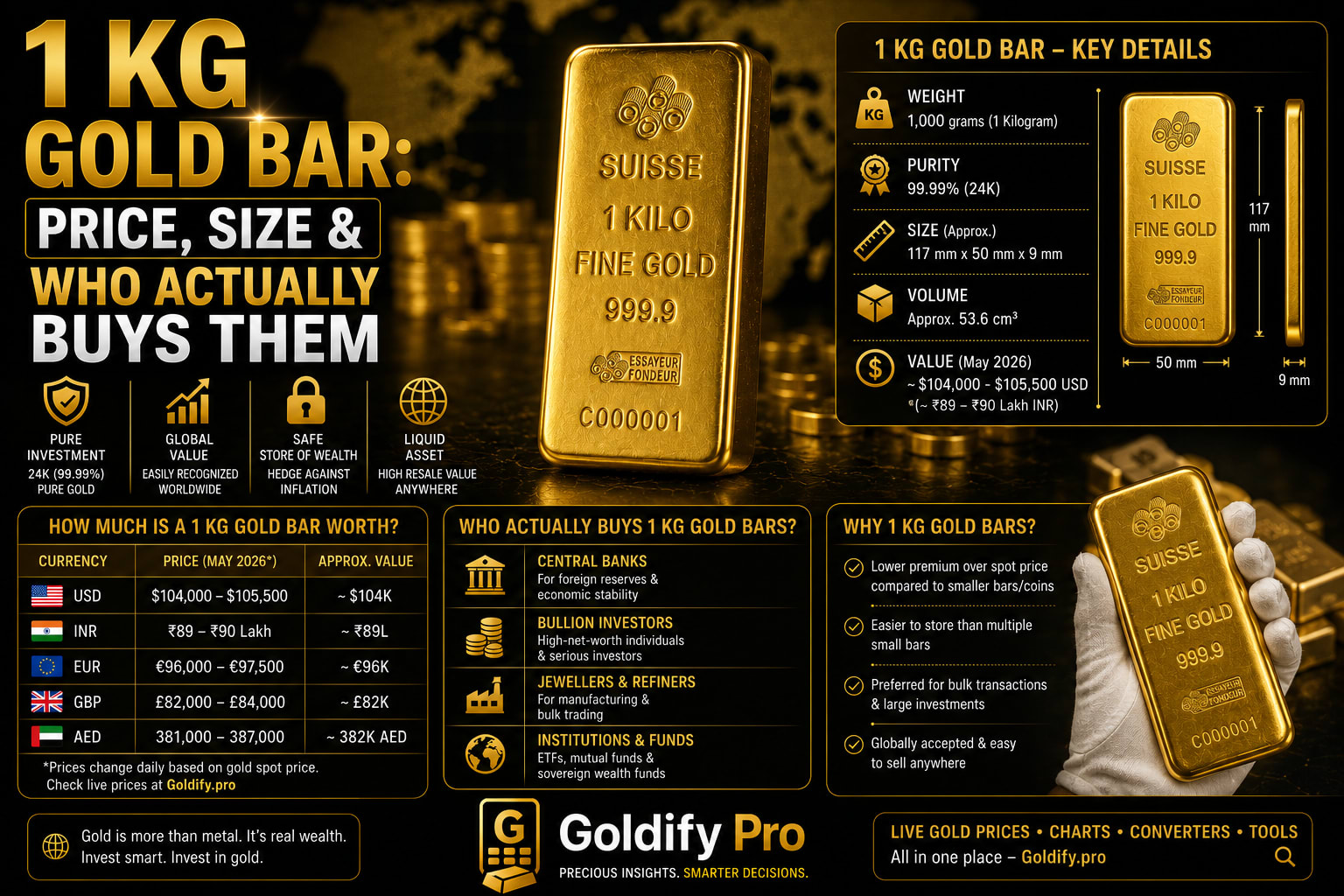
1 Kg Gold Bar: Price, Size and Who Actually Buys Them
A 1 kg gold bar holds $131,140 of fine metal at $131.14 per gram, yet occupies just 51.8 cm3 and fits in a jacket pocket. Here is the kilobar's price in five markets, its real dimensions, its 1-2% premium, and who actually buys them.
Advertisement
At $131.14 a gram, a 1 kg gold bar holds $131,140 of metal and still fits in a jacket pocket. That combination of very high value and very small volume is exactly why the kilobar is the workhorse of the wholesale bullion market. This guide covers the live gold price per kilogram, the bar's real dimensions, the premium you pay over spot, and who actually buys them.
Quick Takeaways
One kilogram of 24K gold is worth $131,140 at a spot price of $4,079 per troy ounce, or $131.14 per gram. The same bar is about 1.256 crore rupees in India, GBP 103,600 in the UK and AED 481,610 in Dubai. It measures roughly 116 x 51 x 9.5 mm, occupies only 51.8 cm3 and weighs 2.2 lb. Kilobars carry the lowest premium of any retail format, typically 1-2% over spot against 10-15% on 1 g bars. The trade-off is divisibility: you cannot sell part of a kilobar.
How Much Is a Kilo of Gold? The 1 Kg Gold Price Today
A kilobar contains 1,000 grams of fine gold. Gold trades at $4,079 per troy ounce at the time of writing, and $4,079 divided by 31.1035 grams gives $131.14 per gram. Multiply by 1,000 and the melt value of a 1 kg gold bar is $131,140.
Advertisement
That is fine-metal value only: no dealer premium, no assay charge, no shipping, no tax. You can reach the same figure the other way, since 1 kg is 32.1507 troy ounces, and 32.1507 x $4,079 is $131,143. It is also 85.73 tola, the unit South Asian buyers work in.
Melt value scales linearly, so larger sizes are easy to price. The 400 oz London Good Delivery bar at the top of the table is the institutional standard, weighing about 12.44 kg. For any other weight, the kilogram to gram, ounce and tola converter runs the maths on a live rate.
| Bar size | Fine gold | Troy ounces | Melt value (USD) |
|---|---|---|---|
| 100 g bar | 100 g | 3.22 oz | $13,114 |
| 1 kg bar (1000g gold bar) | 1,000 g | 32.15 oz | $131,140 |
| 2 kg | 2,000 g | 64.30 oz | $262,280 |
| 5 kg | 5,000 g | 160.75 oz | $655,700 |
| 400 oz London Good Delivery | 12,441 g | 400 oz | about $1,631,600 |
1 Kg Gold Price in India, the UK, the UAE and Pakistan
Gold is a single global market priced in dollars, so a kilobar's local price is the dollar melt value multiplied by the exchange rate. What differs between markets is tax, duty and the quoting convention buyers are used to.
Advertisement
India is the clearest example. Dealers there quote per 10 grams rather than per kilo, so the familiar 1,25,600 rupee figure has to be multiplied by 100. That gives 1,25,60,000 rupees, about 1.256 crore for a kilo. Import duty and GST sit on top of melt, so the counter price exceeds the table below; the live gold rate in India page carries the current retail quote.
India also searches for this in its own vocabulary. A query for the 1kg gold biscuit price in India is asking for the same object, since 'biscuit' is the local term for a flat cast bar, explained further in the gold biscuit guide.
| Market | 1 kg melt value | Local quoting habit |
|---|---|---|
| United States | $131,140 | Per troy ounce |
| India | 1,25,63,000 rupees (about 1.256 crore) | Per 10 grams, duty and GST on top |
| United Kingdom | GBP 103,600 | Per ounce, investment gold is VAT exempt |
| United Arab Emirates | AED 481,610 | Per gram, by karat |
| Pakistan | 36,430,000 rupees (about 3.64 crore) | Per tola |
| Eurozone | EUR 120,650 | Per gram or per ounce |
What a Kilo of Gold Actually Looks Like
Gold's density is 19.32 grams per cubic centimetre, roughly two and a half times that of steel. Divide 1,000 g by 19.32 and a kilo of gold occupies just 51.8 cm3. In bar form that is about 116 x 51 x 9.5 mm for a typical cast or minted kilobar. Refiners vary the proportions slightly, but the volume is fixed by physics.
- It is smaller than a phone. A 160 x 75 x 8 mm handset takes up about 96 cm3, nearly double the volume of the same gold.
- It lies flat in an open palm and disappears into a jacket pocket.
- It weighs 2.2 lb, the same as a bag of sugar. That mismatch between size and weight is what surprises people handling one for the first time.
- Fill a one-litre carton with gold and you would be holding 19.32 kg, worth about $2.53 million.
- A 400 oz London bar is 12.4 times heavier at roughly 27 lb, and is awkward to lift one-handed.
Advertisement
Why the Kilo Gold Bar Carries the Lowest Premium in Bullion
Premium is what a dealer charges above melt to cover refining, minting, distribution, insurance and margin. Most of that cost is incurred per bar rather than per gram, so it spreads far more thinly across a kilobar than a 1 g wafer. That is why the kilobar sits at the bottom of the ladder at roughly 1-2% over spot, about $1,300 to $2,600 on $131,140 of gold.
Run the same purchase in 1 g bars and you need 1,000 of them, each carrying 10-15%. At a mid-range 12% the premium is $15,737; at 14% it is $18,360. Against a kilobar bought at 1.5%, costing $1,967, buying your gold one gram at a time costs roughly $13,000 to $17,000 more for identical metal. That gap is close to the value of a whole 100 g bar, paid purely for small units. Compare formats on the gold bar price page before committing to a size.
| Format | Typical premium | Premium paid on $131,140 |
|---|---|---|
| 1 g bar | 10-15% | $13,100 - $19,700 |
| 10 g bar | 5-8% | $6,600 - $10,500 |
| 1 oz coin | 4-8% | $5,200 - $10,500 |
| 100 g bar | 2-4% | $2,600 - $5,200 |
| 1 kg bar | 1-2% | $1,300 - $2,600 |
| 400 oz LGD bar | Under 1% | Institutional only |
995 or 9999: kilobar fineness is not cosmetic
Kilobars come in two common finenesses. Bars aimed at the Indian and Middle Eastern trade are often 995 fine, while bars made for Chinese and Hong Kong delivery are almost always 9999, because that is what the Shanghai benchmark contract requires.
The difference matters when a bar is sold by gross weight rather than fine weight. A 9999 kilobar contains 999.9 g of gold, worth $131,127. A 995 bar of the same gross kilogram contains 995 g, worth $130,484. That is $643 of missing metal. If two dealers quote the same price for both, the 995 bar is the worse deal by exactly that amount, so always confirm whether a quote refers to gross or fine weight.
Goldify Pro Insight
The premium ladder is steep at the bottom and almost flat at the top, and most buyers step up one rung too far. Moving from 1 g bars to 100 g bars cuts your premium from about 12% to about 3%, saving roughly $11,800 on a $131,140 position. Taking the last step from ten 100 g bars to a single kilobar moves you from about 3% to about 1.5%, saving only around $1,967, or 1.5% of the position. That final step delivers the smallest saving on the entire ladder while costing you every bit of divisibility you had. Unless you are a dealer, or you are certain the metal will be sold in one transaction, the 100 g rung is usually where the maths stops rewarding you.
Who Actually Buys 1 Kg Gold Bars
Kilobars are not really a retail product. Bullion dealers and wholesalers are the largest buyers: they acquire metal near spot in kilobar form, break it into coins and small bars, and sell those at retail premiums. The ladder above is their business model, not an accident of manufacturing.
Asian trading houses and banks work in kilobars because the kilobar is the Asian market standard. The Shanghai benchmark 9999 contract settles in 1 kg lots, and Hong Kong, Singapore and Indian import flows move in the same format. A large share of Swiss refining capacity exists precisely to recast 400 oz London bars into 9999 kilobars for that demand.
Family offices and high-net-worth private investors buy them for storage efficiency. Vaulting $2 million of gold takes about fifteen kilobars, less bulk than a shoebox, and costs far less in premium than the 490 one-ounce coins holding the same metal.
Central banks and the London market do not use kilobars at all. They hold 400 oz Good Delivery bars of minimum 995 fineness, about 12.44 kg and roughly $1.63 million each. That is the unit behind official reserves and most ETF holdings; for the scale of those stockpiles see how much gold there is in the world.
The divisibility problem nobody mentions at the counter
A kilobar is a single indivisible unit. You cannot sell 100 grams of it: you sell all $131,140 or none. Cutting or drilling a bar destroys its assay and forces it back to a refiner at a discount. If there is any chance you will need partial liquidity, ten 100 g bars are the safer structure. At typical spreads they cost roughly $2,000 more in premium, about 1.5% of the position, and in exchange you can release $13,114 at a time without disturbing the rest. Kilobars are also slower to resell privately, because the pool of buyers able to settle a six-figure sum is small.
Frequently Asked Questions
How much is a kilo of gold?
A kilo of gold is worth $131,140 at a spot price of $4,079 per troy ounce, which is $131.14 per gram. That is the fine-metal melt value of a 24K kilobar and excludes dealer premium, tax and delivery. Gold trades continuously, so the figure moves every few seconds and should be treated as a snapshot.
How much is 1kg of gold worth in India?
About 1.256 crore rupees, or 1,25,63,000, from a melt value of $131,140 at roughly 95.8 rupees to the dollar. Indian dealers quote per 10 grams, so the same figure is 1,25,600 multiplied by 100. Import duty and GST are charged on top, so the real 1kg gold biscuit price in India sits above the melt number.
What is the 5kg gold price and the 2 kilo gold price?
Five kilograms of 24K gold is worth $655,700 and two kilograms is $262,280 at $131.14 per gram. Melt value scales linearly, so any multiple prices off the kilo figure. Dealers rarely cast 2 kg or 5 kg as single bars, so those weights are normally supplied as several kilobars.
How big is a 1 kg gold bar?
Roughly 116 x 51 x 9.5 mm, occupying about 51.8 cm3. Gold's density of 19.32 g/cm3 packs a full kilogram into less space than a smartphone, so the bar lies flat in a palm and fits in a jacket pocket. It weighs 2.2 lb, which is why it feels far heavier than its size suggests.
Is a 1kg gold bar cheaper than buying smaller bars?
Yes, materially. A kilo gold bar typically carries a 1-2% premium against 10-15% on 1 g bars. Buying $131,140 of gold as 1,000 one-gram bars costs roughly $13,000 to $17,000 more than a single kilobar for identical metal. The 1kg gold bar cost advantage comes from fixed per-bar manufacturing and handling costs being spread over far more grams.
What is the gold price per kilogram in USD?
$131,140 per kilogram, derived from $4,079 per troy ounce divided by 31.1035 grams to give $131.14 per gram, then multiplied by 1,000. One kilogram equals 32.1507 troy ounces or 85.73 tola. The number changes with every tick of spot, so any published kilo price is a reference point, not a firm quote.
Conclusion
The 1 kg gold bar is the most cost-efficient way to hold physical gold: $131,140 of metal in a package smaller than a phone, at a premium no retail format matches. Its weakness mirrors its strength, because you own it whole or not at all. If you may need to sell in pieces, the extra 1.5% for a ladder of 100 g bars is money well spent. Track the live gold rates for spot, use the gold price per gram page for part-weights, and check the gold price per kilogram for today's kilobar melt value in your own currency. If the kilo ticket is too large, the 100 gram gold bar captures most of the same premium saving at a tenth of the price, and how to buy gold bars covers verification, refiners and buying channels in full.
Methodology & Disclaimer
All values here are fine-metal weight multiplied by the live spot price at the time of writing ($4,079 per troy ounce, $131.14 per gram), converted at the exchange rates stated. They exclude dealer premiums, fabrication charges, assay fees, import duty, VAT, GST and delivery, all of which vary by market and by dealer. Spot prices and exchange rates move continuously, so every figure is a snapshot rather than a quote. This article is educational reference content and not investment advice or an offer to transact. Goldify Pro is a rate-reference and calculator service: it publishes live prices and unit conversions and does not buy, sell, broker or ship gold or silver.
Advertisement
Tools mentioned in this article
Advertisement


