Gold Price Comparison · Saturday, August 29, 2026
China vs Japan
Live 24K gold rate side-by-side in CNY and JPY. Updated every minute from the international XAU/USD spot price.
Today's Spread
After converting both rates to a common USD basis, gold is +0.00% cheaper in China. The base XAU/USD spot price is the same worldwide — the difference comes from exchange rates, local taxes, and import duties.
Advertisement
Karat-by-Karat Comparison
| Karat | China | Japan |
|---|---|---|
| 24K · per tola | ¥11,263 | ¥265,429 |
| 22K · per tola | ¥10,324 | ¥243,310 |
| 21K · per tola | ¥9,855 | ¥232,250 |
| 18K · per tola | ¥8,447 | ¥199,072 |
Compare Gold Price in Every Weight Unit — China vs Japan
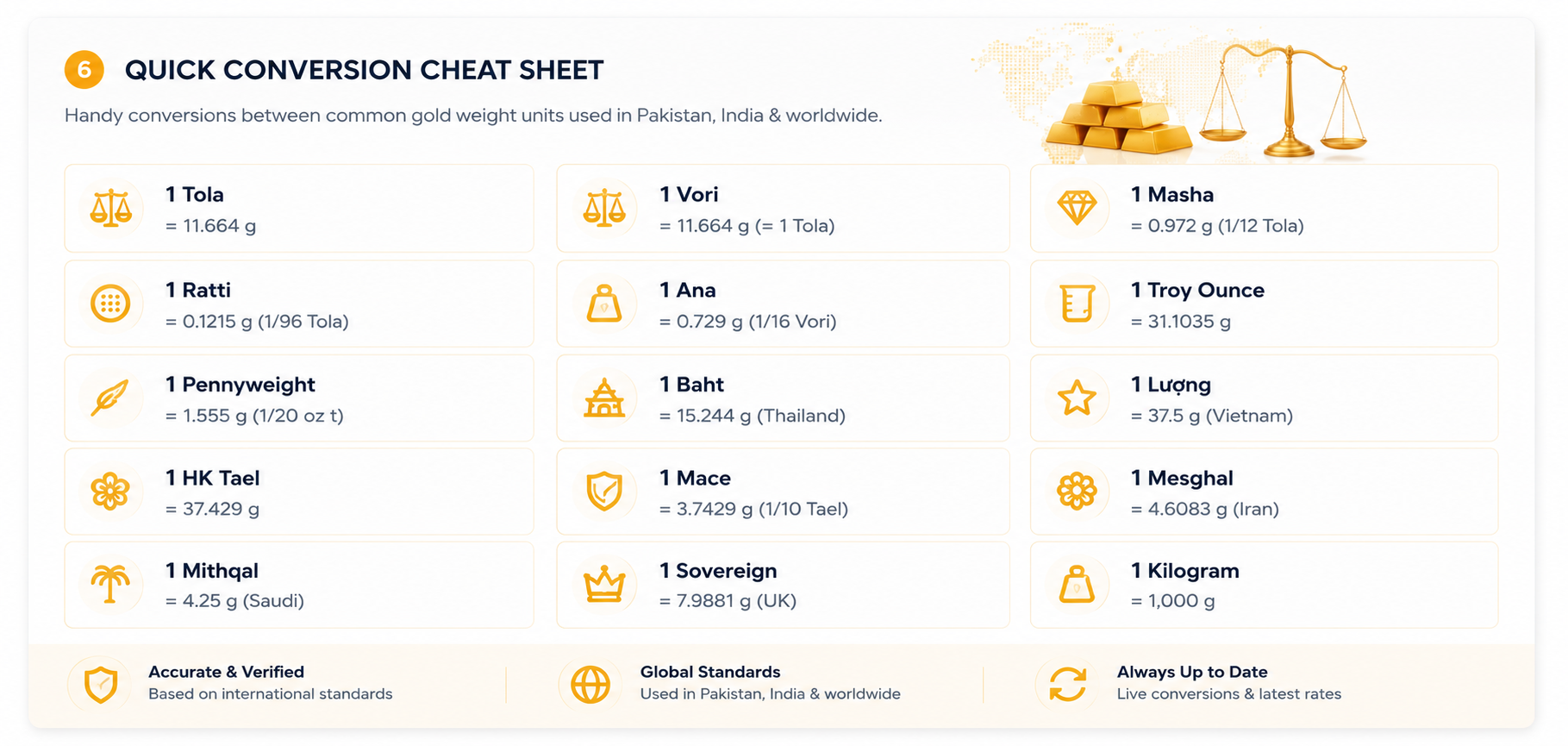
Side-by-side 24K gold prices across every major regional weight unit used worldwide — from the South Asian Tola, Masha, and Ratti to Bangladesh's Vori, Thailand's Baht, Vietnam's Lượng, Iran's Mesghal, and the Chinese Tael, Mace and Candareen. Both columns are calculated live from each country's per-gram rate: ¥965.60/g in China vs ¥22,756/g in Japan.
South Asian
1 Tolaتولا · तोला
11.664 g · Pakistan, India, Nepal
1 Mashaماشہ
0.972 g · 1/12 Tola
1 Rattiرتی
0.1215 g · 1/96 Tola · gemstones
1 Vori (Bhori)ভরি
11.664 g · Bangladesh
1 Ana (Anna)আনা
0.729 g · 1/16 Vori
Metric & Global
1 Gramg
1 g · Worldwide standard
1 Kilogramkg
1,000 g · Bulk trade
1 Troy Ounceoz t
31.1035 g · LBMA bullion standard
East & SE Asian
1 HK Tael兩
37.429 g · Hong Kong, Macau
1 CN Tael兩
31.25 g · Mainland China
1 Mace錢
3.7429 g · 1/10 HK Tael
1 Candareen分
0.37429 g · 1/100 HK Tael
1 Bahtบาท
15.244 g · Thailand
1 Luong (Lượng)lượng
37.5 g · Vietnam
Middle Eastern
1 Mesghalمثقال
4.6083 g · Iran
1 Mithqalمثقال
4.25 g · Saudi, UAE, Egypt
Imperial & Western
1 Pennyweightdwt
1.55517 g · 1/20 Troy Oz
1 Graingr
0.064799 g · 1/480 Troy Oz
Prices computed from live 24K per-gram rates · China: ¥965.60/g · Japan: ¥22,756/g · Updated every 60 seconds
Why Gold Prices Differ Between China and Japan
Gold trades on a single global market — the XAU/USD spot price is the same everywhere. But once you compare China (CNY) against Japan (JPY) in local currency, the prices differ for four reasons:
- Currency exchange rates — a weaker CNY or JPY against the dollar pushes the local gold price up.
- Local taxes — VAT, GST, sales tax differ by country.
- Import duties — both countries levy different customs charges on gold imports.
- Jeweller making charges — when shopping for jewellery (not bullion), local labour costs change the final price.
Goldify Pro tracks the live international XAU/USD rate every 60 seconds and converts it to CNY and JPY using real-time exchange rates so you can compare both markets accurately.
Other comparisons
Browse other gold price comparisons:
Advertisement
Weight Units Used in China and Japan
China
In China, gold is most commonly quoted in gram (the international standard) and local traditional units. The standard jewellery purity is 22K and 24K for investment, with 18K, 21K, and lower karats for daily-wear jewellery.
Japan
In Japan, gold is most commonly quoted in gram (the international standard) and local traditional units. The standard jewellery purity is 22K and 24K for investment, with 18K, 21K, and lower karats for daily-wear jewellery.
When comparing rates between China and Japan, always check whether the price you're quoted is for the same weight unit and purity. A tola in India is identical (11.664 g) to a vori in Bangladesh, but a Saudi mithqal (4.25 g) is roughly 2.74 times heavier than a Persian mesghal converted at the same per-gram rate. The table above normalises every unit so you can compare apples-to-apples.
Taxes & Duties — Why the Sticker Price Differs
China
- Local sales tax, VAT, or GST on jewellery value
- Often reduced or zero rates on investment-grade bullion
Japan
- Local sales tax, VAT, or GST on jewellery value
- Often reduced or zero rates on investment-grade bullion
These taxes affect the final price you pay. They do not include country-specific taxes, duties, or jewellery making charges (3–15% of metal value depending on design), the relevant tax rate, and any dealer margin (1–3% on bullion, more on jewellery).
Gold Market Culture — China vs Japan
China
Markets: regional bullion dealers and city-centre gold markets set daily retail benchmarks.
Peak buying season: wedding seasons, religious festivals, and year-end holidays typically drive peak demand.
Japan
Markets: regional bullion dealers and city-centre gold markets set daily retail benchmarks.
Peak buying season: wedding seasons, religious festivals, and year-end holidays typically drive peak demand.
Worked Example — Converting Between CNY and JPY
Suppose you want to buy 1 tola (11.664 g) of 24K gold.
China
Japan
Important — Gold prices cannot be compared directly because they are in different currencies. This page first converts both rates back to a common USD basis (using live exchange rates), then expresses the spread as a percentage. Live: 1 tola of 24K gold today costs ¥11,263 in China and ¥265,429 in Japan.
Buying Tips When Comparing China and Japan
Check the hallmark
Look for BIS Hallmark (India), Hallmark Certificate (Bangladesh), 916/750 stamp, or local equivalents. Never buy unmarked gold.
Ask for the per-gram price first
Jewellers often quote in tola, vori, or at piece price — request the per-gram rate so you can verify against the live spot.
Separate metal cost from making charges
A receipt should show: metal weight × per gram rate, plus making charges, plus tax. It is your right before paying.
Compare same purity
A 22K item in one country is not directly comparable with an 18K item in another. Always compare the same purity.
Factor in repatriation
If you're buying abroad to bring home, account for customs duty, declaration thresholds, and baggage allowance limits.
Time your purchase
Spot prices fluctuate. Festival markups and exchange-rate swings can change retail prices ±5% in a week.
Pro Tip: Use our live gold price converters to compare prices accurately in CNY, JPY, AED, USD & more.
Frequently Asked Questions
Is it cheaper to buy gold in China or Japan?+
On the international XAU/USD basis the price is the same in both countries. After converting to local currency and adding taxes plus making charges, the cheaper destination depends on the day's exchange rates, the purity you buy, and the dealer's margin. The diff bar at the top of this page shows today's USD-equivalent spread.
Can I buy gold in China and sell it in Japan?+
Cross-border gold arbitrage is legal in most countries within declared baggage allowances, but customs duties, VAT/GST, and proof-of-purchase requirements often erode any spread. Most tourists also lose 4–8% on jeweller buy-back margins. Goldify Pro is intended as a reference, not investment advice.
Why is the same 24K gold priced differently in China and Japan?+
The XAU/USD international spot price is the same everywhere. Local prices in CNY and JPY differ because of (1) exchange-rate fluctuations versus the dollar, (2) import duties and VAT/GST, (3) jeweller making charges, and (4) supply-and-demand spreads.
Which is purer — gold sold in China or Japan?+
Purity depends on the karat you buy, not the country. Hallmarked 24K is 99.9% pure regardless of origin. China commonly stocks 22K and 24K for investment, with 18K, 21K, and lower karats for daily-wear jewellery; Japan commonly stocks 22K and 24K for investment, with 18K, 21K, and lower karats for daily-wear jewellery. Always check the local hallmark (BIS, Hallmark Certificate, KDM, 916/750 stamps, etc.).
How often does Goldify Pro update the rates on this comparison page?+
Live XAU/USD spot is fetched every 60 seconds from gold-api.com. Currency exchange rates refresh every minute from exchangerate-api.com. This page itself is statically generated and revalidated every 5 minutes (ISR) so it stays fast while staying close to live.
Are the prices on this page the retail rates I'll pay at a jeweller?+
No — they are pure-metal value at international parity. A jeweller's quote adds making charges, design premium, and local taxes. Expect retail to sit 5–15% above the rates shown here. Use this page as a baseline to verify that a dealer's quote isn't unfair.
Can I use this comparison for investment-grade bullion?+
Yes — investment-grade bullion (≥99.5% pure) typically trades very close to the per-gram or per-ounce rate shown here, with a small dealer premium of 1–3%. Many countries (UK, US, Singapore) exempt investment-grade gold from VAT/sales tax.
What does "per tola" mean and is it the same as "per vori"?+
1 tola = 1 vori = exactly 11.664 grams. The two are identical in weight — "tola" is the standard term in Pakistan, India, and Nepal, and "vori" (also spelt "bhori") is used in Bangladesh. The price per tola/vori is simply the per-gram rate multiplied by 11.664.
Methodology: Goldify Pro derives every price on this page from the live XAU/USD spot rate (sourced from gold-api.com) divided by 31.1035 g per troy ounce to get a per-gram USD rate, then multiplied by the live CNY/USD and JPY/USD exchange rates (from exchangerate-api.com) to produce the local-currency rates shown. Multipliers for tola (11.664), masha (0.972), ratti (0.1215), vori (11.664), ana (0.729), baht (15.244), lượng (37.5), HK tael (37.429), mace (3.7429), candareen (0.37429), mesghal (4.6083), mithqal (4.25), pennyweight (1.55517), grain (0.064799), and karat purity ratios (purity ÷ 24) are mathematical constants and never approximated.
What this page does NOT include: local sales tax, VAT, GST, import duty, jeweller making charges, design premiums, or coin numismatic premiums. The values are pure metal value at international parity — useful for cost-basis calculations, valuation, accounting, and educational research, but not directly comparable to a jeweller's retail quote.
Always verify locally: before any significant transaction, confirm the live rate with a reputable bullion dealer in China or Japan. Goldify Pro is for reference and education, not a price quote for buying or selling physical gold.