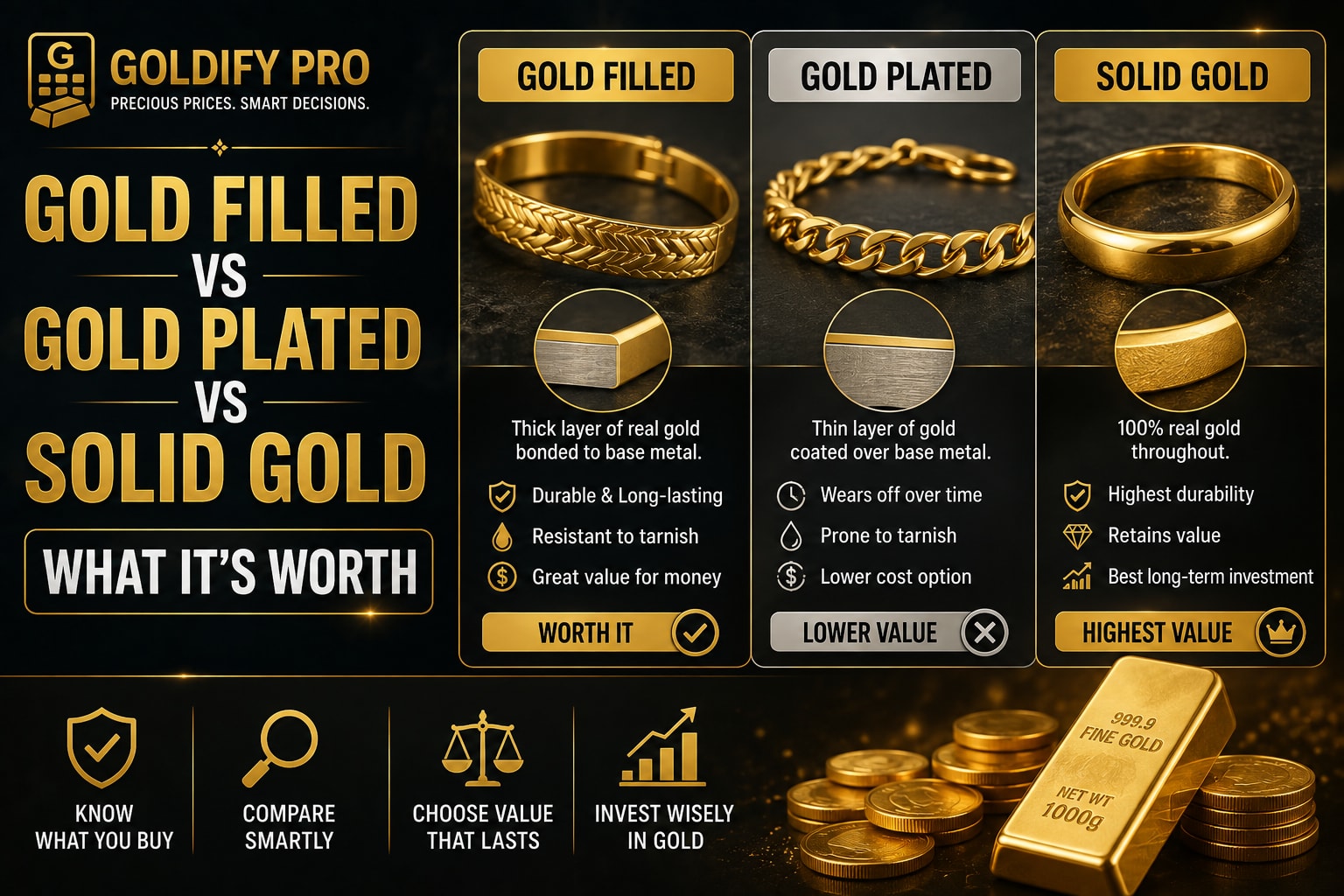
Gold Filled vs Gold Plated vs Solid Gold: What It's Worth
A 20 g solid 14K chain holds $1,515.60 of gold at $129.90 per gram. The same chain gold plated holds about $5 of gold, and no refiner will pay for it. Here is what gold filled, gold plated, vermeil and solid gold actually contain, and what each is worth.
Advertisement
A 20-gram chain in solid 14K contains 11.67 g of fine gold, which is $1,515.60 at today's gold price per gram of $129.90. The identical-looking chain in gold plate holds roughly five dollars' worth of gold, and no refiner will pay you a cent for it. Four tiers of gold jewellery look almost the same in a display case and differ by a factor of several hundred in metal value.
Quick Takeaways
Solid gold is gold all the way through and carries a bare karat stamp such as 10K, 14K, 585 or 750 — a 20 g 14K piece is worth 20 x $75.78 = $1,515.60 in metal. Gold filled carries a fraction before the karat, such as 1/20 14K GF, meaning about 2.9% of the item's weight is fine gold; a 20 g gold-filled chain holds roughly 0.58 g of gold, about $76. Gold vermeil is gold over a sterling silver core, so the core alone is worth 0.925 x $1.864 = $1.72 per gram, or about $34 for that same 20 g piece. Gold plated, electroplate and HGE are measured in microns and hold a few hundredths of a gram — a trivial sum that costs more to recover than it yields. The stamp tells you which tier you own before you touch a test kit.
The Four Tiers, Ranked by How Much Gold Is Actually There
Solid gold meaning is the simplest of the four: the alloy is uniform throughout, so a cut section looks the same in the middle as on the surface. It is stamped with a karat number — 10K, 14K, 18K, 22K, 24K — or the millesimal equivalent such as 417, 585, 750, 916 or 999. Nothing can wear off it, because there is no layer, and it has genuine melt value at any scrap counter.
Advertisement
Gold filled sits a long way below solid gold but far above plating. A comparatively thick sheet of karat gold is mechanically bonded — heat and pressure, not electricity — to a brass core. Under US Federal Trade Commission jewellery guidance, an item may only be called gold filled if that layer is at least 1/20th, or 5%, of total weight, and the marking says so: 1/20 14K GF. Since 14K is itself 58.3% pure, the fine gold in a 14k gold filled piece is 0.05 x 0.583 = about 2.9% of total weight.
Gold vermeil is the tier most people underestimate, and the reason is the core. Vermeil is a defined minimum thickness of gold — commonly cited as 2.5 microns of at least 10K under the same US guidance — applied over sterling silver rather than brass or steel. The gold is thin. The silver underneath is not: it is 92.5% fine metal with a market price of its own, so a vermeil chain has real melt value hiding inside it.
Gold plated is the bottom tier. What is gold plated, precisely? An electric current deposits a microscopically thin film of gold onto a base-metal item — typically 0.5 microns for flash plating, up to about 2.5 microns for heavy gold electroplate. It is stamped GP, GEP, HGE or EP. RGP, rolled gold plate, is a bonded layer like gold filled but too thin to meet the 1/20 threshold. An 18k gold plated label describes the purity of a film you could scratch through with a fingernail, not the body of the piece.
| Tier | Gold actually present | Common markings | Finish lifespan | Resale reality |
|---|---|---|---|---|
| Solid gold | 41.7% to 99.9% by weight, throughout the piece | 10K, 14K, 18K, 22K, 417, 585, 750, 916 | Permanent — there is no layer to wear off | Full melt value less a refining margin; any dealer will quote |
| Gold filled | About 2 to 5% of total weight as fine gold | 1/20 14K GF, 1/20 12K GF, 'gold filled' | Decades of normal wear; can outlast the wearer | Small but genuine melt; only specialist refiners handle it |
| Vermeil | A few microns of 10K or better; sterling core beneath | 925 or 'sterling' under a gold colour, 'vermeil' | Several years; wears first at contact points | Gold negligible, but the 925 core is worth silver melt |
| Gold plated / electroplate | 0.5 to 2.5 microns — a small fraction of 1% | GP, GEP, HGE, EP, RGP, '18k gold plated' | Months to a couple of years on worn pieces | Effectively zero; refiners decline it |
Is Gold Plated Worth Anything? The Arithmetic
Work the plating maths through and the answer stops being a matter of opinion. Gold has a density of 19.32 g per cubic centimetre, and a micron is one ten-thousandth of a centimetre. One micron of gold spread over 25 square centimetres of chain surface is 0.0025 cubic centimetres — about 0.048 g, less again once the plating is 18K rather than pure. Call it 0.03 to 0.05 g of fine gold on a typical plated chain: roughly $4 to $6 at $129.90 per gram.
Advertisement
Then the recovery problem finishes the job. Stripping that film means chemical processing of the whole item, assaying and disposal of the base metal, and the cost comfortably exceeds a few dollars of yield. That is why gold plated scrap value is quoted as zero rather than as a small number: the gold exists, but nobody can profitably get it out. Compare the same chain in solid 14K at $75.78 per gram — see the live 14K gold price per gram.
| Version of the chain | Fine metal it contains | Metal value today | What a buyer realistically pays |
|---|---|---|---|
| Solid 14K gold | 20 x 0.583 = 11.67 g fine gold | 20 x $75.78 = $1,515.60 | Most of it, less a refining margin of a few per cent |
| 1/20 14K gold filled | 20 x 0.029 = about 0.58 g fine gold | About $75.80 | Well under melt, and only from a refiner who takes filled stock |
| Vermeil over sterling | Gold negligible; 20 g of 925 silver | 20 x $1.72 = $34.40 | Close to silver melt at any scrap counter |
| 18K gold plated | About 0.03 to 0.05 g fine gold | About $4 to $6 | Nothing — recovery costs more than the yield |
Gold filled value deserves one clarification. The metal is real, but the market for it is thin: most high-street buyers refuse gold filled outright because they cannot separate the layer without a refining run, and those who take it discount the already-small fine weight. Treat any figure from a scrap gold calculator as a theoretical ceiling for filled stock, and a realistic starting point only for solid karat gold.
Goldify Pro Insight
The tier everyone writes off is the one worth checking. Plating is a dead end — 0.03 to 0.05 g of gold on a whole chain, $4 to $6 of metal, and a recovery cost that wipes it out, versus 20 x $75.78 = $1,515.60 for that chain in solid 14K. But vermeil is not plating over brass, it is plating over sterling, and sterling is 92.5% silver: 0.925 x $1.864 = $1.72 per gram. A drawer holding 200 g of vermeil chains and earrings you assumed were costume jewellery is 200 x $1.72 = about $344 of silver, and unlike plating it is instantly saleable because scrap counters buy 925 by weight all day. Run the weight through the sterling silver calculator before you write the drawer off, and read is sterling silver worth anything for how those offers are actually priced. The decision rule at a counter: gold colour plus a 925 stamp means weigh it, not bin it.
How to Tell Gold Plated From Solid Gold
Read the stamps first: they answer the question in seconds and cost nothing. Check the clasp, the inside of a ring shank, a pendant bail or the tab on a bracelet. The grammar of gold plated markings is consistent — what sits before and after the karat number tells you the tier.
Advertisement
- A bare karat number or millesimal figure — 14K, 585, 750, 916 — means solid gold throughout.
- A fraction in front of the karat — 1/20 14K GF, 1/10 12K GF — means gold filled. The fraction is the proportion of total weight in the bonded layer.
- Letters after the karat — GP (gold plated), GEP (gold electroplate), HGE (heavy gold electroplate), EP, or the words 'gold plated' — mean a microns-thick film.
- RGP (rolled gold plate) means a mechanically bonded layer thinner than the gold filled threshold. Better than electroplate, still not worth refining.
- 925 or 'sterling' stamped on a gold-coloured piece almost always means vermeil: silver body, gold surface.
- No stamp at all is not proof of anything — but on modern mass-market jewellery it usually points to plated or unmarked base metal.
After the stamp, look at wear. Plating fails at friction points first, so inspect ring shanks, clasp springs and links where they rub. A dull grey, pinkish or white metal showing through is the base core, and that alone settles it. Solid gold wears down without ever changing colour.
Then the physical checks. A magnet catches many plated pieces because steel and nickel cores are common, but brass cores are non-magnetic, so a negative result proves nothing. Weight is the better tell: a solid chain feels startlingly heavy against an identical plated one. For acid, electronic and specific-gravity testing, how to test if gold is real has the full sequence and hallmark gold meaning explains assay-office marks. Only an assay is definitive.
Watch the wording, not the number
The most common way buyers mislead themselves is reading '18k gold plated' as an 18K item. The karat figure describes the purity of a film perhaps 1 micron thick; the body of the piece is brass or steel. Equally, 'gold tone', 'gold finish' and 'gold colour' are not gold claims at all and carry no minimum standard. And a forged 14K stamp on plated stock is trivially easy to apply, which is why anything you are paying solid-gold money for should be tested, not trusted.
Why Gold Plated Jewellery Still Makes Sense
None of this makes plating a scam. It is a legitimate manufacturing choice: it delivers the appearance of gold at a small fraction of the cost, which is exactly right for trend pieces, travel jewellery, and anything you would be upset to lose. A plated hoop costing a few dollars that looks like a 14K hoop costing several hundred is doing its job.
The mistake is category confusion. Plating is a consumable finish, like the sole of a shoe — designed to be used up. It is not a store of value and should never be bought as a way to own gold. Gold filled jewelry sits usefully in between: at 2.9% fine gold it will not fund a retirement, but the bonded layer survives daily wear for decades, which is why early-twentieth-century gold filled pieces still turn up with an intact surface.
Does Gold Plated Tarnish? Making a Finish Last
Gold itself does not tarnish, but plated jewellery does, and the mechanism matters. The film is thin and slightly porous, so the base metal beneath — copper, brass, nickel — oxidises and migrates to the surface. The discolouration is the core coming through, not the gold going bad. Sweat, chlorine, perfume and cosmetics all accelerate it.
- Put jewellery on last, after perfume, lotion and hairspray have dried, and take it off first.
- Remove plated pieces before showering, swimming, exercising or washing up — chlorine and salt are the fastest killers.
- Wipe with a soft dry cloth after wearing to lift sweat and oils before they sit on the surface.
- Never use silver dip, polishing cloths or abrasive paste on plated or vermeil items; polishing removes the layer you are trying to protect.
- Store pieces separately in a soft pouch or lined box so links do not abrade each other.
- Expect to replate a favourite piece eventually — many jewellers offer it, and it is normal maintenance rather than a defect.
No plating is permanent. A 2.5-micron finish worn occasionally may last years; flash plating on a daily ring shows brass within months.
Frequently Asked Questions
Is gold plated worth anything?
Not in metal terms. A plated chain carries roughly 0.03 to 0.05 g of gold, about $4 to $6 at $129.90 per gram, and stripping it costs a refiner more than the yield, so gold plated scrap value is effectively zero. Plated jewellery can still hold value as a designer or vintage piece, but that is the brand being priced, not the gold.
Does gold plated tarnish?
Yes, though the gold itself does not. The plated film is thin and slightly porous, so the copper, brass or nickel core beneath oxidises and works through to the surface as dullness or a greenish cast. Sweat, chlorine, perfume and cosmetics speed it up. Removing pieces before showering and wiping them dry after wear extends the finish.
What is gold filled jewellery worth?
A 14k gold filled item marked 1/20 14K GF is about 2.9% fine gold by weight, so a 20 g piece holds roughly 0.58 g, about $76 at today's spot. That is real metal, unlike plating, but most buyers will not touch it and refiners pay well below melt. Its main value is durability: the layer survives decades of wear.
How can you tell gold plated from solid gold at home?
Read the stamp first: a bare karat number means solid, letters such as GP, GEP or HGE mean plated, and a fraction like 1/20 12K GF means filled. Then check clasps and edges for base metal showing through, try a magnet, and compare weight against a similar-sized piece. Solid gold feels notably heavier. Only an assay is conclusive.
Is gold vermeil real gold, and is it better than gold plated?
Gold vermeil is a genuine gold layer held to a minimum thickness and purity, but the important difference is underneath: vermeil is plated over sterling silver, not brass. That gives it a core worth 0.925 x $1.864 = $1.72 per gram, so a 20 g piece holds about $34 of silver. Vermeil also wears better than base-metal plate.
What do GP, GF and GEP markings mean?
GF is gold filled — a bonded layer that must be at least 1/20th of the item's weight in the US, always written with a fraction. GP is gold plated and GEP is gold electroplate, both films measured in microns. HGE is heavy gold electroplate, still only a few microns. RGP is rolled gold plate, too thin to qualify as filled.
Conclusion
The stamp settles the question before any test kit does: a bare karat number is solid, a fraction in front means filled, letters after mean plated, and 925 under a gold colour means vermeil with silver melt underneath. Solid gold at 20 x $75.78 = $1,515.60 for a 14K chain is the only tier that behaves like metal you own; everything below it is a finish you are renting. If you are deciding what to buy, is 14k gold real gold and is 10k gold worth buying weigh purity against durability, and how to sell gold best price covers what happens at the counter.
Methodology & Disclaimer
All values here are fine-metal weight multiplied by live spot at the time of writing — $4,040.50 per troy ounce or $129.90 per gram for gold, and $57.99 per troy ounce or $1.864 per gram for silver. They exclude making charges, dealer premiums, VAT or sales tax, refining fees and any other charges, and spot prices move continuously, so recheck a live rate before acting on any figure. Legal definitions of gold filled and vermeil described here follow US Federal Trade Commission jewellery guidance and differ in other jurisdictions; confirm the current rules where you are. This article is educational and is not investment, valuation or tax advice. Goldify Pro is a rate-reference and calculator service and does not buy, sell, broker or ship gold or silver.
Advertisement
Tools mentioned in this article
Advertisement


