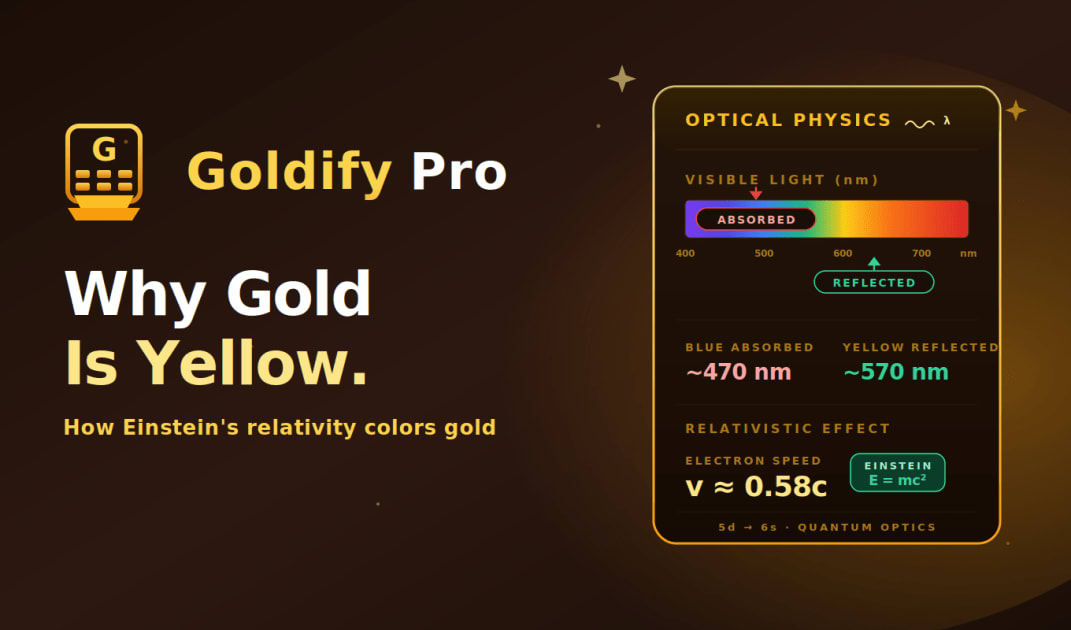
Why Is Gold Yellow? Einstein's Relativity Explains It
Why is gold yellow when most metals are silver-grey? The surprising answer involves Einstein's theory of relativity, the quantum physics of electrons orbiting at near light speed, and a chain of effects that also explains why mercury is liquid at room temperature.
Advertisement
Stand next to a silver bracelet and a gold bracelet in a jewellery shop. Both metals share almost identical electron arrangements — they sit one row apart on the periodic table. Yet one is silver-grey and the other is warm yellow. The reason for this difference is not paint, not finish, not alloy mix. It is one of the most surprising consequences of Einstein's theory of relativity ever to show up in everyday life. Gold is yellow because some of its electrons move so fast that they obey relativistic physics rather than classical physics — and that single fact rewrites the colour you see on your finger.
The short answer
TL;DR
Most metals reflect all visible light equally, so they look silver-grey. Gold absorbs the blue end of the visible spectrum and reflects yellow and red. This happens because gold's outermost 6s electrons move so fast (over half the speed of light) that relativistic effects contract their orbital. The contracted orbital shifts gold's electronic transitions from the ultraviolet into visible light. Without relativity, gold would look silver.
Advertisement
Why most metals look silver-grey
When light hits a metal surface, the metal's electrons absorb and re-emit photons across the spectrum. For most metals — silver, aluminium, platinum, iron — the energy required for electron transitions sits above the visible-light range, in the ultraviolet. Visible light passes through unabsorbed, gets re-emitted, and the metal looks 'silver' — reflecting all visible wavelengths roughly equally. That's why everything from a stainless-steel knife to a platinum ring to a silver coin all look broadly the same neutral colour.
What makes gold different
Gold absorbs blue and violet light (wavelengths around 400–450 nanometres) and reflects yellow, orange and red wavelengths. The visible result is a warm yellow shine. The question is: why is gold the only metal whose electronic transitions land in the visible range instead of the ultraviolet? The answer is that gold's atomic number is high enough (79) that its innermost electrons move at relativistic speeds — meaning fast enough that Einstein's special relativity applies rather than classical mechanics.
The 6s electron and relativistic contraction
Gold has 79 protons in its nucleus and 79 electrons orbiting around it. The innermost electrons are pulled extremely close to the nucleus by its strong positive charge. To stay in stable orbits without falling in, these inner electrons must move very fast — calculations show gold's 1s electrons move at roughly 58% of the speed of light. At those speeds, Einstein's special relativity kicks in: relativistic mass increases, which contracts the electron's orbit closer to the nucleus. The effect cascades outward. Gold's outermost 6s orbital — the one most involved in optical and chemical interactions — also gets contracted. That contraction shifts gold's electronic transitions from the ultraviolet range (where they would normally sit) down into the visible blue range. Blue light is absorbed; yellow light is reflected; gold looks yellow.
Advertisement
Relativistic contraction of 6s → Lower 5d→6s transition energy → Blue light absorbed → Yellow light reflectedWithout relativistic effects, gold's 5d→6s electronic transition would sit in the ultraviolet, making gold look silver like its periodic-table neighbours.
Compare with silver — same family, different colour
Gold and silver have nearly identical chemistry — both have one electron in their outermost s orbital, both sit in Group 11 of the periodic table. The structural difference is that silver has atomic number 47 and gold has atomic number 79. Silver's electrons are not heavy enough or fast enough for relativistic effects to matter significantly. Its 5s→4d transition stays in the ultraviolet, and silver looks silver. Gold's 6s→5d transition is shifted into the visible range by relativity, so gold looks yellow. Two elements in the same family. The same chemistry. Different colours, purely because gold is heavier and its electrons faster.
| Property | Silver (Ag) | Gold (Au) |
|---|---|---|
| Atomic number | 47 | 79 |
| Outermost orbital | 5s | 6s |
| Inner electron speed | ~33% speed of light | ~58% speed of light |
| Relativistic effects | Negligible | Significant |
| Electronic transition wavelength | Ultraviolet (~310 nm) | Visible blue (~400 nm) |
| Absorbed light | None in visible range | Blue / violet |
| Reflected light | Full visible spectrum | Yellow, orange, red |
| Apparent colour | Silver-grey | Warm yellow |
Other relativistic consequences in gold
Gold's yellow colour is the most visible relativistic effect, but not the only one. Several of gold's most useful properties are also relativistic in origin: gold's resistance to corrosion (relativistically stabilised 6s electron is hard to remove); gold's malleability (relativistic effects strengthen metallic bonding); gold's specific electrical and thermal conductivity profile; and gold's catalytic behaviour in nanoparticle form. Almost every famous property of gold can be traced back, at some level, to the speeds at which its inner electrons orbit.
Advertisement
Why mercury is liquid — the same relativity story
Mercury sits next to gold on the periodic table (element 80). Like gold, its inner electrons move at relativistic speeds. The relativistic contraction of mercury's 6s orbital makes mercury atoms unusually reluctant to share electrons with each other for metallic bonding — much weaker than chemistry alone would predict. As a result, mercury has a melting point of −38.83°C, making it the only metal liquid at room temperature. Without relativistic effects, mercury would be a solid metal like its neighbours. The same physics that makes gold yellow makes mercury liquid.
Two visible consequences of relativity
If Einstein had been wrong and special relativity didn't exist, gold would look silver and mercury would be a solid. Two everyday observations — the colour of a wedding ring and the liquidity of an old thermometer — are direct confirmations of relativity in plain sight.
Why caesium and other heavy metals don't show the same effect
Several heavy metals are even more relativistic than gold, but they look silver because their electronic structure doesn't position the relativistic transition in the visible range. The specific combination needed for a yellow metal is: heavy enough for strong relativistic effects + electron configuration that places the contracted transition energy in the blue range of visible light. Gold is the only common element that meets both conditions. Copper has a related but weaker effect — it absorbs slightly into the green range, producing copper's warm reddish hue without being as dramatically coloured as gold.
How rose, white and green gold change the colour
Pure gold is always the same yellow because relativity is the same in every gold atom. The different colours of jewellery gold come from alloy metals that shift the apparent colour: copper makes rose gold (more red because copper itself has weak relativistic colouring), silver and palladium make white gold (mostly silver-grey with rhodium plating for brightness), and high-silver alloys make green gold (a subtle olive tone). The underlying yellow of gold is always there; the alloys reshape what wavelengths reflect off the final surface.
Gold nanoparticles — when the colour changes completely
At nanoscale sizes (1–100 nanometres), gold behaves dramatically differently. Gold nanoparticles in solution can appear red, purple, blue or pink depending on their size and shape. The cause is a quantum-mechanical effect called surface plasmon resonance, where light interacts with the collective motion of free electrons on the nanoparticle's surface. Medieval stained glass artisans accidentally used this effect for centuries — adding gold to molten glass to produce ruby-red colours, without knowing the quantum reason. Today, the same physics underlies advanced cancer treatments and biosensors using gold nanoparticles.
Frequently asked questions
Is gold's colour really because of Einstein's relativity?
Yes — this has been calculated and confirmed by quantum chemists since the 1970s, including landmark work by Pekka Pyykkö and others. Standard non-relativistic calculations predict gold should look silver. Adding relativistic corrections correctly produces gold's observed yellow colour. The link between Einstein's special relativity and gold's colour is one of the most-cited examples of relativity in chemistry.
Would gold look different on a planet with different physics?
Physical laws including relativity are universal — they don't change by location. So gold would look the same yellow on Mars, in another galaxy, or anywhere else in this universe. The colour is determined by gold's atomic structure plus the laws of physics, both of which are constant everywhere we have observed.
Why doesn't silver have the same effect?
Silver's atomic number (47) is too low for relativistic effects to significantly shift its electronic transitions into the visible range. Silver's transitions stay in the ultraviolet, so silver looks silver. Gold's atomic number (79) is high enough — and its electrons fast enough — for relativity to make the visible difference.
Common myths — busted
| Myth | Reality |
|---|---|
| Gold is yellow because of impurities | Pure gold is yellow. Impurities can shift the colour but the underlying yellow is intrinsic. |
| Gold's colour comes from how it's polished | Polishing affects brightness, not colour. The colour is atomic. |
| Relativity is only about black holes and spaceships | Relativity has measurable everyday effects, including the colour of gold and the liquidity of mercury. |
| Silver is just unpolished gold | Silver and gold are entirely different elements with different atomic numbers. |
| Synthetic gold would look different | Synthetic gold made by transmutation would be chemically identical to natural gold and would look the same yellow. |
Einstein won the Nobel Prize for explaining the photoelectric effect. He never mentioned that his theory also explains the colour of a wedding ring — but it does.
The bottom line
Gold is yellow because its inner electrons move at relativistic speeds, contracting its outermost 6s orbital and shifting its electronic transition from the ultraviolet into visible blue light. The blue light is absorbed; the yellow, orange and red wavelengths are reflected; the metal looks warm yellow. This is not a chemistry curiosity — it is a direct, everyday demonstration of Einstein's special relativity working at the atomic scale. The same physics makes mercury liquid at room temperature and explains many of gold's most useful properties. Hold a piece of gold up to the light and you are looking, literally, at relativity made visible.
Stay informed
Track today's gold rate live on Goldify Quick Rates — 24K, 22K, 21K and 18K prices in tola, gram, masha and ratti, refreshed every minute, in your local currency. Use the Goldify converters to verify any quote at the counter.
Advertisement
Disclaimer
Editorial & scientific disclaimer
This article is original, human-written content created exclusively for Goldify by our editorial team. It is intended for general educational and informational purposes only and does not constitute physics, chemistry, materials-science, financial or investment advice. The relationship between relativistic effects and gold's colour is widely accepted in the scientific community based on quantum-chemistry calculations by Pekka Pyykkö and other researchers since the 1970s. Specific numerical values (electron speeds, wavelengths, orbital energies) are widely reported scientific estimates; precise figures may vary by calculation method. References to scientific concepts (special relativity, relativistic mass, orbital contraction, surface plasmon resonance) describe widely accepted physics. Goldify is not affiliated with any university, research institution, refiner, jeweller or platform mentioned. We do our best to keep information accurate but make no warranty of completeness or fitness for any purpose. By reading this article you agree that Goldify is not liable for any decision you take based on its contents.
Originality & AI policy
This article was written and edited by humans on the Goldify editorial team. Research, examples and analysis were prepared in-house. We do not republish or scrape content from other websites. If you believe any portion of this article infringes a copyright, please contact us at gold@goldify.pro and we will review it promptly.
Advertisement
Tools mentioned in this article
Advertisement


