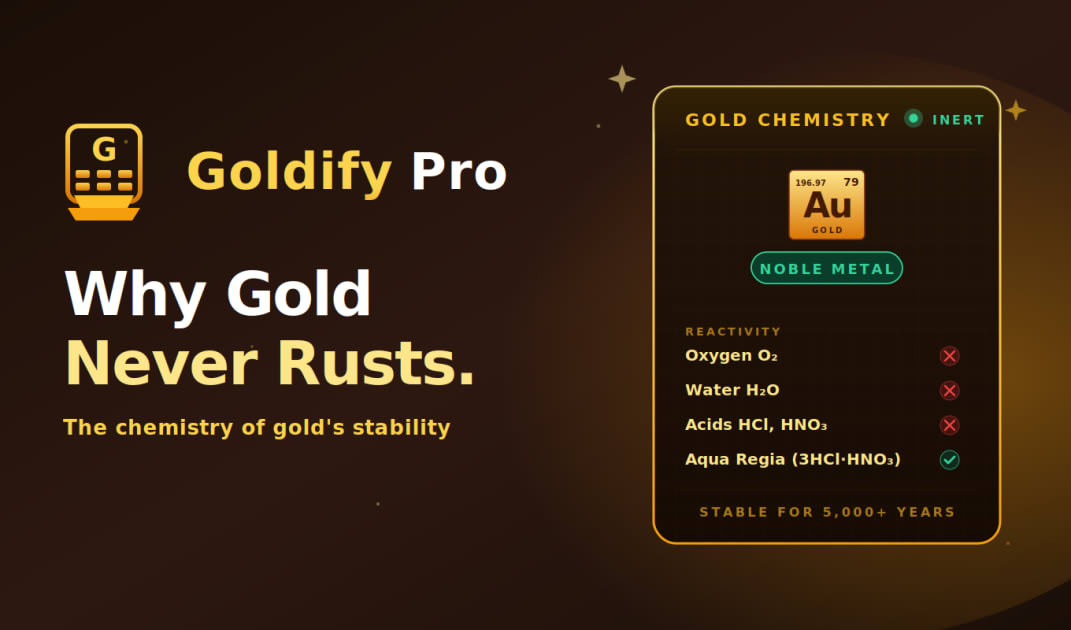
Why Doesn't Gold Rust? The Chemistry of Gold's Stability Explained (Complete Guide)
Why doesn't gold rust or tarnish like other metals? A complete chemistry guide to gold's extraordinary stability — covering noble metal status, electron configuration, oxidation resistance and why pure 24K gold survives millennia underground or underwater.
Advertisement
A 5,000-year-old gold mask from an Egyptian tomb looks essentially the same today as the day it was buried. An iron knife from the same tomb would be a pile of red dust. The difference is not luck or storage — it is chemistry. Gold is one of the most chemically stable metals on earth, and that stability is the reason gold has served as humanity's store of value for longer than any other material. This guide explains exactly why gold doesn't rust — covering the noble-metal concept, electron configuration, oxidation resistance, and the few rare conditions under which even gold can be made to react.
Quick answer
The short version
Gold doesn't rust because its outermost electrons are held so tightly that oxygen, water and most acids cannot strip them away. This makes gold one of the seven 'noble metals' that resist oxidation in normal conditions. Iron, by contrast, gives up its outer electrons easily — that's why iron rusts. Gold's chemical inertness is intrinsic to its atomic structure, which is why even pure gold buried for millennia emerges essentially unchanged.
Advertisement
What is rust, technically?
Rust is the specific name for iron oxide — the red-brown flaky compound that forms when iron reacts with oxygen in the presence of water. The same general process, called oxidation, happens to many metals: copper turns green (copper carbonate), silver tarnishes black (silver sulfide), aluminium develops a thin oxide layer. In every case, the metal loses electrons to oxygen, sulfur, or other reactive elements. The chemistry is brutally simple — metals are reducing agents, oxygen is an oxidising agent, and given the chance, the two react. Gold's defining property is that it does not give up the chance.
4Fe + 3O₂ + 6H₂O → 4Fe(OH)₃ (rust)Iron loses electrons to oxygen, forming iron hydroxide. The same general electron-loss reaction does not occur for gold under normal conditions.
Why some metals rust and others don't
A metal's tendency to oxidise depends on how easily it gives up electrons. Some metals (sodium, potassium, magnesium) hold their electrons so loosely they react violently with water itself. Others (iron, zinc, copper) react slowly. A small group — gold, platinum, iridium, palladium, rhodium, ruthenium, osmium — hold their electrons so tightly that oxygen and water are not strong enough to pull them away. Chemists call these the 'noble metals' (the term originally coined by alchemists in the Middle Ages to distinguish them from 'base metals' like lead and copper). Nobility, in chemistry, means a refusal to react.
| Position | Metal | Reactivity |
|---|---|---|
| Most reactive | Potassium / Sodium | Reacts violently with water |
| Highly reactive | Calcium / Magnesium | Reacts steadily with water |
| Reactive | Aluminium / Zinc | Forms protective oxide layer |
| Moderately reactive | Iron / Lead | Rusts/tarnishes over months |
| Less reactive | Copper / Silver | Tarnishes over years |
| Noble (barely reactive) | Platinum / Gold | Essentially inert in normal conditions |
| Least reactive (gold's neighbourhood) | Iridium / Osmium | Among the most chemically stable metals on earth |
Advertisement
Gold's atomic structure — the source of its stability
Gold is element 79 on the periodic table. Its full electron configuration is [Xe] 4f¹⁴ 5d¹⁰ 6s¹. That single outer electron in the 6s orbital is the one that, in less stable elements, would be easily lost to oxidation. In gold, two factors keep it firmly in place: relativistic effects on the 6s electron (it moves so fast that Einstein's relativity contracts its orbital, pulling it closer to the nucleus and binding it more tightly), and the completed 5d¹⁰ subshell beneath it, which provides exceptional electron-shell stability. The combination is why gold is famously hard to oxidise — and incidentally why gold is yellow (most metals are silver-grey; gold's relativistic 6s contraction shifts its electronic transitions into the visible-light range).
Relativity and gold
The fact that gold is yellow and platinum is silver — even though both are noble metals next to each other on the periodic table — is one of the most visible everyday demonstrations of Einstein's relativity. Without relativistic effects, gold would look more like silver. Without the same effects, mercury would not be a liquid at room temperature. These small atomic facts have huge visible consequences.
Standard electrode potential — the chemistry that proves it
Chemists measure how willingly a metal gives up electrons using something called standard electrode potential (E°). The more positive the number, the more strongly the metal holds its electrons. Iron has an E° of −0.44 V (negative — wants to give up electrons easily). Gold has an E° of +1.50 V for Au³⁺/Au — one of the highest values of any metal. That positive value is the formal chemical reason gold resists oxidation: oxygen simply isn't strong enough to win the electron-tug-of-war against gold.
Advertisement
| Metal | E° (V) | Behaviour |
|---|---|---|
| Potassium | −2.93 | Reacts violently with water |
| Aluminium | −1.66 | Forms protective oxide |
| Zinc | −0.76 | Tarnishes in air |
| Iron | −0.44 | Rusts in moist air |
| Lead | −0.13 | Tarnishes slowly |
| Copper | +0.34 | Tarnishes over years |
| Silver | +0.80 | Tarnishes from sulfur |
| Platinum | +1.20 | Essentially inert |
| Gold (Au³⁺/Au) | +1.50 | Essentially inert |
What actually CAN dissolve gold?
Saying gold doesn't react isn't quite right. Saying gold doesn't react under normal conditions is more accurate. Under specific, extreme chemical conditions, gold can be dissolved — and these methods are how gold is actually refined and recovered industrially.
- Aqua regia — a 3:1 mixture of concentrated hydrochloric and nitric acid. The combination is the only common chemical that dissolves gold reliably. Named 'royal water' by medieval alchemists for its ability to dissolve the noble metal.
- Cyanide solutions — used industrially in modern gold mining to leach gold from ore. The cyanide ion bonds with gold to form a soluble complex.
- Mercury — gold dissolves into liquid mercury to form an amalgam. Used historically in gold extraction; banned in many countries today for environmental reasons.
- Halogens (chlorine, bromine, fluorine) — in gaseous form at high temperatures, can react with gold.
- Selenic acid — concentrated hot selenic acid will dissolve gold.
- Iodine in alcohol — slow but real dissolution.
These are extreme conditions
None of these dissolving methods occur in normal life. Gold jewellery, coins and bars never encounter aqua regia or cyanide solutions in daily wear or storage. That's why gold survives millennia of burial in tombs, shipwrecks underwater, or storage in vaults essentially unchanged.
So why does my gold jewellery tarnish?
Here's the crucial distinction: pure 24K gold (99.9% Au) does not tarnish. What tarnishes is the alloy metals mixed in to make jewellery durable. A 22K piece is 91.6% pure gold and 8.4% other metals — copper and silver. A 14K piece is only 58.5% gold and 41.5% other metals. The gold itself does not react, but the copper and silver in the alloy do — and the dark tarnish you see is silver sulfide and copper oxide on the surface, not gold rust. This is why higher-karat gold tarnishes less, and why pure 24K bullion does not tarnish at all even after decades in a safe.
2Ag + H₂S → Ag₂S (black tarnish) + H₂The silver in lower-karat gold reacts with sulfur compounds in sweat, air pollution and certain foods to form silver sulfide. The gold itself never participates in this reaction.
Real-world evidence — gold across millennia
- Tutankhamun's gold mask (1323 BCE) — recovered in 1925 essentially unchanged after 3,200 years in a tomb.
- The Treasure of Priam (Troy, ~2500 BCE) — gold jewellery from over 4,500 years ago, still intact.
- Gold from the SS Central America shipwreck (1857) — recovered from 2,200 metres underwater after 130 years, in pristine condition.
- Roman gold coins recovered from Pompeii — preserved by volcanic ash since 79 CE, still bright yellow.
- Inca and Aztec gold artefacts — 500+ years old, often dug up unmarred.
The investment implication
Gold's chemical stability is precisely why it has served as a store of value across every civilisation in human history. An iron coin from 500 BCE would not exist today. A gold coin from the same era would still be valuable — and recognisably gold. This durability is not an investment 'theory' — it is an atomic property.
Gold in extreme environments
- Deep-sea environments — gold is unaffected by saltwater. Shipwreck gold recovered from the deep ocean is essentially identical to the day it sank.
- Volcanic ash and acidic soil — gold survives the chemistry of buried environments that would destroy iron, copper or silver.
- Body fluids — gold is biologically inert, which is why it's used in dental fillings, ear-piercing studs, and pacemaker connectors without causing reactions.
- Space environment — gold is widely used as a thermal coating on spacecraft and satellites because it doesn't degrade in vacuum or under solar radiation.
- High temperatures — pure gold has a melting point of 1,064°C and resists oxidation even when molten. The James Webb Space Telescope's primary mirrors are gold-coated for exactly this reason.
Industrial uses that depend on gold's stability
- 1.Electronics — gold-plated connectors in computers and smartphones never corrode, ensuring reliable signal transmission over decades.
- 2.Medical implants — gold-coated stents, pacemaker electrodes and dental crowns are biocompatible because they don't react with body fluids.
- 3.Aerospace — satellite thermal coatings, astronaut helmet visors, and Mars rover wiring all use gold.
- 4.Laboratory equipment — corrosion-resistant electrodes and analytical surfaces.
- 5.Long-term data storage research — gold is being explored as a medium for permanent data storage because of its near-indefinite stability.
- 6.Anti-tarnish electrical contacts in audio equipment, hearing aids and medical devices.
Gold vs other noble metals — a chemistry comparison
| Metal | Symbol | Atomic number | Notable property | Reactivity |
|---|---|---|---|---|
| Gold | Au | 79 | Yellow colour, malleable | Essentially inert in air |
| Platinum | Pt | 78 | Silver-grey, catalytic | Essentially inert |
| Palladium | Pd | 46 | Light grey, hydrogen absorbing | Slightly more reactive than gold |
| Rhodium | Rh | 45 | Bright silver mirror finish | Inert in air |
| Iridium | Ir | 77 | Densest naturally occurring metal | Most corrosion-resistant element known |
| Ruthenium | Ru | 44 | Hard, brittle | Very inert |
| Osmium | Os | 76 | Hardest of platinum-group | Inert in air, reactive with oxygen at high T |
Frequently asked questions
Can gold rust at all?
No — gold does not rust. Rust specifically refers to iron oxide formation, and gold does not react with oxygen and water under normal conditions. Under extreme chemical conditions (aqua regia, cyanide leaching, high-temperature halogens) gold can be dissolved or compound-formed, but these never occur in normal life.
Why does 18K gold sometimes turn dark?
The gold itself doesn't tarnish — the alloy metals (copper, silver, palladium) react with sweat, cosmetics or sulfur in the air. Higher-karat gold (22K, 24K) tarnishes far less because there's less alloy to react. White gold can also lose its rhodium plating over time, exposing the slightly yellower underlying alloy.
What is aqua regia and why does it dissolve gold?
Aqua regia is a 3:1 mixture of concentrated hydrochloric acid (HCl) and nitric acid (HNO₃). The nitric acid oxidises gold atoms while the chloride ions immediately complex the dissolved gold into tetrachloroaurate (AuCl₄⁻), preventing the gold from precipitating back out. Neither acid alone can dissolve gold; the combination does it by attacking from two chemical angles at once.
Is gold biocompatible?
Yes — gold is one of the most biocompatible metals known. It does not react with body fluids, does not corrode in saline environments, and does not trigger immune responses in most people. This is why gold is used in dental work, ear piercings for sensitive skin, surgical implants and pacemaker electrodes. Gold allergy exists but is rare and usually traced to alloy metals (especially nickel) rather than the gold itself.
Why is gold yellow?
Gold's yellow colour comes from relativistic effects on its outermost 6s electron. The electron moves so fast that Einstein's relativity contracts its orbital, shifting gold's electronic transitions into the visible spectrum — specifically, gold absorbs blue and violet light and reflects the rest, producing the characteristic warm yellow appearance. Without relativistic effects, gold would look silver-grey like its periodic-table neighbours.
Common myths — busted
| Myth | Reality |
|---|---|
| Gold can rust over centuries | Pure gold cannot rust. Iron-oxide rust does not form on gold under any natural conditions. |
| All metals tarnish eventually | Pure gold and platinum essentially do not tarnish in normal environments — ever. |
| Tarnish on gold jewellery means it's fake | Lower-karat real gold tarnishes because of alloy metals, not because the gold itself reacts. |
| Gold is unreactive with everything | Gold reacts with aqua regia, cyanide solutions, and a few specific chemicals — just not the ones found in daily life. |
| Gold's colour is just paint or finish | Gold's yellow is an intrinsic atomic property caused by relativistic electron effects. |
Iron tells you what year it was made. Gold tells you nothing — it could be from 4,000 BCE or last Tuesday. That is the whole point.
The bottom line
Gold doesn't rust because its atomic structure — relativistic contraction of the 6s electron and a stable filled 5d¹⁰ subshell — holds its outer electrons too tightly for oxygen or water to remove them. This makes gold one of the seven noble metals: chemically inert under normal conditions, dissolvable only by extreme reagents like aqua regia or cyanide. The result is a metal that has survived 5,000 years of human civilisation in the same physical form it had at the start. Iron rusts, copper greens, silver blackens — gold endures. That is the chemistry behind gold's role as the world's longest-running store of value.
Stay informed
Track today's gold rate live on Goldify Quick Rates — 24K, 22K, 21K and 18K prices in tola, gram, masha and ratti, refreshed every minute, in your local currency. Use the Goldify converters to verify any quote at the counter.
Advertisement
Disclaimer
Editorial, scientific & safety disclaimer
This article is original, human-written content created exclusively for Goldify by our editorial team. It is intended for general educational, scientific and informational purposes only and does not constitute chemistry, metallurgy, medical, investment or appraisal advice. Chemical reactions described (including aqua regia, cyanide leaching, halogen reactions and acid-metal interactions) are hazardous and should never be attempted outside a properly equipped laboratory by trained personnel. Standard electrode potentials, atomic numbers, electron configurations and historical artefact dates are widely accepted reference figures; actual measurements and dating may vary by source and method. References to specific artefacts (Tutankhamun's mask, the Treasure of Priam, the SS Central America, Pompeii Roman coins) and instruments (James Webb Space Telescope) describe widely reported public information. Gold's biocompatibility is described in general terms; medical and dental applications must be guided by qualified professionals. Goldify is not affiliated with any laboratory, museum, refiner, mining company, brand or platform mentioned. We do our best to keep information accurate but make no warranty of completeness or fitness for any purpose. By reading this article you agree that Goldify is not liable for any decision you take based on its contents.
Originality & AI policy
This article was written and edited by humans on the Goldify editorial team. Research, examples and analysis were prepared in-house. We do not republish or scrape content from other websites. If you believe any portion of this article infringes a copyright, please contact us at gold@goldify.pro and we will review it promptly.
Advertisement
Tools mentioned in this article
Advertisement


