Most Expensive Gold Coins Ever Sold at Auction: 15 Record-Breaking Pieces
From the $18.9 million 1933 Double Eagle to medieval European masterpieces and the gold dinars of the Umayyad caliphs, these are the gold coins that have set world auction records — with grading explained, provenance maps and what their numismatic premiums tell us about gold beyond melt value.
Advertisement
A single gold coin can be worth thousands of times its weight in gold. Rarity, historical importance, condition and provenance are why numismatics is a separate market from bullion — and why the world auction record for a coin is held by a $18.9 million piece of metal that contains less than one ounce of actual gold.
Two prices for any old gold coin
Every collectable gold coin has a melt value (its gold content × spot price) and a numismatic value (what collectors will pay). On rare pieces, numismatic value can be hundreds of thousands of times the melt value.
1. 1933 Double Eagle — $18.9 million (2021)
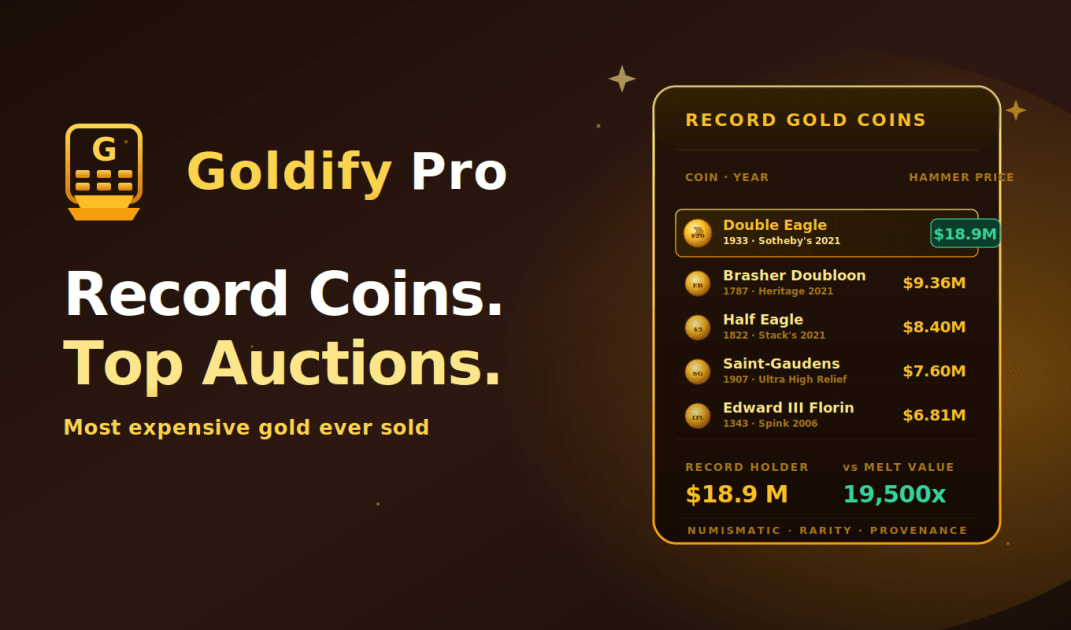
The single most valuable coin ever sold. The 1933 $20 Saint-Gaudens Double Eagle was struck but never officially released — Roosevelt called in the gold and the entire mintage was supposed to be melted. One coin escaped, passed through King Farouk of Egypt, was seized by the US Secret Service in 1996, ruled legal in a famous 2002 settlement, and was finally sold at Sotheby's in 2021 for $18.9 million.
Advertisement
2. 1787 Brasher Doubloon (EB on Wing) — $9.36 million (2021)
Struck privately by goldsmith Ephraim Brasher, this is widely considered the first US-made gold coin. The 'EB on Wing' variant is unique. It sold for $9.36 million at Heritage Auctions in 2021.
3. 1822 Half Eagle — $8.4 million (2021)
Only three examples are known. Two are in the Smithsonian. The third — graded PCGS AU-50 — sold in March 2021 for $8.4 million at Stack's Bowers.
4. 1804 Plain 4 Eagle — $5.0 million (2007)
The 1804 $10 gold Eagle is one of the most enigmatic US coins — most were struck several years after the date on the coin. Only three are known. A Proof example sold in 2007 for $5 million.
Advertisement
5. 1343 Edward III Gold Florin (Double Leopard) — ~$6.8 million (2006)
Only three examples are known. The coin was withdrawn from circulation within months because its face value did not match its gold weight — making it an immediate financial mistake but a five-century numismatic prize.
6. 723 AD Umayyad Dinar — ~$6.0 million (2011)
Struck in 105 AH (723 CE), this gold dinar bears the legend 'mine of the Commander of the Faithful'. It sold at a London auction for £3.7 million (~$6 million) and remains one of the most valuable Islamic coins ever sold.
7. EID MAR Aureus (Brutus, 42 BC) — $4.2 million (2020)
A gold version of the famous silver EID MAR coin commemorating Julius Caesar's assassination sold for £3.24 million ($4.2 million) at Roma Numismatics in October 2020.
Advertisement
8. 1822 Half Eagle (Pogue) — $4.32 million (2014)
A different specimen of the 1822 rarity from the Pogue collection sold for $4.32 million in 2014, illustrating how a single date can have multiple separately-tracked rarities.
9. 1907 Ultra High Relief Double Eagle — $2.99 million (2005)
Saint-Gaudens' masterpiece was struck experimentally with such high relief that ordinary commerce was impossible. Roughly 22 examples are known. The finest sold for $2.99 million in 2005.
10. Indian Mughal Mohur (Akbar, Jahangir era) — $250K–$2M each
Mughal gold mohurs, particularly the zodiac series of Jahangir (1611–1618) and the presentation pieces of Akbar, regularly sell in the $250,000–$2 million range. The Hyderabad 1000 Mohur (1670s) — roughly 12 kg of gold — has been valued at over $5 million.
11. 1854-S $5 Half Eagle — $2.16 million (2018)
Only three are known. The 1854 San Francisco half eagle represents the earliest gold rush mintage of this denomination.
12. 1907 Indian Head Eagle (Wire Rim) — $2.18 million (2011)
Another Saint-Gaudens experimental design. The Wire Rim variant is among the most coveted US $10 gold issues of the 20th century.
13–15. Multi-ducat strikes, presentation mohurs, German states
Multiple-ducat gold strikes from Venice, Hungary and the Holy Roman Empire — particularly 50- and 100-ducat presentation pieces — regularly sell for $500,000 to $3 million. Their combination of heavy gold weight, intricate engraving, and tiny populations makes them perpetual auction headliners.
Top records (summary table)
| Coin | Year struck | Sale price | Year sold | House |
|---|---|---|---|---|
| 1933 Double Eagle | 1933 | $18.9M | 2021 | Sotheby's |
| 1787 Brasher Doubloon | 1787 | $9.36M | 2021 | Heritage |
| 1822 Half Eagle | 1822 | $8.4M | 2021 | Stack's Bowers |
| 1343 Edward III Florin | 1343 | $6.8M | 2006 | Spink |
| 723 AD Umayyad Dinar | 723 | $6.0M | 2011 | Morton & Eden |
| 1804 Plain 4 Eagle | 1804 | $5.0M | 2007 | Heritage |
| 1822 Half Eagle (Pogue) | 1822 | $4.32M | 2014 | Stack's Bowers |
| EID MAR Aureus | 42 BC | $4.2M | 2020 | Roma Numismatics |
| 1907 UHR Double Eagle | 1907 | $2.99M | 2005 | Heritage |
| 1907 Indian Head Eagle (Wire Rim) | 1907 | $2.18M | 2011 | Heritage |
| 1854-S $5 Half Eagle | 1854 | $2.16M | 2018 | Heritage |
What makes a gold coin extremely valuable?
- 1.Rarity — single-digit known examples (the lower, the higher the premium).
- 2.Provenance — famous prior owners (Farouk, Eliasberg, Pittman, Pogue) add 20–50%.
- 3.Condition — graded by PCGS or NGC; an MS65 sells for many times an MS62 of the same coin.
- 4.Historical significance — coins tied to specific events (EID MAR) or first-of-kind issues.
- 5.Strike quality and design — Saint-Gaudens designs command higher premiums than plain bullion.
- 6.Original luster — never-cleaned coins are worth 2–10× cleaned equivalents.
- 7.Eye appeal — a subjective premium experienced collectors pay above raw technical grade.
- 8.Pedigree continuity — coins with continuous documented ownership since the 19th century carry premiums.
The Sheldon grading scale
| Grade | Description | Value vs MS-60 |
|---|---|---|
| P-1 to F-12 | Poor to Fine | Melt value only |
| VF-20 to EF-40 | Very Fine to Extremely Fine | ~10–30% of MS |
| AU-50 to AU-58 | About Uncirculated | ~30–70% of MS |
| MS-60 to MS-63 | Lower Mint State | Baseline |
| MS-64 to MS-65 | Choice Mint State | 1.5–4× |
| MS-66 to MS-67 | Gem Mint State | 5–20× |
| MS-68 to MS-70 | Superb Gem to Perfect | Often 50×+ |
PCGS vs NGC vs ANACS
Professional Coin Grading Service (PCGS) and Numismatic Guaranty Company (NGC) dominate the market. ANACS is third. For rare US gold, PCGS-graded examples typically trade at a small premium over NGC equivalents; NGC dominates world-coin grading. Always insist on a tamper-evident grading slab before paying numismatic prices.
Famous prior owners (provenance that moves price)
- Louis E. Eliasberg Sr. — the only person ever to assemble a complete US coin collection.
- John Jay Pittman — schoolteacher whose collection sold for $30M total.
- D. Brent Pogue — a 1930s-era family collection that set multiple records in 2015–2017.
- King Farouk of Egypt — collected the 1933 Double Eagle; his 1954 estate sale dispersed treasures globally.
- Norman Stack & Harvey Stack — multi-generational NY dealers whose name on a pedigree alone adds value.
How to value an old gold coin you own
- 1.Identify the coin (year, mint mark, country, denomination).
- 2.Check melt value: weight × purity × today's spot gold price.
- 3.Look up auction records on PCGS CoinFacts, NGC Coin Explorer, or Heritage Auctions archive.
- 4.Get the coin graded by PCGS or NGC before listing if it might exceed melt.
- 5.Compare numismatic value to melt — sell to a numismatic buyer if premium is significant; otherwise to a bullion dealer.
- 6.Never clean the coin. Cleaning can destroy 50–90% of numismatic value instantly.
Premium % = ((Sale price − Melt value) / Melt value) × 100For a common Krugerrand this is around 3–5%. For a 1933 Double Eagle it is over 1,000,000%.
Storage, insurance and tax considerations
Rare gold coins are insurable assets that often need scheduled coverage. Specialist insurers (Hugh Wood, Lloyd's syndicates) write coverage by coin schedule. Tax treatment varies: the US treats numismatics as collectibles (28% federal capital gains); the UK exempts legal-tender Sovereigns and Britannias. Always consult a local tax advisor.
Where to buy and sell rare gold coins
- Heritage Auctions — largest US numismatic auction house by volume.
- Stack's Bowers — long history with US rarities.
- Sotheby's & Christie's — top-tier marquee single-lot sales.
- Spink (London) — strong in British and world coinage.
- Künker (Osnabrück) — leading European house for German states and Habsburg pieces.
- Morton & Eden — specialist for Islamic and Indian gold.
- Authorized PCGS / NGC dealers — retail channel for graded coins.
Counterfeit warning
High-quality Chinese counterfeits of US $20 Saint-Gaudens and Liberty Head gold coins have circulated since the early 2010s. Many pass weight, diameter and magnetic tests. Never pay numismatic premium for a coin not certified by PCGS, NGC or another globally recognized service.
Frequently asked questions
What is the most expensive gold coin ever sold?
The 1933 US Double Eagle, sold at Sotheby's in June 2021 for $18.9 million — a world record for any coin.
Are old gold coins a good investment?
Numismatic coins can appreciate well but require expertise, take time to sell, and have wider spreads than bullion. Most investors keep numismatics separate from their bullion allocation.
Why was the 1933 Double Eagle illegal for so long?
Roosevelt's 1933 executive order recalled all gold; the 1933 mintage was never legally released. The Farouk specimen was ruled exempt in a 2002 settlement.
Does cleaning a coin destroy its value?
Yes — almost always. Cleaning leaves hairlines and changes original surfaces, which graders detect easily. Cleaned coins can lose 50–90% of their value.
What's the cheapest way to start collecting?
Common-date pre-1933 US gold ($5, $10, $20 issues) in MS-62 to MS-63 can be acquired for 30–50% over melt — 'starter' graded coins that introduce buyers to the slabbed market.
Is the numismatic gold market liquid?
Less so than bullion. Retail bullion sells in hours; rare gold coins often take weeks to months to achieve fair price, especially through major auctions.
Advertisement
Disclaimer
Forecast and financial-advice disclaimer
Numismatic prices are illiquid, volatile and subject to fashion. This article is for general information and does not constitute investment, tax or appraisal advice. Always work with a licensed appraiser and grading service.
Editorial disclaimer
Auction prices are rounded and sourced from public records of Heritage Auctions, Sotheby's, Stack's Bowers and the relevant grading services. Live bullion rates appear on the Goldify Quick Rates page.
Originality and AI policy
Researched and written by the Goldify editorial team. All record prices are cross-checked against public auction archives. We do not publish unedited AI output.
Advertisement
Tools mentioned in this article
Advertisement


