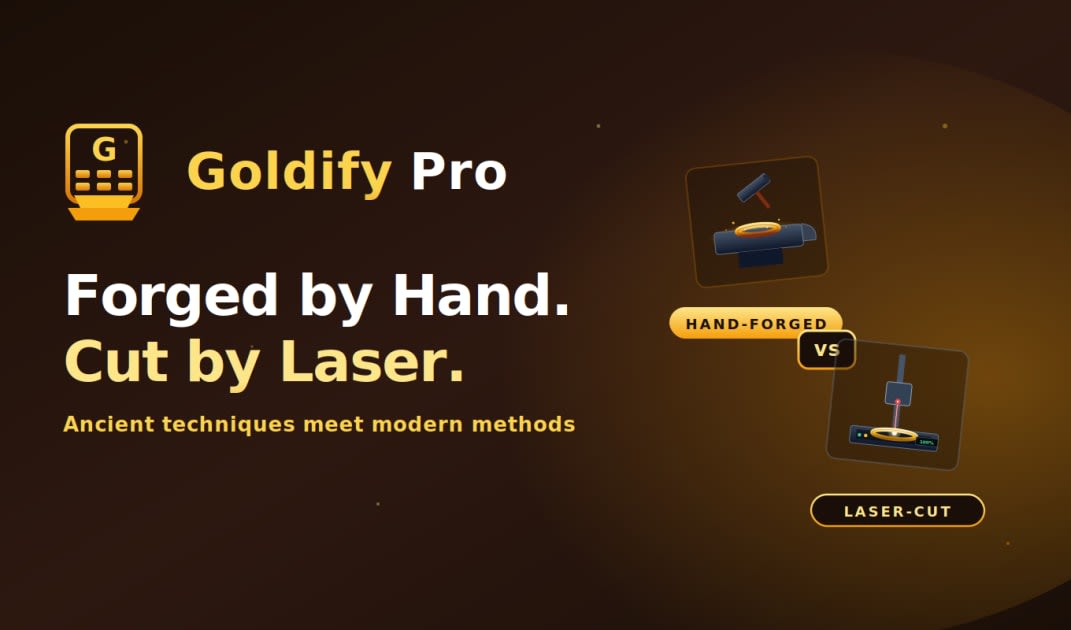
Gold Making: Traditional Craftsmanship vs Modern Methods
How was gold jewellery made 5,000 years ago — and how is it made today? A complete guide comparing traditional craftsmanship techniques (lost wax casting, filigree, granulation, kundan, jadau, meenakari) with modern manufacturing (CAD/CAM, 3D printing, laser welding, electroplating).
Advertisement
Hold a piece of gold jewellery in your hand and you are holding the end product of one of humanity's oldest crafts. Goldsmiths have been shaping gold for over five thousand years — first with hammers and fire, later with intricate wire work and stone settings, and today with computer-aided design, 3D printing and laser welding. The techniques have evolved enormously, but every era has produced jewellery worth keeping. This guide compares the traditional craftsmanship methods that built the great gold jewellery traditions of India, Turkey, Italy and Egypt with the modern manufacturing methods that now produce most of the world's commercial jewellery — so you can recognise both, appreciate both, and choose the right kind for your purchase.
Quick verdict
TL;DR
Traditional gold making is hand-crafted — every piece takes days or weeks, no two are identical, and the craft is centuries old. Modern manufacturing uses CAD design, 3D-printed wax models, investment casting and laser tools to produce consistent pieces at scale. Neither is universally 'better' — traditional pieces carry irreplaceable craftsmanship and cultural value; modern pieces offer precision, design freedom and lower cost. The smartest buyers know how to recognise both.
Advertisement
A short history of gold making
Gold was one of the first metals worked by humans. Archaeological evidence shows goldsmithing in Mesopotamia, Egypt and the Indus Valley as far back as 4,000 BCE. The Egyptians mastered granulation and inlay; the Etruscans perfected gold-bead work so fine it remains unreproducible today; medieval Indian artisans developed kundan and jadau under royal patronage; Italian Renaissance jewellers raised filigree to an art form. The Industrial Revolution introduced steam-powered tools and roll mills. The 20th century brought investment casting, electroplating and mass production. The 21st century brought CAD, 3D printing, laser welding and computer-controlled machining. Each shift made jewellery faster and more affordable — but the hand-made traditions never disappeared.
Traditional gold making techniques — the timeless craft
Traditional gold making is defined by what is NOT used — no computers, no laser, no CNC. Every piece begins with raw gold, a few simple tools, and decades of skill in the hands of a karigar (artisan). The techniques below are all still practised today, often by families that have passed the craft down through generations.
1. Hammering and forging
The oldest gold-shaping technique on earth. A goldsmith heats a gold ingot, then carefully hammers it on an anvil to flatten, stretch or shape it. Heat-and-hammer cycles are repeated dozens of times — heating relieves the work-hardening that gold develops as it is shaped. Hammering is still used today for the base form of bangles, simple bands, and the metal sheets from which other techniques begin.
Advertisement
2. Traditional lost-wax casting
Used in ancient Egypt, India and Mesoamerica. The artisan sculpts a model of the piece in beeswax, surrounds it with clay or plaster to form a mould, melts the wax out (the 'lost' wax), and pours molten gold into the cavity. Once cooled and the mould broken, a near-perfect copy of the original wax model emerges. This method is responsible for thousands of ancient Indian and Egyptian gold figurines, idols and decorative pieces. Modern investment casting is the industrial descendant of this exact technique.
3. Filigree (tarkashi / Telkari)
Filigree is the art of working gold into hair-thin wires, then twisting, curling and soldering them into delicate openwork patterns. Major centres for filigree include Karimnagar (Telangana, India), Cuttack (Odisha, India), Mardin (Turkey), and Sardinia (Italy). A single intricate filigree pendant can take a master craftsman 30–80 hours to complete by hand. Modern CAD-printed versions exist but rarely match the depth and texture of true hand-pulled filigree.
4. Granulation
Tiny spheres of gold (sometimes finer than a grain of sand) are fused onto a gold surface to form geometric or floral patterns. The Etruscans mastered granulation 2,500 years ago to a level of fineness that 19th-century jewellers spent decades trying to recreate. The technique requires perfect heat control — too hot and the granules melt into the base; too cool and they refuse to bond. Modern granulation is rare and largely the work of specialist artist-jewellers.
Advertisement
5. Repoussé and chasing
Two complementary techniques. Repoussé works the metal from the back (reverse) side, pushing it outward with hammers and punches to create raised relief. Chasing works from the front side, refining detail into the pushed-out shape. Together they produce three-dimensional decorative panels — temple jewellery, ceremonial vessels and traditional Pakistani and Indian wedding ornaments often use these techniques. The work is slow; a single repoussé panel can take a craftsman weeks.
6. Hand engraving
Designs are cut into the gold surface using small chisels called burins. A skilled engraver controls depth, line weight and direction by hand, producing patterns no laser can fully replicate because of the subtle human variation that gives hand-engraving its character. Personalised wedding bands, monograms and traditional Mughal-era jewellery often feature hand engraving. The skill takes years to master.
7. Meenakari — enamel work on gold
Meenakari originated in Persia and was brought to India in the 16th century by Mughal patronage. Powdered coloured glass (enamel) is applied into engraved hollows on a gold surface and fired at high temperature; the glass melts and fuses to the gold, producing brilliant colours that never fade. Jaipur is the heart of Indian meenakari today, and meenakari often appears on the reverse side of kundan pieces — visible only when removed.
8. Kundan and jadau setting
Kundan is a uniquely Indian stone-setting technique in which uncut or rose-cut precious stones (polki diamonds, emeralds, rubies) are embedded in pure 24K gold foil. The foil is highly malleable and is shaped around each stone by hand, holding it in place without modern prongs or claws. Jadau ('embedded') jewellery combines kundan with meenakari on the reverse — a pinnacle of Mughal-era craftsmanship. A single elaborate jadau necklace can take months to complete.
9. Temple jewellery (Nakshi work)
Originating in South Indian temple traditions, nakshi work involves intricate hand-carved figurative motifs — deities, peacocks, lotus flowers — formed in solid gold. Worn historically by temple dancers and royalty, nakshi pieces remain a signature of South Indian wedding jewellery today, particularly in Tamil Nadu, Karnataka and Andhra Pradesh.
Tools of the traditional goldsmith
- Anvil (Niharani) — small steel base for hammering.
- Hammers in dozens of sizes for different forming actions.
- Files of different cuts for shaping and finishing.
- Wire-drawing plates with progressively smaller holes.
- Charcoal blocks and a hand bellows or blow-pipe for soldering.
- Burins (gravers) for hand engraving.
- Pitch bowl — a heated pitch surface to hold the workpiece for repoussé.
- Tweezers, dapping punches, polishing wheels with rouge and beeswax.
Modern gold making techniques — precision at scale
Modern jewellery manufacturing did not replace traditional goldsmithing — it sits alongside it. Where traditional craftsmanship is slow, expensive and unique, modern methods deliver design freedom, precision and consistency at scale. Most commercial jewellery sold today — by mass-market brands, supermarket chains, online retailers and even many high-end designers — uses one or more modern techniques.
1. CAD / CAM design
Modern jewellery design begins on a computer. CAD (Computer-Aided Design) software lets designers model rings, pendants and bracelets in three dimensions, rotate them, adjust gemstone settings, and visualise the finished piece before a single gram of gold is melted. CAM (Computer-Aided Manufacturing) then translates the digital file into instructions for the next step — usually 3D printing or CNC carving. This step alone has transformed the industry; one designer can now produce dozens of designs per week that would have taken a traditional master craftsman months.
2. 3D printing (resin and wax)
A 3D printer reads the CAD file and prints a precise resin or wax model of the piece, accurate to a fraction of a millimetre. Modern jewellery 3D printers use stereolithography (SLA) or DLP technology to print models with surface finishes so smooth they rarely need post-processing. The printed model then goes to investment casting (next step) just like a hand-carved wax model would. 3D printing has dramatically reduced the cost and time of new design iterations — a custom engagement ring that once took weeks can now be ready in days.
3. Investment casting (modern lost-wax)
Industrial lost-wax casting is the most common method for producing gold jewellery today. The 3D-printed or hand-sculpted wax model is encased in a special plaster compound called investment. The plaster is fired to harden it and burn out the wax. Molten gold is then poured (or vacuum-injected, or centrifugally cast) into the resulting cavity. After cooling and breaking off the investment, multiple identical gold pieces emerge. Modern investment casting can produce intricate designs in alloys ranging from 9K to 24K, in yellow, white or rose gold.
4. CNC machining
Computer Numerical Control (CNC) machines cut gold blanks into precise shapes using rotating cutting tools controlled by software. CNC is used for ring shanks, watch components, and pieces where extreme geometric precision matters more than intricate organic detail. The technology produces consistent, repeatable results impossible to achieve by hand.
5. Laser welding and cutting
Laser welding has revolutionised modern jewellery making. A focused laser beam fuses two pieces of gold with millimetre precision, no flux required, and almost no heat damage to surrounding metal. Stone-set jewellery can now be repaired without removing stones — impossible with traditional torch soldering. Laser cutting produces clean edges on filigree-like patterns at speed. Most modern repair work and many designer pieces depend on laser tools today.
6. Electroforming
Electroforming builds up a layer of gold around a model using electric current and a gold-bearing solution. The model is dissolved out at the end, leaving a hollow gold shell. This produces large lightweight pieces — chunky hollow earrings, big chains and statement jewellery — with a fraction of the gold weight of solid pieces. The result is gold jewellery that looks substantial but is much cheaper because less gold is used. Common in modern fashion jewellery.
7. Die-striking and stamping
Hardened steel dies are pressed against gold sheet under high tonnage to stamp out shapes — coin blanks, charms, pendants, and base shapes for further work. Die-struck gold has a tighter molecular structure than cast gold, making it harder, more durable and longer-lasting under daily wear. Many traditional wedding-band styles are produced this way; high-end watch components also use die-striking.
8. Electroplating
Electroplating coats a base metal (often brass, silver or copper) with a thin layer of gold using electric current. Used widely for costume jewellery, fashion pieces, and some affordable wedding jewellery. The plating layer is thin — typically 1–5 microns — and wears off over time with use. Pieces marked 'gold-plated' or 'GP' use this method. It is also the technique behind rhodium plating on white gold.
9. Computer-controlled engraving
Laser engraving and CNC engraving machines cut precise patterns, names, dates and serial numbers into gold surfaces in seconds. The results are absolutely uniform, ideal for branded jewellery, hallmark stamping, BIS HUID codes and wedding-band personalisation. Less expressive than hand engraving but far more consistent.
Modern manufacturing tools
- CAD workstations running specialised software (Rhino, Matrix, JewelCAD).
- 3D resin and wax printers (SLA / DLP).
- Investment casting machines (vacuum or centrifugal).
- Laser welders, laser cutters, laser engravers.
- CNC milling and turning machines.
- Ultrasonic cleaners.
- Pneumatic engraving systems.
- XRF analysers for instant purity verification.
- Digital jeweller's scales accurate to 0.001 g.
Traditional vs modern — side-by-side comparison
| Factor | Traditional | Modern |
|---|---|---|
| Design process | Sketch on paper, hand-developed | CAD software, 3D rendered |
| Model making | Hand-carved beeswax or direct metal | 3D-printed resin / wax |
| Production method | Hammer, file, hand-solder, hand-set | Investment casting, CNC, laser |
| Time per piece | Days to months | Hours to days |
| Consistency | Each piece unique (small variations) | Identical replicas possible |
| Detail precision | Reflects the artisan's skill | Mechanically precise |
| Cost (labour share) | Very high — labour dominates | Lower — automation reduces labour |
| Cultural value | High — preserves craft heritage | Modern, brand-driven |
| Repairability | Easy by any skilled goldsmith | Sometimes requires laser tools |
| Customisation flexibility | High but slow | High and fast |
| Volume capability | Limited (one-off / small batch) | Mass production possible |
| Best for | Heirloom pieces, traditional weddings, artistic value | Engagement rings, daily-wear designer pieces, fashion jewellery |
Quality differences — what really changes
Modern casting can produce pieces with slightly higher porosity (tiny internal voids) than die-struck or hand-forged jewellery — meaning cast pieces can occasionally wear down faster than equivalent forged ones. But casting allows complexity impossible to forge by hand. Hand-made pieces are typically denser, more durable and carry character that machines cannot replicate. Neither is intrinsically 'higher quality' — the right method depends on the piece. A delicate filigree pendant is best hand-made; a perfectly symmetrical engagement-ring shank is best CNC-cut.
Cost differences — where the money goes
On a like-for-like gold-weight basis, a hand-made traditional piece is significantly more expensive than its modern-manufactured equivalent. The difference is almost entirely labour — a master craftsman's time is irreplaceable. A 30-gram kundan necklace can take 200+ hours of artisan work; the same gold weight in a modern cast pendant takes a fraction of the labour. This is why hand-made traditional jewellery commands a clear premium across South Asia, Turkey and Italy — and why the labour cost of a kundan piece can exceed the gold cost in some cases.
Famous traditional craftsmanship hubs
- Jaipur (India) — kundan, jadau, meenakari, polki diamond setting.
- Hyderabad (India) — uncut diamond jewellery and Nizam-era heritage designs.
- Karimnagar (India, Telangana) — silver and gold filigree.
- Cuttack (India, Odisha) — Tarakasi filigree work.
- Chennai and Madurai (India, Tamil Nadu) — temple jewellery, nakshi work.
- Lahore and Peshawar (Pakistan) — kundan, traditional bridal sets.
- Mardin (Turkey) — Telkari filigree tradition.
- Sardinia (Italy) — Sardinian filigree (filigrana sarda).
- Vicenza and Arezzo (Italy) — chain and goldsmithing centres.
- Cairo and Damascus — traditional Middle Eastern repoussé and engraving.
Famous modern manufacturing centres
- Vicenza and Arezzo (Italy) — global hubs for designer modern jewellery.
- Bangkok (Thailand) — high-volume cast jewellery for global fashion brands.
- Hong Kong and Shenzhen — modern Asian jewellery manufacturing.
- Mumbai and Surat (India) — large-scale modern manufacturing alongside diamond cutting.
- Geneva and Le Locle (Switzerland) — luxury watch jewellery, ultra-precision finishing.
- Istanbul (Turkey) — large modern manufacturing for European retail.
How to tell if a piece is hand-made or machine-made
- Slight asymmetry — hand-made pieces have tiny human variations; machine-made are perfectly symmetric.
- Tool marks under magnification — files, gravers and burins leave traces invisible to the naked eye.
- Solder joints — traditional joints are slightly visible under a loupe; laser welds are nearly seamless.
- Casting porosity — small pinholes on the inside surfaces suggest investment casting.
- Filigree depth — true hand-pulled filigree wire has variable thickness; printed filigree is uniform.
- Weight relative to size — electroformed pieces feel surprisingly light for their volume.
The hybrid future — both worlds combined
The most exciting work in modern jewellery is the hybrid approach — designers using CAD and 3D printing for the structural base of a piece, then handing it to traditional artisans for kundan setting, meenakari finishing, or hand-engraved detail. The base is precise and consistent; the surface carries the soul of human craftsmanship. Some of the finest contemporary Indian and Italian jewellery is made this way today. The future of gold making is not traditional OR modern — it is both.
Which technique should you buy?
| Goal | Best technique |
|---|---|
| Heirloom wedding jewellery | Hand-made (kundan, jadau, filigree, temple work) |
| Engagement ring with diamond | Modern (CAD + investment cast + laser-set) |
| Daily-wear designer chain | Modern (cast or die-struck) |
| Cultural / festival jewellery | Hand-made traditional |
| Affordable fashion piece | Modern (cast or electroformed) |
| Lightweight statement jewellery | Modern (electroformed) |
| Custom one-of-a-kind piece | CAD design + hand-finished by artisan |
Common myths — busted
| Myth | Reality |
|---|---|
| Hand-made gold is always better quality | Hand-made shines in artistry; machine-made wins on precision. Quality depends on the piece. |
| Cast jewellery is fragile | Modern investment casting produces strong pieces. Most engagement rings are cast. |
| Traditional kundan jewellery is mass-produced | Real kundan/jadau remains hand-made; only the imitations are machine pieces. |
| 3D-printed jewellery is plastic | 3D printers print the wax/resin model. The final piece is still solid gold cast from it. |
| Hand-engraving is identical to laser-engraving | Hand-engraving has variable depth and human character; laser is uniform. |
Machines made gold cheaper. Hands made gold meaningful. The smartest jewellers learned to use both.
Common mistakes to avoid
- 1.Paying hand-made prices for a machine-made piece — verify with the jeweller and a magnifier.
- 2.Refusing all machine-made jewellery on principle — modern techniques produce excellent results.
- 3.Assuming traditional means lower karat — kundan is always set in 24K foil.
- 4.Buying electroformed pieces for long-term investment — gold weight is low even though volume looks impressive.
- 5.Confusing gold-plated with solid gold jewellery — they are entirely different products.
- 6.Overlooking labour cost when budgeting for hand-made heirloom pieces.
- 7.Not verifying the hallmark stamp regardless of how the piece was made.
The bottom line
Gold making has travelled from the goldsmith's anvil 5,000 years ago to the 3D printer in the back office of a modern jeweller — and both approaches are still alive. Traditional techniques like kundan, jadau, meenakari, filigree and lost-wax casting preserve craftsmanship that machines cannot replicate. Modern manufacturing — CAD, 3D printing, investment casting, laser welding — delivers precision, design freedom and affordability. The best gold buyers know how to recognise both, value both, and choose the right one for the piece they want. Whether your jewellery comes from a master karigar's pitch bowl or a polished casting machine, the gold inside is the same — and the only difference that matters is the one you can see, feel and treasure for life.
Stay informed
Bookmark Goldify Quick Rates for live 24K, 22K, 21K and 18K gold prices in tola, gram, masha and ratti — refreshed every minute, in your local currency. Use the Goldify converters to verify any quote at the counter.
Advertisement
Disclaimer
Editorial & content disclaimer
This article is original, human-written content created exclusively for Goldify by our editorial team. It is intended for general educational, cultural and informational purposes only and does not constitute appraisal, investment, financial, tax or legal advice. Traditional gold-making techniques described — kundan, jadau, meenakari, filigree, granulation, repoussé, nakshi work, temple jewellery and others — refer to widely recognised craft traditions; specific historical attributions, regional variations and contemporary practice may vary. Modern manufacturing technologies (CAD/CAM, 3D printing, investment casting, CNC, laser welding, electroforming, electroplating) are described in general terms; specific equipment, software, methods and quality outcomes vary by manufacturer and country. References to craft hubs, brand names, mints, refiners and authorities describe widely reported public information. Goldify is not affiliated with any artisan, workshop, jeweller, manufacturer, brand, association or platform mentioned. We do our best to keep information accurate but make no warranty of completeness or fitness for any purpose. By reading this article you agree that Goldify is not liable for any decision you take based on its contents.
Originality & AI policy
This article was written and edited by humans on the Goldify editorial team. Research, examples and analysis were prepared in-house. We do not republish or scrape content from other websites. If you believe any portion of this article infringes a copyright, please contact us at gold@goldify.pro and we will review it promptly.
Advertisement
Tools mentioned in this article
Advertisement


