Gold Market Blog
Expert guides on gold pricing, karat purity, weight conversions and jewellery tips for 104 countries.
9
Articles
11
Languages
104
Countries
 Gold Market9 min
Will the Israel–Iran Conflict Push Gold Even Higher?
Gold spiked past $5,400 when the US and Israel struck Iran — then gave it all back. So will the Israel–Iran conflict push gold even higher? Here's what history, oil, and gold's real drivers say about war premiums, ceasefires, and where prices go next.
 Gold Market7 min
What If the Stock Market Crashes? Gold's Real Response
If equities collapse overnight, will gold save you — or fall with everything else? The honest answer surprises most investors. Here's how gold behaves in the first hours, the first weeks, and the full arc of a market crash, with what to do at each stage.
 Gold Market8 min
Why Investors Panic Buy Gold During Economic Chaos
When financial systems shake, millions of people rush to buy gold simultaneously. Mints sell out. Premiums spike. Dealers queue buyers for weeks. Why does this happen — and what does it mean for gold prices and smart investors?
 Gold Market7 min
Is a Financial Crisis Coming? What Gold Investors Watch
Global debt has hit $315 trillion. Banking systems carry hidden stress. Gold investors are quietly watching a set of indicators that historically precede financial crises. Here is what they are tracking — and what it means for gold.
 Gold Market5 min
Sovereign Debt Crisis 2026: Will Gold Become the Only Safe Asset?
Global public debt has crossed $92 trillion — the highest level since WWII. With G7 deficits widening, Treasury auctions weakening and AAA ratings falling, 2026 carries real sovereign-debt stress risk. Why gold is treated by central banks as the only asset that survives every prior reset.
 Gold Market7 min
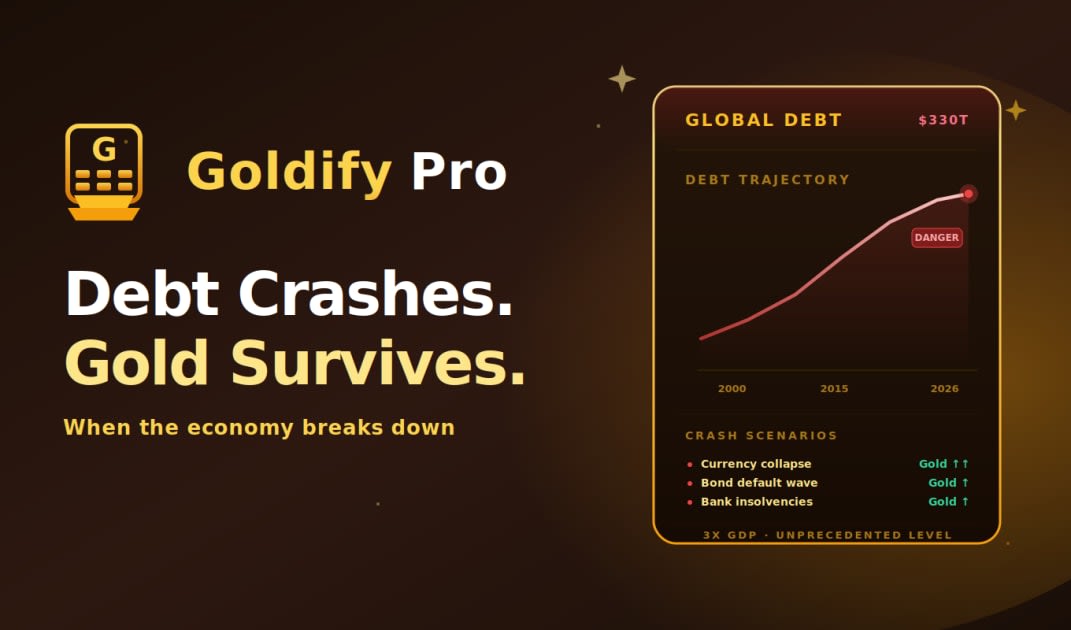
What Happens If Global Debt Crashes the Economy? Gold's Role When Sovereign Debt Becomes Unmanageable
Global debt has reached $315 trillion — over 333% of world GDP. What happens to your savings if a major sovereign defaults, central banks lose bond-market control, or a debt-deflation spiral takes hold? The historical playbook, the modern risks, and why gold has survived every prior debt crisis.
Advertisement
 Gold Market7 min
Why Gold Performs During Economic Crashes: A 100-Year Pattern Explained
From 1929 to 2008 to 2020, gold has repeatedly outperformed during recessions, banking crises and market crashes. Here is the 100-year historical evidence, the three mechanisms behind it, the times the pattern has failed — and how much gold actually reduces a portfolio's drawdown.
 Gold Market8 min
What Happens If the US Dollar Collapses? Gold's Role in a Worst-Case Scenario
A clear-eyed look at what a real US dollar collapse would mean — hyperinflation risk, bond market shock, global trade fallout, BRICS de-dollarization, CBDCs, country case studies and why physical gold has historically protected savers when fiat money loses public trust.
 Gold Market12 min
How Wars and Global Crises Affect Gold Prices (Complete Historical Guide)
Gold has been the world's safe-haven asset for thousands of years. A complete guide to how wars, financial crises and geopolitical shocks affect gold prices — covering historical examples from WW2 to 2022 Ukraine and how to position gold for crisis periods.
Why Gold Market Coverage Matters in 2026
Gold is one of the few assets that simultaneously functions as a currency, a commodity, and a financial safe haven. Its price responds to central bank policy, inflation expectations, geopolitical events, and shifts in the US dollar — making it one of the most complex markets to track. The Goldify Pro blog covers these drivers in plain language, helping readers in over 104 countries understand why the gold price moves and what it means for their local currency value.
Whether you follow the live gold rate in Pakistan, track the gold rate in India, or monitor prices across the Gulf, every article here connects real-time market data to the real-world decisions jewellers, investors, and buyers make every day.
From Spot Price to Jewellery — Practical Gold Knowledge
Understanding the international spot price is only half the picture. To apply it to real transactions, you need to convert troy ounces to tolas, grams, or mashas, then adjust for karat purity (24K, 22K, 18K) and local making charges. Our Gold Reference Guide explains every conversion formula and purity standard used in the trade, while our live gold converters apply them in real time using the current spot price.
Blog articles tagged Gold Education and Gold Guide specifically bridge the gap between market data and practical jewellery-trade knowledge — covering topics like hallmarking, polish loss calculation, and how buying at different karat grades affects long-term value retention.
Historical Context — Gold Prices Since 1970
The gold market has lived through oil shocks, the collapse of Bretton Woods, the 2008 financial crisis, COVID-19, and multi-decade inflation cycles. Each of these events left a distinct fingerprint on the gold price chart. Our historical gold price analysis archives daily data back to January 1, 1970 — giving readers the long-run context that's missing from 30-day charts. Blog articles in the Gold Investment and Gold Market categories draw on this data to explain where we are in the current cycle and what prior market episodes suggest about what comes next.
About This Blog · Reader FAQ
About blogs in general
What is a blog?
A blog is a regularly-updated online journal where writers publish articles in reverse chronological order. Unlike static reference sites, a blog adds ongoing commentary — blending reporting, opinion, explainers and how-to guidance written by someone with first-hand expertise.
Why do people read blogs?
Blogs go deeper than news headlines and stay more current than reference books. Readers want context — not just what happened, but why it matters, how it fits the bigger picture, and what to do about it. Good blogs cut through noise and make complex markets legible.
How is a blog different from news?
News reports what happened. Blogs explain what it means. A news article tells you gold hit a new high; a Goldify Pro blog post explains the seasonal, monetary and geopolitical forces that drove it there — and whether that high is likely to hold or reverse.
How often should you read blogs?
For gold pricing, weekly reading is usually enough to stay informed without daily-volatility overload. Save deeper dives — multi-year analyses, buying guides, karat purity explainers — for when you're actually making a financial or jewellery purchase decision.
About Goldify Pro
Why follow Goldify Pro?
Gold prices move every minute, but the reasons behind those moves take longer to explain than a ticker line. Goldify Pro tells you whether a weekly jump was driven by a Fed pivot, a dollar selloff, central-bank buying, or geopolitical tension — and whether it is likely to extend.
What topics does the blog cover?
Six core themes: live gold rates in 100+ currencies with karat and weight conversions; central-bank policy; market structure (LBMA, COMEX, ETFs); technical analysis; macro and crisis history; and industrial applications (gold in satellites, semiconductors, medical devices).
Who writes Goldify Pro's articles?
Every post is written and edited by Salman Saleem, founder of Goldify Pro — a software engineer and family jeweller with over a century of family heritage in the gold trade, analysing XAU/USD spot trends since 2014.
How are live rates and figures sourced?
Live spot prices update every 60 seconds from the international XAU/USD market with real-time FX conversion. Historical figures are cited from LBMA, World Gold Council, IMF, BIS, and USGS. See our editorial policy for how each piece is produced and corrected.
Advertisement
Editorial Policy
Goldify Pro Editorial Team
VerifiedGold market analysts & weight-conversion specialists
Last reviewed: October 13, 2026·Updated continuously
Content verification
Sourcing
Primary sources only. We never republish numbers from secondary aggregators without verifying the original data.
Corrections
Factual errors acknowledged within 24 hours and corrected within 72 hours. Significant changes carry a visible update note.
Independence
No paid placements, no sponsored content, no editorial influence from advertisers or third parties.