Why China and Russia Are Buying More Gold: The Strategic Story (2026 Guide)
China and Russia have been among the most aggressive gold accumulators in modern history — driven by sanctions risk, de-dollarization, and strategic positioning against US dollar dominance. A complete guide to their motivations and what it means for investors.
Advertisement
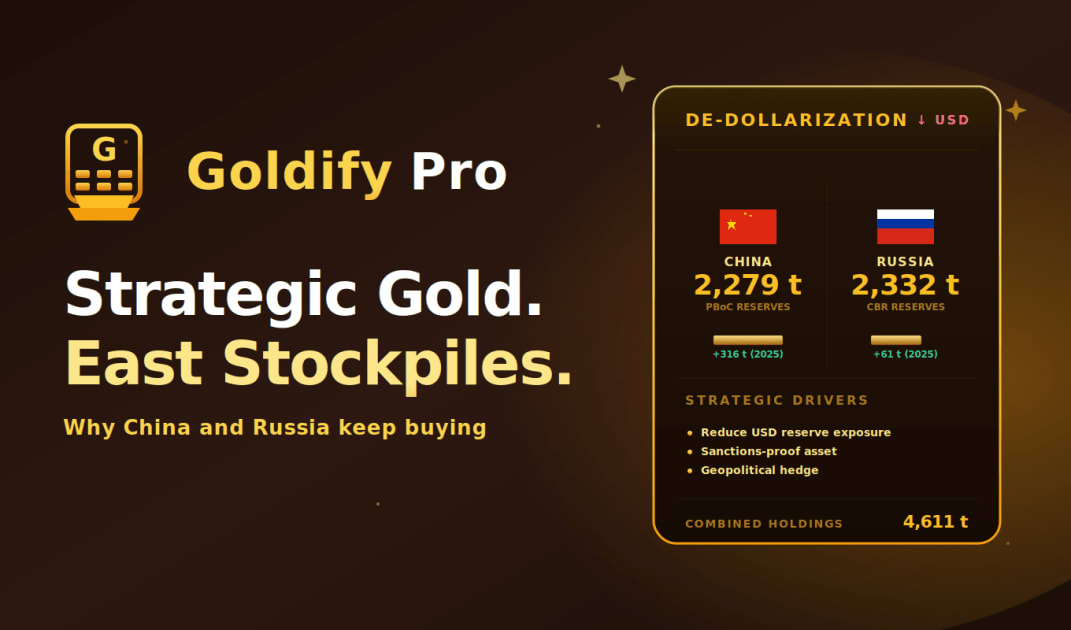
China and Russia have been the most strategically aggressive gold accumulators of the past two decades. Together they have likely added thousands of tonnes of gold to their reserves — much of it under-reported, particularly by China. The buying is not opportunistic; it is part of a sustained, multi-year strategic project to reduce dependence on the US dollar, protect against sanctions, and position both countries advantageously for a multi-polar global financial system. Understanding why China and Russia are buying so much gold reveals more about the future direction of global finance than any other single trend in 2026. This guide explains the complete strategic story.
Quick verdict
TL;DR
China and Russia are buying gold for shared strategic reasons: protection against US dollar dependency, defence against sanctions risk (proven by the 2022 freezing of Russia's dollar reserves), positioning for a multi-polar financial system, and providing gold backing for potential BRICS settlement mechanisms. China's actual holdings are widely believed to exceed officially reported figures. The buying has structural staying power and provides long-term price support that retail investors benefit from.
Advertisement
The China-Russia gold accumulation story
China and Russia represent the two most aggressive central-bank gold accumulators of the modern era. China's official gold reserves grew from approximately 600 tonnes in 2000 to officially over 2,300 tonnes by 2026 — though many analysts believe the true figure is significantly higher. Russia accumulated even more aggressively as a percentage, growing reserves from approximately 350 tonnes in 2000 to over 2,300 tonnes by 2026. Combined, the two countries hold more gold than all of Europe outside Italy, France, and Switzerland. The accumulation has been most aggressive since approximately 2010 and dramatically intensified after the 2014 sanctions on Russia and the 2022 escalation.
| Year | China (officially reported) | Russia |
|---|---|---|
| 2000 | ~600 tonnes | ~350 tonnes |
| 2010 | ~1,054 tonnes | ~789 tonnes |
| 2015 | ~1,762 tonnes | ~1,400 tonnes |
| 2020 | ~1,948 tonnes | ~2,299 tonnes |
| 2023 | ~2,235 tonnes | ~2,332 tonnes |
| 2026 (estimated) | ~2,300+ tonnes (likely much more) | ~2,300+ tonnes |
China's likely under-reporting
Many analysts believe China's actual gold holdings significantly exceed officially reported figures. Evidence includes the volume of gold absorbed through the Shanghai Gold Exchange (consistent with much higher buying than official disclosures), historical patterns of irregular Chinese gold disclosures, and the strategic logic of building reserves without market-moving announcements. Estimates of China's true holdings range from modestly higher than officially reported to several times the reported figure — exact magnitude remains speculative.
Why China specifically is buying gold
- 1.Reserve diversification — China holds the world's largest foreign-exchange reserves (~$3 trillion), most in US Treasuries. Diversifying into gold reduces concentration risk.
- 2.De-dollarization strategy — reducing dollar dependency aligns with broader Chinese geopolitical positioning.
- 3.Sanctions protection — observing Russia's 2022 sanctions experience, China has accelerated its own preparation for potential future sanctions scenarios.
- 4.RMB internationalisation — gold backing helps support efforts to internationalise the renminbi as a settlement currency.
- 5.Strategic resource accumulation — long-term storage of value independent of any other country's policy.
- 6.Geopolitical positioning — gold reserves enhance China's standing in any future BRICS or multi-polar financial framework.
- 7.Domestic gold market depth — China is the world's largest gold consumer; reserves complement domestic infrastructure.
- 8.Inflation hedge — protection against potential RMB devaluation pressures.
Advertisement
Why Russia specifically is buying gold
- 1.Sanctions experience (2014, 2022) — Russia has been directly affected by US-led sanctions and learned the practical lessons.
- 2.Oil revenue conversion — Russia is a major energy exporter; gold provides one way to convert oil/gas revenues into a sanctions-proof reserve asset.
- 3.Strategic independence — gold held domestically cannot be frozen by foreign powers.
- 4.Geopolitical isolation — Russia's diplomatic distancing from Western finance pushes alternatives like gold.
- 5.Domestic gold production — Russia is among the world's top gold-mining countries; reserves use domestic supply.
- 6.Currency support — Russian rouble has faced significant pressure; gold reserves enhance perceived currency credibility.
- 7.Long-term wealth storage — gold provides multi-decade value preservation for state reserves.
The 2022 lesson everyone learned
In February 2022, the US and allies froze approximately USD 300 billion of Russian dollar reserves following Ukraine's invasion. This single event proved beyond doubt that dollar reserves can be neutralised by sanctions. Every major central bank around the world — not just China and Russia — accelerated reserve diversification thinking after this. Gold became the obvious answer because no foreign power can freeze gold held domestically.
The shared strategic playbook
Although China and Russia have different individual circumstances, they share a remarkably similar strategic playbook regarding gold. Both view gold as a sanctions-proof neutral reserve asset; both have accelerated buying since approximately 2014; both have publicly discussed alternatives to dollar-dominated finance; both are core BRICS members; both have repatriated gold from foreign vaults (where applicable); both have built domestic gold-trading infrastructure (Shanghai Gold Exchange, Moscow Exchange); both produce significant gold domestically. The shared playbook suggests strategic coordination — not necessarily formal coordination, but parallel strategic thinking that reinforces each other's buying activity.
Advertisement
The BRICS connection
China and Russia are core BRICS members (along with Brazil, India, South Africa, and recently expanded members). The BRICS group has discussed alternative settlement mechanisms — including possible gold-backed reserve units, BRICS Pay, and local-currency trade settlement — to reduce dollar dependence. While no formal BRICS gold-backed currency has launched as of 2026, the accumulating gold reserves of China, Russia, and other BRICS members would naturally serve as backing for any future BRICS reserve unit. This explains part of why both countries continue aggressive gold accumulation: they are building reserves that could, eventually, back a future alternative financial architecture.
The Shanghai Gold Exchange — China's strategic infrastructure
Launched in 2002, the Shanghai Gold Exchange (SGE) has become the world's largest physical gold exchange by volume. The SGE prices gold in renminbi, settles physically (not just paper), and serves both domestic and international participants. Its existence is a deliberate strategic move — building gold-market infrastructure independent of London and New York. China's vast gold flows through the SGE have led many analysts to believe official Chinese gold holdings are significantly under-reported; the gold absorbed through Shanghai often exceeds what official PBoC reports indicate. The SGE represents physical-gold market infrastructure positioned for a multi-polar future.
Impact on global gold prices
China and Russia's gold accumulation has structurally supported global gold prices. Combined annual purchases of several hundred tonnes by the two countries (plus other emerging-market central banks following similar logic) represent meaningful demand against limited mine supply. Gold prices have benefited from this structural buying floor, providing support during periods when other demand might otherwise weaken. The buying does not 'cause' gold rallies directly, but it provides the supportive base that allows other bullish factors (Fed easing, geopolitical events, ETF inflows) to translate into stronger price moves. Retail investors benefit indirectly from this institutional demand floor.
Could the buying slow or reverse?
- If sanctions risk genuinely abated — unlikely in current geopolitical environment.
- If major political reconciliation occurred between US and China/Russia — possible long-term but not imminent.
- If gold prices spiked dramatically, making accumulation expensive — central banks have demonstrated willingness to pay current prices.
- If domestic economic problems forced reserve liquidation — possible but rare; gold is usually last to be sold.
- If alternative reserve assets (digital currencies, other commodities) became more attractive — possible but slow.
Most likely outlook for 2026 and beyond
Both China and Russia are likely to continue accumulating gold through 2026 and into the late 2020s, with possible variation in pace but durable strategic intent. Reversing the accumulation would require fundamental geopolitical changes that don't appear imminent. The structural support for gold from China-Russia buying is likely to persist.
Implications for retail investors
- 1.Recognise that gold prices have meaningful structural support that did not exist 20 years ago.
- 2.Treat China-Russia buying as a long-term tailwind, not a daily trading signal.
- 3.Don't bet against gold purely on Western policy expectations — the buyers are no longer purely Western.
- 4.Watch the Shanghai Gold Exchange flows as a leading indicator of Chinese absorption.
- 5.Maintain reasonable long-term gold allocation; the trend supports holding gold through cycles.
- 6.Be cautious of headlines claiming China-Russia gold buying is about to crash dollar overnight — the process is structural and slow.
Common myths — busted
| Myth | Reality |
|---|---|
| China has 20,000+ tonnes of secret gold | China likely holds more than officially reported, but extreme estimates lack supporting evidence. |
| China and Russia coordinated gold purchases publicly | Strategic alignment exists but explicit coordination is not publicly documented. |
| The buying is about to collapse the dollar | Gradual reserve diversification is real; immediate dollar collapse is unlikely. |
| Western countries should panic | Western central banks are also buying gold; this is broader than just China-Russia. |
| The buying will end when sanctions end | Even without sanctions pressure, broader strategic diversification has its own logic. |
China and Russia learned the same lesson at different speeds — that dollar reserves are political. Gold is not. The accumulation is the calmest, most strategically rational response any country could make.
Frequently asked questions
Why are China and Russia buying so much gold?
Primarily for sanctions protection (gold cannot be frozen by foreign powers), de-dollarization (reducing dependence on US dollar reserves), and strategic positioning for a potential multi-polar global financial system. The 2022 freezing of Russian dollar reserves demonstrated the value of gold as sanctions-proof wealth. Both countries are also accumulating to potentially back future BRICS settlement mechanisms.
Does China have more gold than officially reported?
Many analysts believe yes, based on evidence including Shanghai Gold Exchange flow data, historical patterns of irregular Chinese gold disclosures, and the strategic logic of accumulating without disclosure. Exact magnitude of any under-reporting is unknown and remains speculative. Treat officially reported figures as a likely minimum, not a complete picture.
Will China and Russia keep buying gold in 2026?
Most analysts expect continued accumulation through 2026 and beyond. The strategic rationale (sanctions protection, de-dollarization, BRICS positioning) remains intact. Pace may vary year-to-year based on prices and individual policy decisions, but reversal of the trend would require fundamental geopolitical shifts that don't currently appear imminent.
How does their buying affect gold prices?
China and Russia (plus other emerging-market central banks following similar logic) collectively buy hundreds of tonnes of gold per year — a meaningful share of new mine supply. This provides structural price support that did not exist 20 years ago. Gold prices have benefited from this institutional demand floor, allowing other bullish factors to translate more strongly into rallies.
The bottom line
China and Russia have been among the most strategically aggressive gold accumulators in modern history, driven by sanctions protection, de-dollarization, and positioning for a multi-polar global financial system. The 2022 freezing of Russian dollar reserves validated the strategic case for gold and accelerated buying not only in these two countries but among emerging-market central banks generally. The trend has structural staying power and provides long-term price support that benefits all gold investors. Watch the Shanghai Gold Exchange flows and central-bank disclosures for ongoing signals. Maintain reasonable gold allocation, recognise the structural tailwind these countries provide to gold prices, and avoid sensational 'imminent dollar collapse' narratives. The process is gradual, strategic, and durable — supportive of gold prices over the multi-year horizon that matters for long-term investors.
Stay informed
Track today's gold rate live on Goldify Quick Rates — 24K, 22K, 21K and 18K prices in tola, gram, masha and ratti, refreshed every minute, in your local currency.
Advertisement
Disclaimer
Geopolitical & forecast disclaimer
This article contains general references to historical events, central-bank policy actions, and forward-looking statements. Forward-looking statements are scenarios and opinions, not guarantees. References to specific events (2014 Russia sanctions, 2022 Russia sanctions following Ukraine invasion, freezing of Russian dollar reserves), institutions (People's Bank of China, Central Bank of the Russian Federation, Shanghai Gold Exchange, Moscow Exchange), and organisations (BRICS, IMF) describe widely reported public information. Specific tonnage figures, growth rates, and country rankings are approximate and based on publicly reported data; actual holdings (especially for countries like China) may differ from officially reported figures. Geopolitical situations evolve rapidly; specific information may have changed since publication. Goldify is not affiliated with any government body, central bank, exchange or platform mentioned. We do our best to keep information accurate but make no warranty of completeness or fitness for any purpose.
Editorial & content disclaimer
This article is original, human-written content created exclusively for Goldify by our editorial team. It is intended for general educational and informational purposes only and does NOT constitute financial, investment, tax, legal or geopolitical advice. Always consult a qualified financial professional licensed in your jurisdiction before making investment decisions based on geopolitical analysis. By reading this article you agree that Goldify is not liable for any decision you take based on its contents.
Originality & AI policy
This article was written and edited by humans on the Goldify editorial team. Research, examples and analysis were prepared in-house. We do not republish or scrape content from other websites. If you believe any portion of this article infringes a copyright, please contact us at gold@goldify.pro and we will review it promptly.
Advertisement
Tools mentioned in this article
Advertisement


