How Much Is an Ounce of Gold?
How much is an ounce of gold? It depends on the second you ask — gold trades live, around the clock. Here's the gold price per ounce, gram, tola and kilo explained, why gold uses troy ounces, and how to convert between units in any currency.
Advertisement
It sounds like it should have a simple answer. How much is an ounce of gold? The honest reply is: it depends on the exact second you ask. As of late June 2026, an ounce of gold was trading around $4,085 — down roughly 8% over the previous month as the Israel–Iran war premium faded and a hawkish US Federal Reserve lifted the dollar, yet still about 25% higher than a year earlier. By the time you read this, that number will have changed, because the price of gold updates every few seconds around the clock. So rather than memorise a figure that's already stale, the more useful thing is to understand what "an ounce of gold" actually means, how it converts to grams, tolas and kilos, and why the price you pay is never quite the number on the screen.
Quick answer
Gold is priced per troy ounce (about 31.1 grams) in US dollars. At an illustrative spot price of ~$4,085/oz (late June 2026), that's roughly $131 per gram, $1,532 per tola (11.66 g), and about $131,350 per kilogram. These move constantly — check the live, real-time figure for your currency on the Goldify Pro live-gold-rates page and the GoldPrice converter before you buy or sell.
How Much Is an Ounce of Gold Right Now?
The price of an ounce of gold you see quoted is the spot price — the current market price for one troy ounce of pure gold for immediate delivery. It's set continuously across global markets (London, New York's COMEX, Shanghai) as they trade nearly 24 hours a day, which is why the gold rate today is never a single fixed number but a live, moving figure. When a news site says gold is "$4,085 an ounce," it's quoting a snapshot of that spot price at one moment.
Advertisement
Because it moves with markets, the only truly accurate answer to "how much is an ounce of gold" is the live one. That's exactly what a real-time converter is for: it pulls the current spot price and shows it in your chosen weight and currency, so a buyer in Lahore sees the rate per tola in rupees while a buyer in London sees it per ounce in pounds — both derived from the same global dollar price.
Why Is Gold Measured in Troy Ounces?
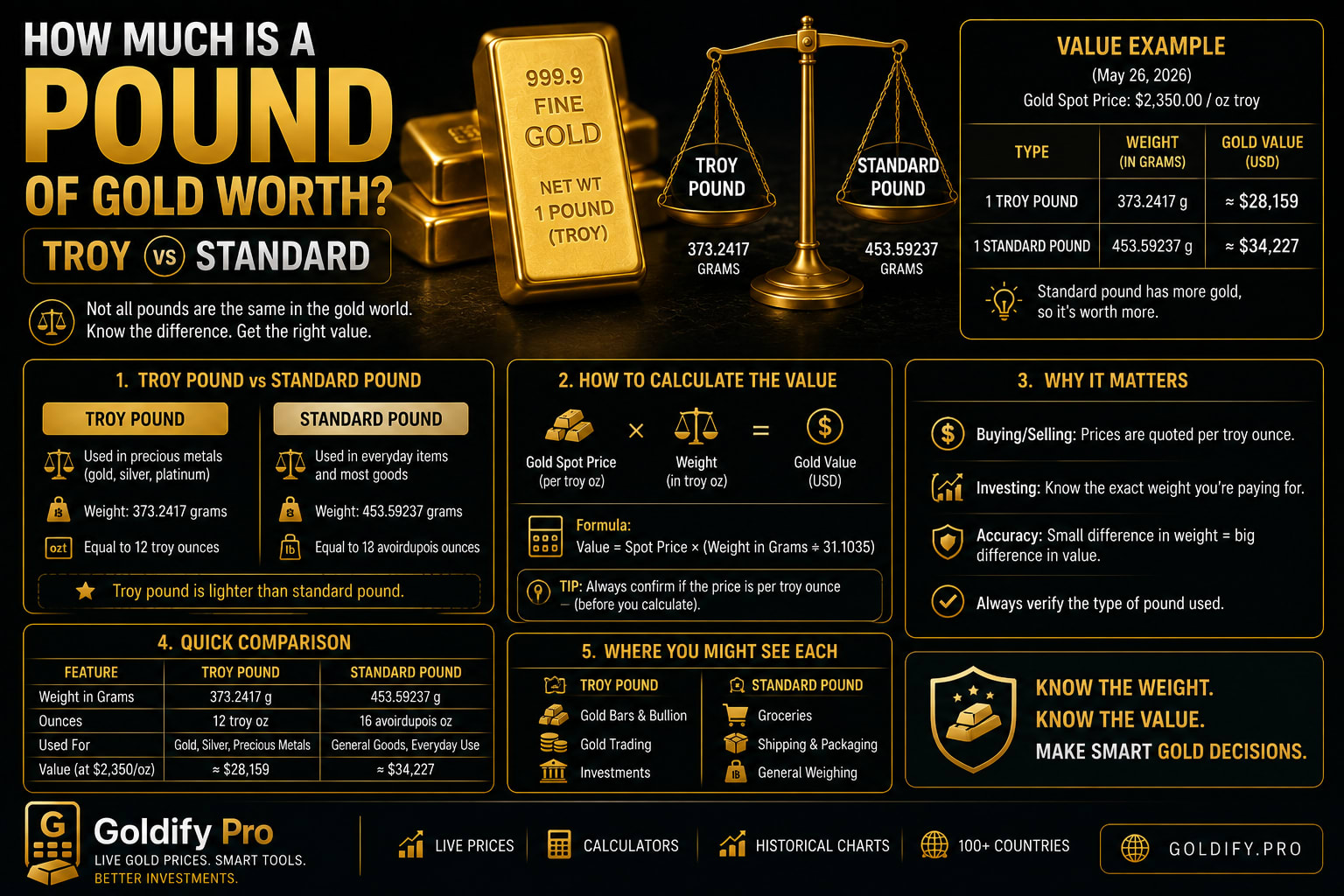
Here's the detail that trips almost everyone up: the ounce used for gold is not the ounce on your kitchen scale. Gold, like silver and platinum, is measured in troy ounces, and a troy ounce is heavier than the everyday (avoirdupois) ounce you use for food. One troy ounce equals about 31.10 grams, while a standard ounce is about 28.35 grams — so a troy ounce is roughly 10% heavier. One troy ounce also equals about 1.097 standard ounces.
This matters because mixing them up leads to real pricing mistakes. If you weighed a gold coin on an ordinary scale and used the food-ounce figure, you'd undercount its gold content. The troy system is the global standard for precious metals precisely so that an ounce of gold means the same thing in every market on earth. (A fun quirk: although a troy ounce is heavier than a standard ounce, a troy pound is actually lighter, because the troy system counts 12 ounces to the pound instead of 16.)
Gold Price Per Gram, Tola, and Kilogram Explained
Most of the world doesn't buy gold by the troy ounce. Small buyers and jewellers think in grams; across South Asia, the Gulf and the Middle East, gold is bought by the tola; and large investors and banks deal in kilo bars. All of these are just different slices of the same spot price. Here's how an illustrative ounce price breaks down across the common units.
Advertisement
| Unit | Weight | Illustrative Value | Typically Used By |
|---|---|---|---|
| Troy ounce | 31.10 g | ~$4,085 | Global benchmark, investors |
| Gram | 1 g | ~$131 | Small buyers, jewellery |
| 10 grams | 10 g | ~$1,313 | Common small bars/jewellery |
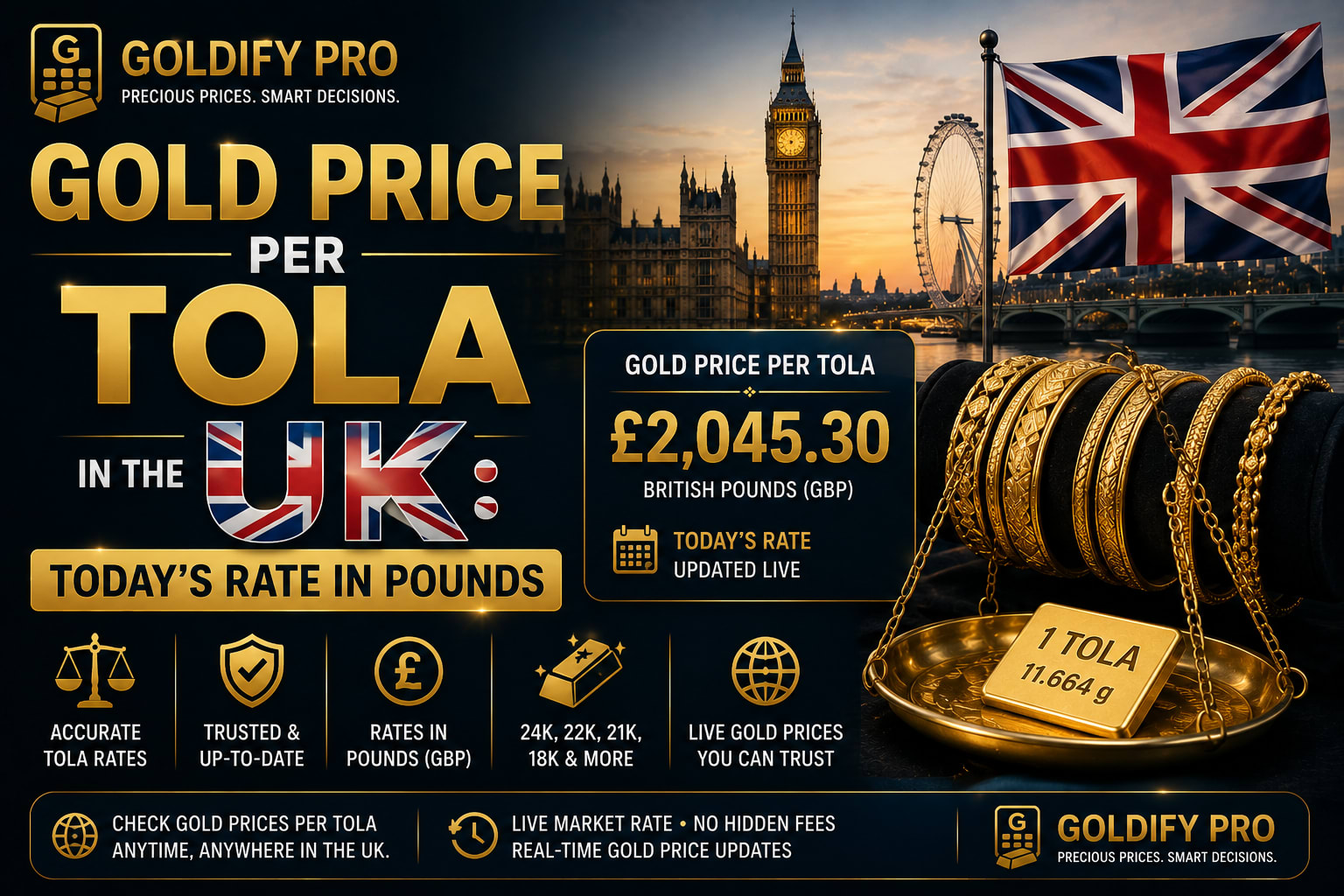
| Tola | 11.66 g | ~$1,532 | South Asia, Gulf, Middle East |
| Kilogram | 1,000 g | ~$131,350 | Banks, large investors, kilo bars |
Treat those figures as a worked example, not today's price — the live number will differ. But the ratios are fixed forever: a gram is always a thirty-first of a troy ounce, a tola is always 11.66 grams, a kilo is always 1,000 grams. Only the spot price moves; the conversions don't.
How to Convert the Gold Price Between Units
Once you know the price per troy ounce, every other unit is simple arithmetic. These are the only formulas you need:
- Price per gram = price per ounce ÷ 31.1035
- Price per tola = price per gram × 11.6638 (or simply price per ounce × 0.375)
- Price per 10 grams = price per gram × 10
- Price per kilogram = price per ounce × 32.1507
- Price per gram of jewellery = price per gram of pure gold × (karat ÷ 24)
Advertisement
That last one matters for jewellery buyers. The spot price is for pure, 24-karat gold (.999 or .9999 fine). A 22-karat piece contains 22/24 — about 92% — gold by weight, and an 18-karat piece about 75%, so their gold value per gram is proportionally lower. A converter does all of this for you, but knowing the maths helps you sanity-check any quote.
Why the Price You Pay Is Higher Than the Spot Price
Here's a common surprise: walk into a dealer and you'll never buy an ounce of gold at the exact spot price. You'll pay a premium on top — a markup that covers minting, fabrication, distribution, and the dealer's margin. For standard bullion bars and coins, that premium is usually modest in calm markets (low single-digit percentages), but it widens during demand spikes and panics, and it's much larger for collectible or graded coins.
The reverse applies when you sell: you'll typically receive the bid price, slightly below spot, while you buy at the ask, slightly above. That gap — the spread — is normal, but it's why gold suits patient holders rather than rapid in-and-out trading, and why comparing dealer premiums matters as much as watching the spot price itself.
What Makes the Price of an Ounce of Gold Change?
Gold's price is in constant motion because so many forces tug on it at once. The biggest long-run driver is real interest rates — when inflation runs hotter than bond yields, non-yielding gold becomes more attractive. The US dollar matters too, since gold is priced in dollars: a weaker dollar tends to lift gold, a stronger one to weigh on it. Layer on central bank buying (running near record levels), inflation expectations, and geopolitical risk, and you get a price that rarely sits still.
The recent pullback is a textbook example of these forces interacting. Gold eased toward $4,000 in late June 2026 as progress in US–Iran peace efforts drained the war premium, oil returned to pre-conflict levels, and a hawkish Fed under its new chair pushed the dollar and bond yields higher — with markets even pricing in a possible December rate hike. None of that changes gold's long-term story; it simply shows why the price of an ounce of gold is a live figure, not a fixed one.
Frequently Asked Questions
How much is an ounce of gold worth?
An ounce of gold (a troy ounce, ~31.1 grams) is worth the live spot price, which was around $4,085 in late June 2026 but changes every few seconds during market hours. The only accurate figure is the real-time one for your currency — check a live gold rate page or converter. Remember you'll pay slightly above spot (a premium) to buy physical gold and receive slightly below spot when you sell.
Is a gold ounce the same as a regular ounce?
No. Gold is measured in troy ounces, which are heavier than the standard (avoirdupois) ounces used for food. One troy ounce is about 31.10 grams versus about 28.35 grams for a regular ounce — roughly 10% heavier. This is a common and costly confusion: always use the troy ounce when valuing gold, or you'll undercount its gold content.
How much is a gram of gold?
Divide the price per troy ounce by 31.1035. At an illustrative spot price of ~$4,085 per ounce, a gram of gold is worth about $131. The exact figure changes constantly with the market, and the gram price of jewellery is lower than pure gold because it's adjusted for karat purity (22k is ~92% gold, 18k ~75%). Use a live converter for the current per-gram rate in your currency.
How much is a tola of gold?
A tola weighs 11.6638 grams, so a tola of gold is the per-gram price multiplied by 11.66 — roughly $1,532 at an illustrative spot price of ~$4,085 per ounce. The tola is the standard unit for buying gold across Pakistan, India, and parts of the Gulf. As with every unit, the live value moves with the global spot price, so check a real-time converter in your local currency before transacting.
Why is gold priced in US dollars?
Gold is traded globally and priced in US dollars because the dollar is the standard for international commodity trade, and the world's deepest gold markets (London and COMEX) quote in dollars. Local prices everywhere are derived from this dollar-per-troy-ounce benchmark, then converted into the local currency using the exchange rate — which is why a weaker or stronger dollar directly affects the gold price you see locally.
Advertisement
Disclaimer
Pricing and financial-advice disclaimer
All prices in this article are illustrative examples as of late June 2026 and are not live quotes. Gold prices change continuously; always check a real-time source before buying or selling. This article is for educational purposes only and is not financial, investment, or legal advice. Consult a licensed financial adviser before making investment decisions.
Editorial disclaimer
Conversion constants and market data drawn from LBMA, COMEX/CME, APMEX, and Trading Economics sources, current to June 2026. Live gold rates appear on the Goldify Pro home page, the live-gold-rates page, and the GoldPrice converter.
Originality and AI policy
Researched and written by the Goldify editorial team. Every claim verified against named primary sources. We do not publish unedited AI output.
Advertisement
Tools mentioned in this article
Advertisement