How Gold Is Stored in Central Bank Vaults (Complete Guide to Global Storage)
Where does central-bank gold actually live? A complete guide to the world's major gold vaults — Fort Knox, NY Fed, Bank of England, Banque de France — covering security, audits, leasing programs, and the international storage system.
Advertisement
When central banks talk about their gold reserves, what they actually mean is gold sitting in specific physical locations — vaults built underground, behind multi-tonne steel doors, monitored by armed security, and accessible only to authorised personnel. The global central-bank gold storage system involves a handful of major facilities holding the majority of the world's official gold: Fort Knox in Kentucky, the Federal Reserve Bank of New York vault, the Bank of England's London vault, the Banque de France vault, and the Bundesbank's Frankfurt facility, among others. Understanding how this gold is stored, audited, leased, and occasionally repatriated reveals the practical infrastructure behind central bank gold ownership. This guide walks through the world's major gold vaults, their security, and the operational systems that move gold between them.
Quick verdict
TL;DR
Central-bank gold is stored in heavily-fortified vaults at a small number of locations: Fort Knox (US gold), Federal Reserve Bank of New York (US gold plus foreign deposits), Bank of England (UK and foreign deposits), Banque de France, Bundesbank, Swiss National Bank, and others. Storage facilities use multi-layer security (vault doors, armed guards, biometric access, surveillance). Gold leasing programs allow central banks to earn yield on their gold holdings. Audit transparency varies — Germany has done extensive audits and repatriation; US gold has limited recent audit history.
Advertisement
Fort Knox — the most famous gold vault
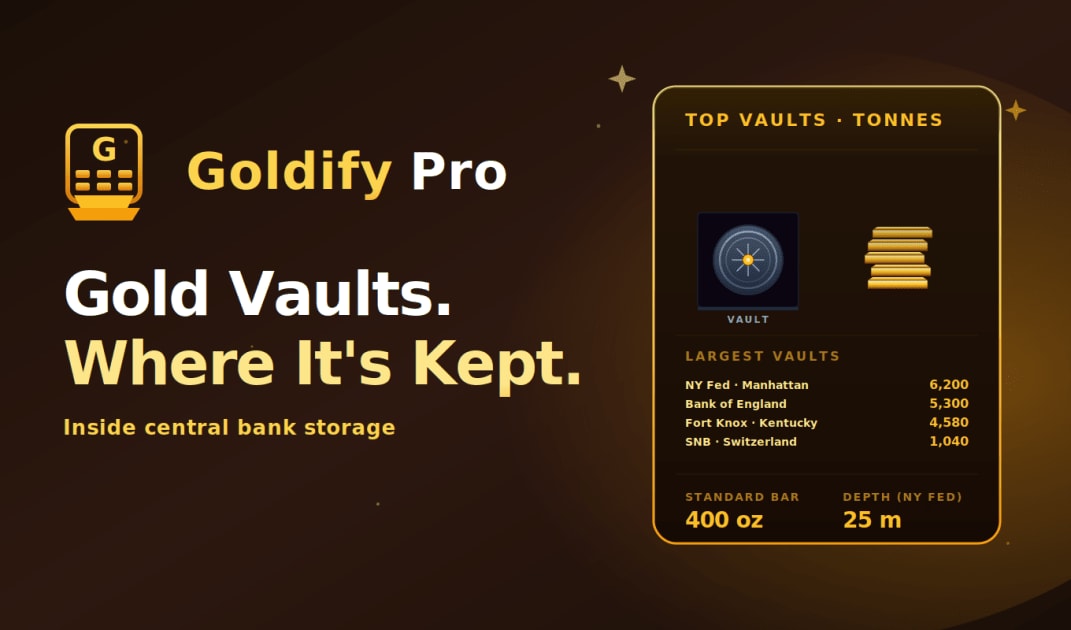
The United States Bullion Depository at Fort Knox in Kentucky is the most famous gold storage facility in the world. Built in 1936, it holds a substantial portion of US gold reserves — approximately 4,500 tonnes by official disclosures. The facility was designed for maximum security: granite walls, multi-layered steel doors, an interior structure essentially impossible to access without authorization, surrounded by military installations, and protected by armed personnel. The facility is so secure that its complete interior has rarely been inspected by outside parties. The last comprehensive third-party audit of Fort Knox gold was decades ago, which has fueled occasional public speculation about exact holdings.
Federal Reserve Bank of New York — international gold hub
The Federal Reserve Bank of New York operates one of the world's largest gold vaults, located beneath the bank in lower Manhattan. The vault stores a portion of US gold (smaller share than Fort Knox) plus foreign gold deposited by other central banks and the International Monetary Fund. Estimated holdings have exceeded 6,000 tonnes total at various points. The vault is located approximately 80 feet below ground, behind a massive 90-tonne steel cylinder door. Foreign central banks pay storage fees to keep gold there for practical reasons — international settlements can occur by transferring ownership records within the vault rather than physically moving the gold.
Bank of England — historic London vault
The Bank of England's gold vault, located in the bank's headquarters in London, holds gold for many foreign central banks plus UK government holdings. Estimated total holdings approach or exceed 5,000 tonnes including foreign deposits. The vault is a historic facility, with parts dating back to the bank's earliest years; modernised continuously for security. As one of the world's premier bullion centres (LBMA headquarters and main bullion banks), London's role as a gold-storage hub serves international settlement and trading.
Advertisement
Bundesbank — German repatriation story
The German Bundesbank holds approximately 3,350 tonnes of gold — the world's second-largest official reserves. Historically, German gold was stored largely at the Federal Reserve Bank of New York, Bank of England, and Banque de France for Cold War strategic reasons. Starting in 2013, the Bundesbank executed a major repatriation program, completed in 2017, bringing most German gold back to domestic storage in Frankfurt. The repatriation was widely watched and influenced other central banks to consider similar moves. The Bundesbank also conducted extensive audits during the program, providing more transparency than most central banks routinely offer.
Other major central bank gold vaults
| Country / Institution | Vault location |
|---|---|
| United States Treasury | Fort Knox, Kentucky; West Point, NY; Denver Mint |
| Federal Reserve Bank | New York City (vault below building) |
| Bank of England | London (under bank headquarters) |
| Bundesbank | Frankfurt, Germany (primary domestic storage) |
| Banque de France | Paris (under bank headquarters) |
| Banca d'Italia | Rome (Bank of Italy headquarters) |
| Swiss National Bank | Bern (and select foreign locations) |
| Bank of Japan | Tokyo |
| People's Bank of China | Multiple domestic locations (specifics undisclosed) |
| Central Bank of Russia | Multiple domestic locations |
| International Monetary Fund | Multiple locations including NY Fed and Bank of England |
Security infrastructure of central bank vaults
- Multi-tonne steel doors — vault doors typically weigh 50–100+ tonnes; impossible to penetrate without specialised equipment.
- Reinforced concrete construction — walls many feet thick of high-density concrete.
- Underground location — most major vaults are below ground for physical protection and inherent security.
- Multiple access controls — biometric, card-based, multi-person authorisation required.
- Continuous surveillance — cameras, motion sensors, environmental sensors throughout facility.
- Armed security — varies by location; military or specialised police often involved.
- Bar-by-bar inventory tracking — each gold bar individually identified and tracked.
- Tamper-evident sealing — vaults sealed when not in active use; any access logged.
- Compartmentalisation — different sections accessible only to specific authorised personnel.
- Disaster protection — earthquake-resistant, flood-resistant, fire-protected construction.
Advertisement
How gold is physically stored in vaults
Gold bars in central-bank vaults are typically stored as LBMA-good-delivery bars — roughly 12.4 kg (400 troy ounce) bars from accredited refiners. Bars are stacked in compartments or pallets, with each bar tracked by serial number, weight, purity, and refiner. The vault floor is reinforced to support enormous weight (gold is extremely dense). Bars are physically arranged in standardised patterns for inventory counting. Climate control maintains stable temperature and humidity. Each bar has documented provenance, allowing complete audit trails of when and where each bar was acquired.
Audit transparency — how often is the gold checked?
- Germany — completed extensive bar-by-bar audits during 2013–2017 repatriation; high transparency.
- Netherlands — conducted public audits during gold movements.
- UK — Bank of England audits regularly; some details public.
- US Treasury — conducts annual continuing audits of small portion; no recent comprehensive third-party audit of Fort Knox.
- France, Italy, Switzerland — periodic internal audits with selective public disclosure.
- China, Russia — limited public disclosure of audit practices.
The Fort Knox audit question
The lack of comprehensive third-party audits of Fort Knox gold since the 1950s has fueled occasional speculation about exact holdings. The Treasury conducts ongoing internal audits and selective verification, and there has been no formal allegation of missing gold. However, the absence of full transparency creates a persistent topic of debate among gold-watchers.
Gold leasing — how central banks earn from gold
Central banks lease portions of their gold to bullion banks, which use the leased gold for various market activities (lending to jewellery industry, providing liquidity in derivatives markets, or selling forward). The central bank receives a lease rate (typically very small — fractions of a percent annually). This allows central banks to earn modest income on otherwise non-yielding gold while maintaining the legal claim to the gold. Critics argue that gold leasing complicates audit transparency and creates 'paper gold' separate from physical possession. The practice is common but specific levels of leasing by individual central banks are often not publicly disclosed.
Gold repatriation trends since 2013
Starting around 2013, several major central banks began repatriating gold previously stored abroad. Germany completed the most famous program (2013–2017). Netherlands repatriated significant gold. Austria, Belgium, and other smaller countries followed. The trend reflects growing concern about geopolitical risk and the strategic importance of physical control over national gold reserves. The 2022 freezing of Russian dollar reserves accelerated repatriation thinking — if foreign-held dollar reserves can be frozen, the same logic could apply to gold. As of 2026, many central banks have stronger preference for domestic storage than they did 15 years ago.
How gold transfers between vaults
- 1.Internal accounting transfers — when one central bank 'transfers' gold to another within the same vault (NY Fed, Bank of England), no physical movement occurs; only ownership records change.
- 2.Physical international transfers — when gold moves between countries, secure logistics involve armored aircraft, multi-stage handoff, and continuous tracking.
- 3.Vault-to-vault transfers — coordinated by armored ground transport with police escort.
- 4.Documentation — every transfer involves detailed paperwork tracking each bar by serial number.
- 5.Verification at destination — receiving institution verifies bars match documentation; weight, purity, and authenticity confirmed.
Famous vault stories and incidents
- Germany's 2013–2017 repatriation — extensive operation moving gold from NY and Paris back to Frankfurt.
- 1971 Nixon Shock — gold convertibility ended; foreign central banks could no longer redeem dollars for US gold.
- Venezuela's 2018 gold dispute — Bank of England refused to release Venezuelan gold held in London amid political crisis.
- Romania's WWII gold — long-running dispute about gold sent to USSR during WWII for safekeeping; partial return.
- Italy's 1976 gold movement — Italy moved gold during fiscal crisis.
- Iran's frozen gold reserves — multiple countries have frozen Iranian gold reserves over decades.
Implications for investors
- 1.Understand that central-bank gold is genuinely held physically — not just paper claims.
- 2.Recognise the geopolitical implications — foreign-held gold can theoretically be frozen.
- 3.Appreciate why central banks accelerated buying after 2022 — physical control matters.
- 4.For retail investors, the lessons mirror central banks — physical possession or allocated storage in trusted jurisdictions.
- 5.Diversify storage if you hold significant gold — multiple jurisdictions reduce concentration risk.
Common myths — busted
| Myth | Reality |
|---|---|
| Most central-bank gold is missing | No verified missing gold; concerns center on audit transparency, not actual losses. |
| Fort Knox is empty | Treasury maintains audit documentation; no evidence of significant missing gold. |
| All central-bank gold is in one place | Multiple vaults across multiple countries hold central-bank gold. |
| Gold leasing means central banks don't really own their gold | Legal claim remains with central bank; leasing involves temporary lending. |
| Vaults are easy to breach | Security infrastructure makes physical theft essentially impossible. |
Central bank gold lives in fortified vaults you'll never see, behind doors weighing more than tanks. The infrastructure exists because the gold is real — and because keeping it real requires more protection than any other asset on earth.
Frequently asked questions
Where is US gold stored?
US gold is stored primarily at Fort Knox in Kentucky (largest single holding ~4,500 tonnes), the Federal Reserve Bank of New York (smaller US holdings plus foreign deposits), West Point Mint in New York, and Denver Mint in Colorado. Treasury maintains documentation of holdings at each location.
Is Fort Knox audited?
Treasury conducts ongoing internal audits and selective verification. The last comprehensive third-party audit was decades ago. There has been no formal allegation of missing gold, but the absence of full transparency creates persistent debate among gold-watchers.
Why did Germany repatriate gold from New York?
Strategic preference for direct physical control over national gold reserves. The Cold War rationale for storing German gold in New York (away from potential Soviet capture) became less compelling. Germany completed major repatriation 2013–2017, moving most gold to domestic Frankfurt storage. Other central banks have followed similar repatriation trends.
What is gold leasing?
Gold leasing is when central banks temporarily lend portions of their gold holdings to bullion banks, which use the gold for market activities (jewellery industry lending, derivatives liquidity, forward sales). Central banks receive small lease income. Specific leasing levels by individual central banks are typically not publicly disclosed.
The bottom line
Central-bank gold is stored in physically secure vaults at a small number of major facilities worldwide — Fort Knox, the Federal Reserve Bank of New York, the Bank of England, the Bundesbank, the Banque de France, and others. Security infrastructure makes physical theft essentially impossible. Audit transparency varies meaningfully across institutions; Germany's 2013–2017 repatriation set new standards while US Fort Knox gold has limited recent third-party audit history. Gold leasing programs allow central banks to earn small income on otherwise non-yielding gold. Repatriation trends since 2013 have accelerated post-2022 as central banks increasingly prefer direct physical control over foreign-stored gold. For retail investors, the lessons translate directly: physical possession or allocated storage in trusted jurisdictions matters; diversification across forms and locations reduces concentration risk. The infrastructure exists because the gold is real — and protecting real gold requires protection no other asset demands.
Stay informed
Track today's gold rate live on Goldify Quick Rates — 24K, 22K, 21K and 18K prices in tola, gram, masha and ratti, refreshed every minute, in your local currency.
Advertisement
Disclaimer
Editorial & content disclaimer
This article is original, human-written content created exclusively for Goldify by our editorial team. It is intended for general educational and informational purposes only and does NOT constitute financial, investment, tax, legal or security advice. References to specific institutions (US Treasury, Federal Reserve Bank of New York, Bank of England, Bundesbank, Banque de France, Banca d'Italia, Swiss National Bank, Bank of Japan, People's Bank of China, Central Bank of Russia, International Monetary Fund, others) and specific facilities (Fort Knox, West Point Mint, Denver Mint, others) describe widely reported public information. Specific tonnage figures, security details, audit practices, and operational specifics are approximate and based on publicly available information; actual details may differ. Vault security details described are general illustrations, not security disclosures. Goldify is not affiliated with any central bank, government body, vault facility or platform mentioned. We do our best to keep information accurate but make no warranty of completeness or fitness for any purpose. By reading this article you agree that Goldify is not liable for any decision you take based on its contents.
Originality & AI policy
This article was written and edited by humans on the Goldify editorial team. Research, examples and analysis were prepared in-house. We do not republish or scrape content from other websites. If you believe any portion of this article infringes a copyright, please contact us at gold@goldify.pro and we will review it promptly.
Advertisement
Tools mentioned in this article
Advertisement


