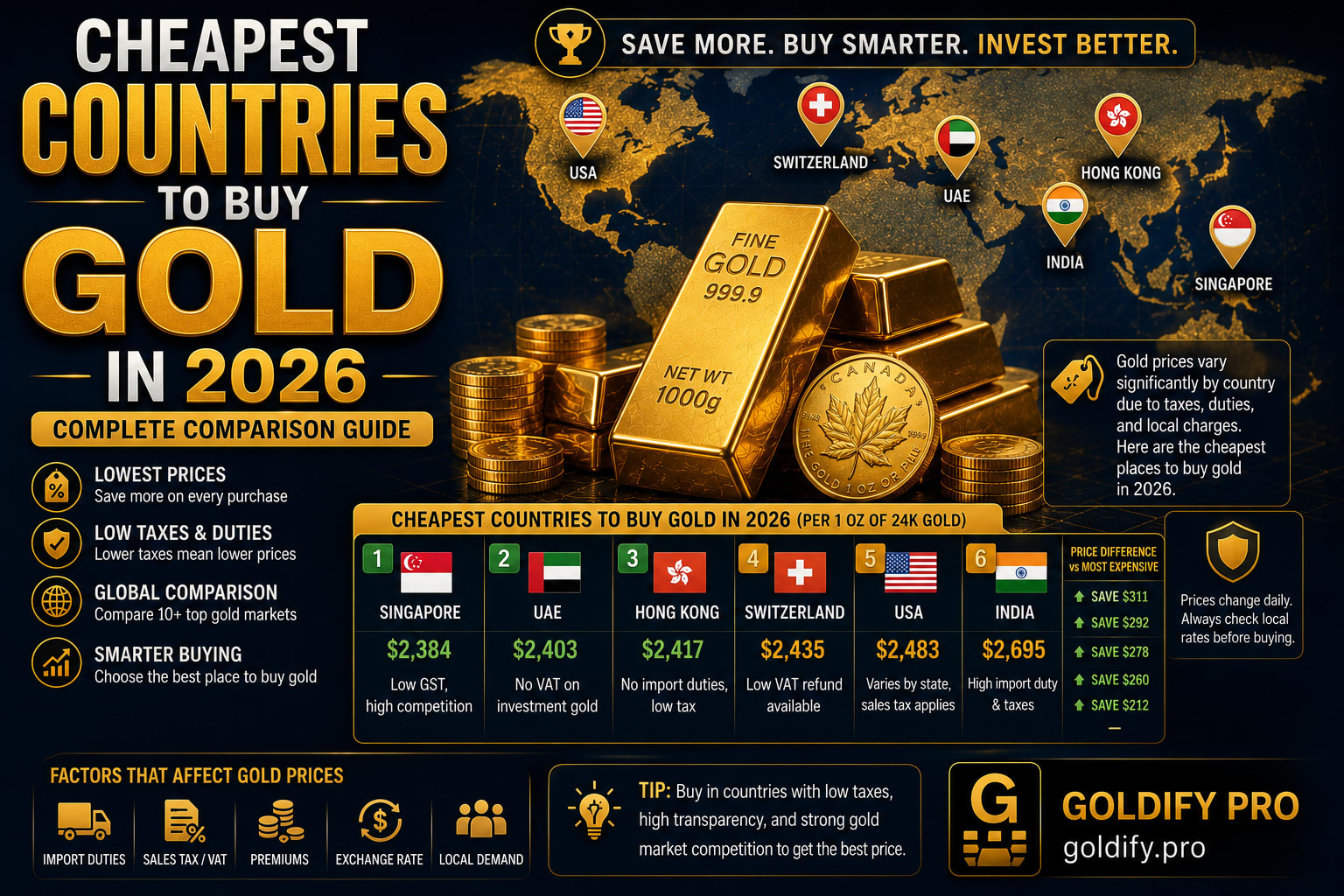
Cheapest Countries to Buy Gold in 2026 (Complete Comparison Guide)
In which country is gold the cheapest? A complete 2026 country-by-country comparison covering UAE, Hong Kong, Singapore, Switzerland, Western Europe and South Asia. Taxes, duties, typical premiums over spot and the realistic savings — plus customs rules when bringing gold home.
Advertisement
Gold is priced globally in US dollars, so the underlying metal costs the same wherever you buy it. What changes from country to country is everything added on top: VAT, customs duties, making charges, dealer margins, and local currency translation. A 100-gram gold bar can cost meaningfully less in Dubai than in Mumbai, and noticeably less again in Hong Kong than in London. The savings are real — but so are the customs rules when you try to bring foreign gold home. This guide ranks the cheapest countries to buy gold in 2026, explains why each is cheaper, and walks through the practical realities of buying gold abroad — including when the savings actually justify the trip.
Quick verdict
TL;DR
For investment-grade bullion (24K bars and coins from recognised refiners), the cheapest markets in 2026 are typically the UAE, Hong Kong, Singapore and Switzerland — all of which exempt investment-grade gold from VAT/GST and have competitive dealer margins. Western Europe and the US sit in the middle. India, Pakistan and Bangladesh are typically the most expensive due to import duties and taxes. The savings only matter if you stay within your home country's customs duty-free allowance — beyond that, the customs duty often erases the saving.
Advertisement
In which country is gold the cheapest?
Gold is cheapest in countries that charge no VAT or import duty on investment gold and have strong dealer competition: the UAE (Dubai), Hong Kong, Singapore, Switzerland, Kuwait and Bahrain consistently sell gold closest to the international spot price, typically 1–3% above spot for bullion. The metal itself costs the same everywhere — what differs is tax, dealer premium and making charges. At the other end, India is usually the most expensive major market because of import duty plus GST, which is why so many Indian travellers buy gold in Dubai. The ranked table below shows the approximate cost structure of each market.
| Rank | Country | Tax on investment gold | Typical bullion premium over spot | Why it's cheap |
|---|---|---|---|---|
| 1 | UAE (Dubai) | 0% VAT on investment gold; 5% on jewellery (tourist-refundable) | 1–3% | Gold Souk competition, free-trade port, no income tax |
| 2 | Hong Kong | 0% | 1–2% | Free port, dense dealer market |
| 3 | Singapore | 0% GST on qualifying Investment Precious Metals | 1–3% | IPM exemption, strong regulation, 24-hour retail (Mustafa Centre) |
| 4 | Switzerland | 0% VAT on investment gold | 1–3% | Home to the world's largest refineries |
| 5 | Kuwait | 0% | 2–3% | No sales tax, Mubarakiya souk competition |
| 6 | Bahrain | 0% on gold | 2–3% | Gold City souk, minimal tax |
| 7 | Bhutan | Duty-free counters for tourists (conditions apply) | Below Indian retail | Tourist duty-free scheme for overnight visitors |
| — | India (for contrast) | Import duty + 3% GST (verify current CBIC rates) | 8–12%+ | High import taxes — the reason Indians buy in Dubai |
| — | Turkey (for contrast) | Low tax but volatile currency | Varies | Lira swings can offset any sticker saving |
A special case worth knowing: Bhutan runs a duty-free gold scheme for foreign tourists — visitors who stay at least one night in certified accommodation can buy gold at duty-free counters (notably in Phuentsholing and Thimphu) by paying in US dollars and showing a passport and hotel receipt, with published purchase limits per visitor. Prices there are often below Indian retail because import duty is waived. You can compare today's prices directly on our live pages for the UAE, Singapore and Bhutan.
Why gold prices vary between countries
The international gold price (USD per troy ounce) is identical everywhere on earth at any given moment. The local retail price varies because of four layered factors: local currency exchange rate against the dollar; import duties (which vary by country, often substantial in South Asia, negligible in free-trade jurisdictions); VAT/GST on the gold itself or on making charges; and dealer/jeweller margins. Each layer can add several percentage points to the final retail price. The cheapest countries for gold are those that combine free-trade status (no or low import duty), investment-grade VAT exemption, and competitive retail markets.
Advertisement
Local Retail Price = (Global USD Price × FX Rate) + Import Duty + VAT/GST + Making Charges + Dealer MarginFirst term is the same in every country. Everything after varies — which is why prices differ.
Country-by-country gold pricing comparison
Tier 1 — Cheapest (VAT-exempt + low premiums)
| Country | Why cheap | Key consideration |
|---|---|---|
| UAE (Dubai) | Investment-grade gold exempt from VAT; competitive Gold Souk | Verify hallmarks; verify dealer reputation |
| Hong Kong | No VAT on investment-grade gold; mature bullion market | Limited tourist customs concessions for travellers |
| Singapore | Investment Precious Metals (IPM) GST-exempt | Strict IPM eligibility rules; verify before buying |
| Switzerland | World's most established refining/banking centre | Dealers focused on institutional buyers; check retail access |
| Cayman Islands | No VAT, minimal duties | Less developed gold market; verify availability |
| Andorra | Low VAT, EU-adjacent | Geographic limitations; small market |
Tier 2 — Mid-priced (some VAT or moderate premiums)
| Country | Why mid-priced | Notes |
|---|---|---|
| United States | No VAT on most gold; varying state sales taxes | Major bullion market with competitive pricing in tax-exempt states |
| Germany | VAT exemption on investment-grade gold (EU rule) | Major European bullion market |
| United Kingdom | VAT exemption on investment-grade gold | Choice of London bullion dealers |
| Canada | GST/HST exemption on investment-grade gold | Royal Canadian Mint products competitively priced |
| Austria | VAT exemption on investment-grade gold | Vienna market; Philharmonic coins |
| Australia | GST-free for investment-grade gold (>99.5%) | Perth Mint products competitively priced |
| Eurozone overall | VAT exemption on investment-grade gold across EU | Local markups vary by country |
Advertisement
Tier 3 — Higher-priced (significant duties and taxes)
| Country | Why higher-priced | Notes |
|---|---|---|
| India | Import duty + GST on metal + GST on making | World's largest consumer market; deep liquidity |
| Pakistan | Import duties; currency depreciation pressure | Saraf Sarafa Association reference rates |
| Bangladesh | Import duties; BAJUS-set local rates | Wedding-driven demand |
| Nepal | Import duties; small market | Bhutanese alternatives sometimes cheaper |
| Turkey | Import duties; currency depreciation | Heavy local demand |
| Egypt | Import duties; currency stress | Cultural demand significant |
The savings reality
Buying gold in Tier 1 countries can save 5–15% versus Tier 3 prices, sometimes more. But customs duties on bringing gold back to your home country often eliminate part or all of the savings. The actual benefit depends entirely on your home country's customs allowance and whether you stay within it.
The customs reality — what your home country allows
Almost every country has rules about how much gold travellers can bring in duty-free. Beyond the allowance, customs duty must be paid — typically at significant rates that can wipe out the savings of buying abroad. Specific limits, gender-based allowances, length-of-stay requirements, and applicable duty rates vary by country and are revised by governments periodically. Always verify the current rules with your home country's customs authority (CBIC for India, FBR for Pakistan, CBP for US, HMRC for UK, others) before booking travel.
- India — specific duty-free allowances based on gender, length of stay abroad, and form of gold (jewellery vs bars/coins). Beyond limits, customs duty applies.
- Pakistan — personal-use jewellery vs bullion treated differently. Limits revised periodically by FBR.
- United States — personal jewellery and small bullion typically duty-free; declarations required above thresholds.
- UK — VAT applies on imports above personal-allowance thresholds.
- Australia — strict declaration requirements; verify with Australian Border Force.
- Canada — declaration required; duty-free thresholds for personal jewellery.
- EU member states — varies by country and length of trip; verify with local customs.
Always declare
Failing to declare gold above your allowance can result in confiscation, fines and prosecution. The financial cost of non-declaration is far higher than the gold's savings. Declare honestly, pay any applicable duty, and keep purchase receipts as proof of value.
When buying gold abroad actually makes sense
- 1.You're already travelling — the trip cost isn't attributable to the gold purchase.
- 2.You're buying within your home country's duty-free allowance.
- 3.You're buying investment-grade bullion (24K bars/coins) with low premiums in Tier 1 markets.
- 4.You're buying a large wedding set in a market with lower making charges (Dubai vs India for example).
- 5.You can verify hallmarks and dealer reputation on-site.
- 6.You're documenting purchases properly for customs declaration.
When buying gold abroad does NOT make sense
- Small purchases where the saving doesn't justify travel cost.
- Quantities significantly exceeding your home country's duty-free allowance.
- Markets you're unfamiliar with where counterfeit risk is elevated.
- Unverified dealers without hallmarks or reputation.
- Time-sensitive purchases (weddings, festivals) where local convenience matters.
- If you cannot reliably verify the dealer or gold on-site.
Tips for buying gold in Tier 1 markets
- 1.Visit established dealers — Dubai Gold Souk has hundreds of competing jewellers; Singapore's UOB and major retailers; Hong Kong's Chow Tai Fook and others.
- 2.Confirm spot rate independently — use Goldify or similar live-rate sources before negotiating.
- 3.Verify hallmarks under magnification — 999, 916, 750 with refiner marks.
- 4.Request assay certificate for bars over 10 grams.
- 5.Get itemised invoice showing weight, purity, per-gram rate, making charges and total.
- 6.Negotiate making charges in jewellery markets — they're not fixed.
- 7.Pay by card where possible for purchase protection.
- 8.Keep all documentation for customs declaration.
- 9.Photograph hallmarks and certificates for your records.
- 10.Buy from established mall-based stores if Souk negotiation is uncomfortable.
Worked example — Dubai vs India for 100g of 22K gold
Suppose international gold trades at the same USD price in both countries. A 100g 22K piece might cost the following (illustrative, not live quotes).
| Cost component | Dubai | India |
|---|---|---|
| Base metal value (same in both) | Base | Base |
| Import duty layer | Negligible | Significant |
| VAT/GST on metal | Generally exempt for investment grade | GST applies |
| Making charges | 5–10% (Souk competition) | 8–25% (varies by jeweller) |
| GST/VAT on making | May apply on jewellery | GST applies |
| Final price (relative) | Lower | Higher |
Customs adjustment
Once you return home, factor in your country's customs duty on any gold above your allowance. For Indian travellers returning with significant Dubai gold purchases, customs duty often eliminates much of the Dubai saving. The net benefit depends on your specific allowance and quantity.
Common myths — busted
| Myth | Reality |
|---|---|
| Dubai gold is purer than Indian gold | All hallmarked 22K is 91.6% pure regardless of country. |
| You can bring unlimited gold from abroad duty-free | Every country has specific limits; beyond them customs duty applies. |
| Gold is always cheapest in Switzerland | Switzerland is cheap for investment-grade bullion but retail access varies. |
| Hong Kong is duty-free for any quantity | Hong Kong is cheap to buy in, but bringing gold to your home country triggers your country's customs rules. |
| Souk gold is always lower quality | Reputable Dubai Souk dealers sell hallmarked, certified gold equivalent to mall stores. |
The cheapest gold isn't the gold with the lowest sticker price — it's the gold whose total cost (purchase + customs + travel) is lowest. The two aren't always the same.
Frequently asked questions
Which country has the cheapest gold in 2026?
For investment-grade bullion, the UAE, Hong Kong, Singapore, and Switzerland are typically the cheapest because they exempt investment gold from VAT/GST and have competitive dealer markets. For wearable jewellery, the UAE often wins on combined metal + making charges. Always factor in your home country's customs allowance before assuming any saving will materialise.
Is Dubai really cheaper than India for gold?
Yes for investment-grade bars/coins and for jewellery within Indian customs allowance. The savings come from no VAT on investment gold, lower making charges due to Souk competition, and free-trade-port duty structure. Beyond customs allowance, Indian import duty erases much of the saving. For travellers already visiting Dubai, large wedding-set purchases often justify the trip.
Is the gold itself different between countries?
No. Purity standards are international: 24K (999) is 99.9% gold and 22K (916) is 91.6% gold whether it was bought in Dubai, Mumbai, Zurich or Hong Kong. What differs between countries is the price structure around the metal — taxes, premiums and making charges — never the gold itself. Always verify the hallmark, not the country.
Where is gold the cheapest in Europe?
Switzerland is the cheapest European market for investment-grade bullion thanks to its refining industry and zero VAT on investment gold. Within the EU, investment-grade gold (999 bars, qualifying coins) is VAT-exempt everywhere under the EU investment-gold directive, so Germany and Austria — with their large, competitive dealer markets — usually offer the best retail prices. Jewellery, by contrast, carries full VAT in most EU countries, which is why wearable gold is noticeably cheaper in Dubai or Istanbul than in Paris or Rome.
Is buying gold abroad legal?
Yes, buying gold in another country is legal. The legal requirement is to declare the gold at your home country's customs and pay any applicable duty on amounts above your duty-free allowance. Failing to declare is illegal and can result in confiscation, fines, and prosecution.
Can I send gold from abroad via mail?
Yes in many cases, but the gold faces customs inspection on arrival and any applicable import duty must be paid. Insured international shipping is available but adds significant cost. For most retail purchases, carrying gold personally (within customs allowance) or buying from local sources is more practical.
The bottom line
The cheapest countries for gold in 2026 are typically the UAE, Hong Kong, Singapore and Switzerland — all of which exempt investment-grade gold from VAT/GST and have competitive dealer markets. The savings versus higher-tax jurisdictions like India can be meaningful — sometimes 5–15% on equivalent products. However, customs duty when bringing gold home often erases part or all of the saving for quantities above duty-free allowance. The trip only makes sense if you're already travelling, buying within your allowance, and dealing with reputable dealers. Always verify hallmarks on-site, keep documentation, declare honestly at customs, and treat any 'too good to be true' deals as suspicious. Done right, international gold buying is one of the most legitimate ways to optimise gold acquisition cost.
Stay informed
Track today's gold rate live on Goldify Quick Rates — 24K, 22K, 21K and 18K prices in tola, gram, masha and ratti, refreshed every minute, in your local currency. Use it to verify any quoted price internationally.
Advertisement
Disclaimer
Customs, tax & travel disclaimer
This article describes general gold pricing patterns and customs/tax frameworks for various countries based on widely reported public information. Customs duties, VAT/GST rates, duty-free allowances, gender-based limits, declaration requirements, and import rules are set by national authorities and revised periodically. Specific rules in any country may have changed since publication and may vary based on traveller residency status, length of stay abroad, and form of gold (jewellery vs bars/coins). Before booking travel or making cross-border gold purchases, always verify current rules directly with your home country's customs authority (CBIC for India, FBR for Pakistan, US CBP, HMRC for UK, Australian Border Force, Canada CBSA, EU customs, others) and with the destination country's tax authority. Failure to comply with customs declaration requirements can lead to confiscation, financial penalties, and criminal prosecution. References to specific markets (Dubai Gold Souk, Hong Kong gold market, Singapore IPM, Switzerland refining centre, others), retailers, regulatory bodies, and trade associations describe widely reported public information. Goldify is not affiliated with any government body, customs authority, refiner, jeweller, retailer or platform mentioned. Always consult a qualified customs broker, tax advisor or legal professional licensed in your jurisdiction before cross-border gold transactions. We do our best to keep information accurate but make no warranty of completeness or fitness for any purpose. By reading this article you agree that Goldify is not liable for any decision you take based on its contents.
Originality & AI policy
This article was written and edited by humans on the Goldify editorial team. Research, examples and analysis were prepared in-house. We do not republish or scrape content from other websites. If you believe any portion of this article infringes a copyright, please contact us at gold@goldify.pro and we will review it promptly.
Advertisement
Tools mentioned in this article
Advertisement


