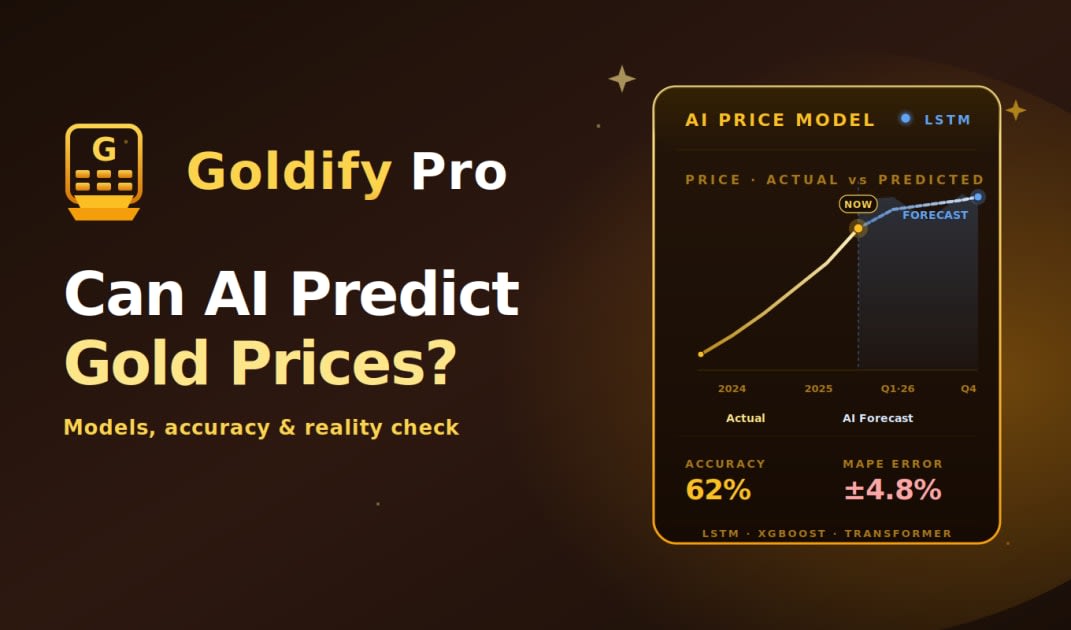
Can AI Predict Gold Prices? Tools, Models & Reality
Can artificial intelligence accurately predict gold prices? A complete guide to AI gold-forecasting models (LSTM, transformers, GenAI), the inputs they use, real-world accuracy, limitations, and the honest answer about whether investors should trust them.
Advertisement
Every few months, a new headline appears: 'AI predicts gold will reach $X by Y.' Hedge funds invest hundreds of millions in machine-learning systems for commodities trading. ChatGPT and other large language models confidently answer 'what will the gold price be next year' for anyone who asks. The marketing around AI gold prediction has reached fever pitch. But what does the actual evidence say? Can artificial intelligence genuinely predict gold prices better than human forecasters or traditional models? Or is it sophisticated pattern-matching that produces impressive backtests and disappointing real-world performance? This guide gives the honest answer — including what AI can do well, what it cannot do, and how serious investors should think about AI-generated gold forecasts.
Quick verdict
TL;DR
AI is useful for analysing gold-market data, spotting patterns, and processing news sentiment at scale. AI cannot reliably predict gold prices weeks or months ahead — no system can, because gold prices respond to unpredictable events (geopolitics, Fed surprises, black swans) that no model has data to learn from. Treat AI gold predictions as one input among many, not as a forecast you can trust. The honest verdict: AI is a better assistant than oracle.
Advertisement
How AI models predict prices (the basics)
AI price-prediction models fall into several families. Traditional machine learning uses algorithms like linear regression, random forests, gradient boosting (XGBoost, LightGBM), and support vector machines — trained on historical gold prices and related features. Deep learning uses neural networks, including LSTM (Long Short-Term Memory) networks designed for time series, CNNs (Convolutional Neural Networks) for pattern recognition, and increasingly transformer-based models adapted from natural-language processing. Generative AI (large language models like ChatGPT and Claude) can summarise news and produce narrative forecasts but typically lack the specialised training to make precise numerical predictions reliably. Each approach has strengths and serious limitations when applied to financial price forecasting.
| Approach | Best at | Limitation |
|---|---|---|
| Linear regression / classical ML | Identifying linear relationships, simple modelling | Misses complex non-linear dynamics |
| Random forests / XGBoost | Handling mixed feature types, feature importance | Can overfit; struggles with regime change |
| LSTM neural networks | Time-series sequence learning, capturing trends | Computationally expensive; sensitive to data quality |
| Transformer models | Long-range dependencies in time series | Newer; less proven in commodities forecasting |
| Sentiment analysis on news/social media | Detecting mood-shift signals | Sentiment ≠ price direction |
| Generative AI (ChatGPT, Claude) | Summarising market narratives | Not designed for precise numerical forecasting |
| Ensemble models | Combining multiple approaches for robustness | Complexity makes errors harder to diagnose |
What inputs AI models actually use
- Historical gold prices (daily, hourly, sometimes minute-by-minute over years).
- US Dollar Index (DXY) and major currency exchange rates.
- US 10-year real yield and Treasury yields across the curve.
- Federal Reserve policy decisions, Fed funds futures and dot-plot data.
- Inflation indicators (CPI, PCE, expected inflation).
- Gold ETF holdings and flows.
- Central-bank gold purchase data.
- COMEX futures positioning and Commitment of Traders reports.
- Equity market indices (S&P 500, VIX volatility).
- Oil prices and other commodity benchmarks.
- News sentiment and social media analysis.
- Geopolitical event flags and major macro announcements.
Advertisement
The accuracy reality — what research actually shows
Academic research on AI price forecasting has produced a clear pattern. Sophisticated models often achieve impressive backtest accuracy — they can 'predict' historical price movements with apparent skill. But forward-tested performance (where models predict actual future prices in real time) consistently disappoints. Multiple peer-reviewed studies have found that complex AI models often perform only marginally better than naive baselines like 'tomorrow's price will be the same as today' over realistic forecasting horizons. The gap between backtested skill and forward-tested performance is so large that researchers call it the 'AI forecasting gap'. The reason is fundamental: gold prices respond to events the AI has no data about — specifically, future events.
The backtest trap
An AI model can be 'tuned' on historical data until it perfectly predicts the past. This proves nothing about future accuracy. Always check forward-tested (out-of-sample) performance — never trust a system that only shows backtested results.
Why gold prices are especially hard to predict with AI
- 1.Gold reacts to one-off events (wars, sanctions, central-bank shocks) that have no historical pattern for AI to learn from.
- 2.Major Federal Reserve surprises can move gold 2–3% in minutes; AI cannot predict surprises by definition.
- 3.Geopolitical risk premiums build and dissipate in non-linear ways that don't match training data patterns.
- 4.Central-bank buying flows shift the structural demand floor; AI models often underweight this slow-moving force.
- 5.Currency translation effects vary by country; AI models trained mostly on USD gold miss local-currency dynamics.
- 6.Market regimes change — what predicted gold prices in 2010–2020 may not predict 2025–2030.
- 7.Black-swan events (COVID, war shocks) destroy model performance precisely when investors need predictions most.
Where AI genuinely helps in gold investing
Despite the limits on forecasting, AI does provide real value in gold-related work — just not as oracle for next month's price. Used carefully, AI is excellent at: processing vast quantities of news data and surfacing sentiment trends in real time; identifying patterns in central-bank purchase data and ETF flows across regions; helping investors understand correlation between gold and other assets across many time windows; analysing technical chart patterns at scale; spotting anomalies in trading volume or volatility; summarising research reports from multiple sources; building risk models that quantify how gold positions move during stress events. None of these is 'predict the price' — but all are real, useful applications.
Advertisement
- News sentiment analysis — AI can read thousands of articles per hour and quantify market mood.
- Pattern recognition — AI can identify unusual price/volume combinations human traders might miss.
- Risk management — AI can stress-test portfolios across thousands of historical scenarios.
- Anomaly detection — AI can flag when gold price moves diverge significantly from typical drivers.
- Cross-asset correlation — AI can monitor gold's relationships with USD, real yields, equities in real time.
- Trade execution — AI can optimise order placement to minimise market-impact costs.
- Research summarisation — generative AI can synthesise multiple analyst reports quickly.
The honest summary
AI is a powerful tool for processing data and identifying patterns — but it cannot reliably forecast gold prices because future prices depend on future events AI has no information about. Use AI to inform your thinking; don't outsource your thinking to AI.
Generative AI (ChatGPT, Claude) and gold predictions
Large language models like ChatGPT and Claude can confidently produce gold price 'forecasts' when asked — but these outputs are not real predictions. The models pattern-match to training data and produce plausible-sounding narratives, not analyses based on real-time market data or quantitative modelling. Treat any specific numerical gold-price prediction from a generative AI as a creative writing exercise, not a forecast. Where generative AI does excel is in: explaining gold market concepts clearly; summarising historical events; comparing different analytical frameworks; helping investors structure their own thinking; processing large research documents quickly. Use it for context and education, not for trade decisions.
How professionals actually use AI in gold trading
- 1.Quantitative hedge funds use machine learning to identify short-term trading edges measured in basis points, not directional forecasts.
- 2.Central banks and large funds use AI for portfolio risk management, not gold-price prediction.
- 3.News and sentiment data feeds use AI to provide real-time market context.
- 4.Trade execution algorithms use AI to minimise market-impact costs when buying or selling large quantities.
- 5.Fundamental analysts use AI to summarise central-bank reports, regulatory filings and economic data.
- 6.Almost no serious professional relies on AI as a standalone price oracle for medium- or long-term gold positions.
Red flags — when to distrust AI gold predictions
- A model that shows only backtested results — always demand forward-tested performance.
- Confident predictions of specific prices weeks or months ahead with high accuracy claims.
- Sales material claiming an AI system 'beats the market' or has 'cracked gold prediction'.
- Models with no transparency about their inputs, methodology or training data.
- Predictions that don't change when major macro events occur (suggests the model is offline or stale).
- AI tools that recommend trading on every prediction (transaction costs eat most short-term edge).
- Anyone offering an AI gold-prediction subscription for a high fee — if it worked, they wouldn't sell it.
The cynic's rule
Genuinely profitable AI trading systems are kept secret and used internally by funds that profit from them. AI prediction tools sold publicly to retail investors almost never live up to their marketing — because if they did, the seller would use them privately, not sell them.
Common myths — busted
| Myth | Reality |
|---|---|
| AI has solved price prediction | AI improves data processing, but no model reliably predicts gold prices weeks or months out. |
| ChatGPT can forecast gold prices | Generative AI produces plausible narratives, not real forecasts based on live data. |
| AI's backtest accuracy proves it works | Backtest accuracy is easily achieved through overfitting; only forward-tested performance matters. |
| Professional traders all use AI prediction | Professionals use AI for risk management and execution, rarely as standalone price oracle. |
| AI eliminates emotional bias in investing | AI inherits biases from its training data and from the humans who design and deploy it. |
AI is the best assistant gold investors have ever had — and the worst oracle. Use it to think faster, not to outsource your judgement.
Frequently asked questions
Can AI accurately predict gold prices?
No — not in the sense most people mean. AI cannot reliably predict gold prices weeks or months ahead. It can analyse historical patterns, process news at scale, identify correlations and assist with risk management — but it cannot foresee future events (Fed surprises, geopolitical shocks, central-bank announcements) that drive most major price moves.
What AI tools do hedge funds use for gold trading?
Quantitative funds use combinations of LSTM neural networks, gradient-boosting models, sentiment-analysis NLP, anomaly detection, and ensemble approaches. Most are proprietary and used for short-term trading edges (microseconds to days), not multi-month directional bets. Specific tools and details are not publicly disclosed by competitive firms.
Should I use ChatGPT for gold predictions?
For specific price predictions, no — generative AI outputs are not based on real-time data or quantitative modelling. For education, concept explanation, research summarisation and structured thinking about gold markets, yes — generative AI is a useful assistant. Always verify any specific number or claim through reliable sources before acting.
What's the most accurate way to forecast gold?
Honestly, no method is consistently accurate over short horizons. The most useful framework combines several inputs: real interest rates (gold's strongest single driver), central-bank purchase trends, US dollar direction, inflation expectations, and major geopolitical signals. Even with all this, professional forecasters routinely miss major moves. Plan for ranges, not points.
The bottom line
AI cannot reliably predict gold prices weeks or months ahead — not because the technology is bad, but because gold prices respond to future events no AI has data about. What AI does superbly is process vast amounts of data, identify patterns, analyse sentiment, manage risk, and assist with structured thinking. Treat AI gold predictions as one input among many — useful for context and analysis, never as the final word on what gold will do. The professionals who use AI most effectively in gold markets use it for risk management and execution, not as an oracle. The honest verdict: AI is the best assistant gold investors have ever had, and the worst forecaster. Plan accordingly.
Stay informed
Track today's gold rate live on Goldify Quick Rates — 24K, 22K, 21K and 18K prices in tola, gram, masha and ratti, refreshed every minute, in your local currency.
Advertisement
Disclaimer
Forecast & AI-tool disclaimer
This article is original, human-written content created exclusively for Goldify by our editorial team. It is intended for general educational and informational purposes only and does NOT constitute financial, investment, tax or legal advice. AI prediction technology evolves rapidly; specific tools, models, accuracy claims and capabilities described here are based on publicly reported information and may have changed since publication. The article does NOT endorse, recommend, or vouch for any AI prediction tool, trading platform, or hedge fund. References to AI techniques (linear regression, random forests, XGBoost, LSTM, transformers, neural networks, sentiment analysis), specific products (ChatGPT, Claude, others), academic research findings, and trading data sources (COMEX, Commitment of Traders reports) describe widely reported public information. Always evaluate AI tools independently, verify forward-tested performance (never trust backtests alone), and consult a qualified financial professional licensed in your jurisdiction before relying on any AI output for investment decisions. Goldify is not affiliated with any AI company, hedge fund, brokerage or platform mentioned. We do our best to keep information accurate but make no warranty of completeness or fitness for any purpose. By reading this article you agree that Goldify is not liable for any decision you take based on its contents.
Originality & AI policy
This article was written and edited by humans on the Goldify editorial team. Research, examples and analysis were prepared in-house. We do not republish or scrape content from other websites. If you believe any portion of this article infringes a copyright, please contact us at gold@goldify.pro and we will review it promptly.
Advertisement
Tools mentioned in this article
Advertisement


