Gold Karat Chart: Every Purity, Hallmark Stamp and Use Explained (24K to 9K)
The complete gold karat chart — every karat from 24K to 9K, the hallmark stamp, the percentage purity, the country where it dominates, and the jewellery and investment uses each is best for. The single reference page that answers every karat question you'll ever have.
Advertisement
Gold karat is the single most important number on every piece of jewellery you will ever buy. It tells you how pure the gold is, how much it is worth, how durable it is, and how it will hold up over the years. Yet most people only know two — 24K and 22K — and have never seen a complete chart of every karat the world actually trades. This is that chart. Every karat from 24K down to 9K, every hallmark stamp, every purity percentage, every country where it dominates, and the use-cases each is genuinely best for. Bookmark this page — you will return to it every time you walk into a jeweller's shop.
Quick reference — the master karat chart
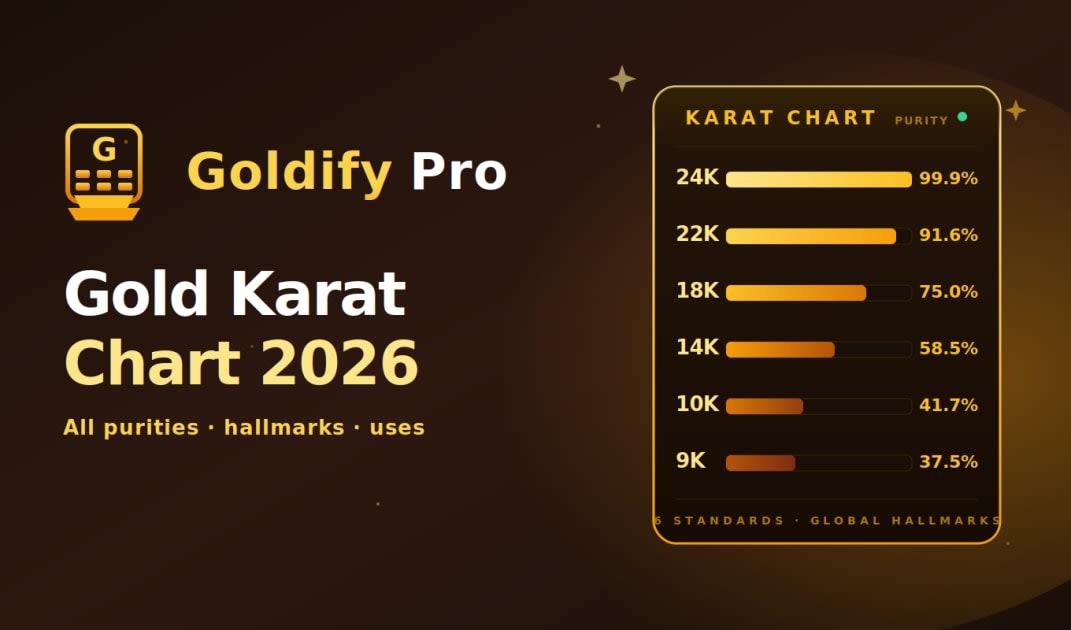
| Karat | Purity % | Hallmark stamp | Where it dominates | Best for |
|---|---|---|---|---|
| 24K | 99.9% | 999 (or 9999 for 4-nines) | Global investment market | Bars, coins, pure savings |
| 23K | 95.8% | 958 | Niche / Asian high-purity jewellery | Specialty pieces |
| 22K | 91.67% | 916 | South Asia, Gulf, Egypt | Wedding sets, daily-wear chains |
| 21K | 87.5% | 875 | Saudi Arabia, UAE, Qatar, Oman | Wedding jewellery (Gulf preference) |
| 20K | 83.3% | 833 | Some Middle Eastern markets | Specialty jewellery |
| 18K | 75% | 750 | Western world, designer pieces | Engagement rings, white gold, watches |
| 14K | 58.33% | 585 | United States, mass-market jewellery | Daily-wear, fashion jewellery |
| 10K | 41.67% | 417 | United States (legal minimum to be sold as 'gold') | Budget jewellery, novelty pieces |
| 9K | 37.5% | 375 | United Kingdom (legal minimum) | Affordable jewellery, costume pieces |
| 8K | 33.3% | 333 | Germany (legal minimum) | Very budget jewellery |
Advertisement
What does 'karat' actually mean?
Karat (abbreviated K or kt) is a unit that measures the proportion of pure gold in an alloy, expressed in 24ths. So 24K means 24 parts pure gold out of 24 — i.e. 100% pure. Each karat number represents the fraction of pure gold in the metal, with the remainder being other metals added for hardness, colour or cost. The system is over a thousand years old and traces back to medieval European gold coinage, where assayers needed a clean way to express purity using simple fractions.
Purity (%) = (Karat ÷ 24) × 100Use this single formula to convert any karat to a percentage. Works for every standard karat from 9K to 24K.
Karat vs carat — they're not the same word
A common spelling and pronunciation confusion: karat (K) measures the purity of gold; carat (CT) measures the weight of gemstones. One carat (the gemstone unit) equals 0.2 grams — used for diamonds, rubies, sapphires and emeralds. They sound identical but mean different things. Some countries (especially the UK) spell both as 'carat' for historical reasons, which adds to the confusion. In the gold context, 'karat' (with K) is universally used to avoid mixing them up.
Quick rule
If you see 18K, 22K, or '750 stamp' — that is gold purity. If you see '1.5 ct' on a diamond — that is gemstone weight. Same sound, totally different meaning.
Advertisement
24K — the purest commercial gold
24K is gold at its purest commercial form — 99.9% pure, stamped 999. Refiners sometimes go further to 99.99% (four-nines, stamped 9999). 24K's defining trait is also its weakness: it is one of the softest metals worked by humans, soft enough to scratch with a fingernail and bend with finger pressure. This makes it perfect for investment-grade bars and coins (which sit in vaults, not on fingers) but unsuitable for almost any wearable jewellery setting. Every central bank reserve in the world holds 24K. Every recognised refiner — PAMP, Valcambi, Perth Mint, Royal Canadian Mint, US Mint — produces 24K bars and coins as the global investment standard.
23K — the rare specialty karat
23K (95.8%, stamped 958) is uncommon but appears in some specialty Asian jewellery markets — particularly in Thailand, Cambodia and Vietnam, where higher-purity wearable gold is traditional. It sits between 24K's softness and 22K's durability, offering a slightly more durable alternative to pure gold for buyers who value purity but need a wearable form. Outside these specific markets, 23K is rarely encountered.
22K — the South Asian and Gulf wedding standard
22K (91.67%, stamped 916) is the most popular karat for wearable jewellery in South Asia, Egypt and most of the Gulf. Its appeal lies in being almost-pure gold with just enough alloy to be wearable as wedding sets, chains, bangles and earrings. The rich warm yellow of 22K is what most South Asian buyers picture when they think of 'gold'. Resale value is high — almost every jeweller in the region values 22K close to its full karat-equivalent of pure gold. India's BIS hallmark system uses the 916 stamp plus a 6-character HUID code; Pakistan's Saraf Sarafa Association references 22K as the daily standard.
Advertisement
21K — the Gulf preference
21K (87.5%, stamped 875) is the dominant karat in Saudi Arabia, the UAE, Qatar and Oman. It sits between 22K's warmth and 18K's durability, offering Gulf buyers a slightly more wearable version of high-purity gold. The Dubai Gold Souk lists 21K rates alongside 22K and 24K daily, and most Gulf wedding jewellery is 21K rather than 22K. Outside the Gulf, 21K is rare; its resale value depends heavily on whether the buyer is in a 21K-recognising market.
18K — the global Western standard
18K (75%, stamped 750) is the global standard for fine designer jewellery, engagement rings, white gold, luxury watches and gemstone-set pieces. Its 75/25 gold-to-alloy ratio is the engineering sweet spot where the metal is hard enough for prong settings, intricate filigree and daily wear, but still elegant and gold-coloured enough for high-end design. Almost every Italian, French, American and British luxury brand uses 18K. Every Swiss luxury watch with gold uses 18K, not 22K.
14K — the American mass-market standard
14K (58.33%, stamped 585) is the most common gold karat in the United States. Its higher alloy content makes it more durable than 18K and more affordable per piece, which suits the high-volume American jewellery market. The colour is noticeably paler than 22K or 18K — sometimes mistaken for white gold by buyers used to richer yellow tones. 14K resale value depends heavily on the gold-content portion (58.5%) plus any design value.
10K — the US legal minimum
10K (41.67%, stamped 417) is the lowest karat that can legally be sold as 'gold' in the United States. It is less than half pure gold, so it is more durable but also less valuable per gram. It is common in budget jewellery, school class rings, and fashion pieces where price matters more than gold content. Outside the US, 10K is rarely used.
9K — the UK legal minimum
9K (37.5%, stamped 375) is the lowest karat that can legally be sold as 'gold' in the United Kingdom and most of the Commonwealth. It is more than half alloy and less than half gold. The colour is noticeably paler and the resale value is correspondingly lower. 9K is common in affordable everyday British jewellery and costume pieces, but it is rarely used for serious investment or high-value gifting.
8K — Germany's legal minimum
8K (33.3%, stamped 333) is the lowest karat permitted to be sold as 'gold' in Germany. It is essentially the budget end of the karat scale. 8K is unusual outside specific European markets and rarely seen elsewhere. Its colour is closer to brass than to traditional gold, and resale value is minimal.
Karat by country — the global preference map
| Country / region | Most common jewellery karat | Investment karat |
|---|---|---|
| India | 22K (916) | 24K coins / SGB |
| Pakistan | 22K (916) | 24K biscuits / coins |
| Bangladesh | 22K (916), some 21K | 24K |
| Sri Lanka | 22K (916) | 24K |
| Saudi Arabia | 21K (875) | 24K |
| UAE | 21K and 22K | 24K (LBMA-approved) |
| Qatar / Oman / Kuwait | 21K | 24K |
| Egypt | 21K and 22K | 24K |
| United States | 14K | 24K (Eagles, Buffalos) |
| United Kingdom | 9K and 18K | 24K (Britannia) |
| Italy / France / Switzerland | 18K | 24K (refiner bars) |
| Germany | 8K and 14K (mainstream); 18K (premium) | 24K |
| China | 24K (Chuk Kam standard) | 24K |
| Thailand | 23K (96.5%) | 24K |
| Australia / Canada | 18K and 14K | 24K (Maple, Kangaroo) |
Karat hardness — durability ranking
Lower karat = more alloy = harder metal. Higher karat = less alloy = softer metal. This is why 24K cannot hold gemstone settings well, while 14K can survive almost any daily-wear punishment. The trade-off cuts in both directions: durability comes at the cost of pure-gold content, and vice versa.
| Karat | Approximate Vickers hardness | Durability rating |
|---|---|---|
| 24K | 20–30 HV | Very soft — bends easily |
| 22K | 50–60 HV | Soft — wears slowly |
| 21K | 70–80 HV | Medium-soft |
| 18K | 120–150 HV | Medium — best balance for most jewellery |
| 14K | 140–180 HV | Hard — survives heavy daily wear |
| 10K | 150–200 HV | Very hard — most durable |
| 9K | 150–200 HV | Very hard |
Choosing the right karat — a decision framework
- 1.Pure investment savings → 24K bars or coins from a recognised refiner.
- 2.South Asian or Egyptian wedding set → 22K hallmarked.
- 3.Gulf wedding set → 21K hallmarked.
- 4.Engagement ring with diamond → 18K (yellow, white or rose).
- 5.Daily-wear American-style fashion jewellery → 14K.
- 6.Affordable everyday British pieces → 9K (recognise the lower gold content).
- 7.Luxury watch with gold case → 18K (industry standard).
- 8.Heirloom investment piece → 22K or 24K coins, carefully stored.
Hallmark stamp guide — quick visual reference
- 999 or 24K — pure gold (24-karat).
- 958 or 23K — 95.8% gold (rare specialty).
- 916 or 22K — South Asian wedding standard.
- 875 or 21K — Gulf preference.
- 750 or 18K — global Western/luxury standard.
- 585 or 14K — American mass-market standard.
- 417 or 10K — US legal minimum.
- 375 or 9K — UK legal minimum.
- 333 or 8K — German legal minimum.
Frequently asked questions
What is the highest karat of gold?
24K is the highest in the karat system — 100% pure gold by definition. Refiners commonly produce 24K at 99.9% (stamped 999) and four-nines at 99.99% (stamped 9999). It is impossible to exceed 24K because 24K means '24 parts gold out of 24'.
Is higher karat always better?
No. Higher karat = more pure gold but less durability. For pure savings, higher is better (24K). For wearable jewellery, the right karat is the one that balances purity with the strength to survive your specific use. 18K is best for engagement rings; 22K is best for South Asian wedding sets; 14K is best for everyday American-style jewellery.
What does the hallmark number mean?
Hallmark numbers (999, 916, 750, 585, 375) represent parts of pure gold per 1,000 parts of metal. So 916 means 916/1000 = 91.6% pure gold = 22K. Multiplying the karat number by 41.67 gives the approximate hallmark stamp (22K × 41.67 ≈ 916).
Can I buy 23K gold?
Yes, but in limited markets — primarily Thailand, Cambodia and Vietnam. Outside Southeast Asia, 23K is rare. If you are buying for international resale, stick to widely-recognised karats: 24K, 22K, 18K, 14K.
Common myths — busted
| Myth | Reality |
|---|---|
| 24K is always the best choice | Best for investment savings; too soft for jewellery. |
| Lower karat means fake gold | Lower karat is real gold with more alloy. 9K is still real gold. |
| The 916 stamp guarantees authenticity | It guarantees the purity claim, but you still need to verify the stamp itself is genuine. |
| Karat and carat are the same word | Karat measures gold purity; carat measures gemstone weight. |
| A piece without a stamp is automatically fake | Some legitimate older pieces lack stamps. Test purity professionally before assuming. |
The right karat is not the highest number on the label — it is the one that matches the job the piece will do.
The bottom line
Gold karat is the language every gold transaction speaks. From 24K bars in central-bank vaults to 9K daily-wear British pieces, every karat has a role, a market, and a purpose. The chart above is the complete map. Use the formula (Karat ÷ 24 × 100) to flip between karat and percentage instantly. Match the karat to your goal — investment, wedding, daily wear, designer piece, budget — and you will never overpay or underbuy. Bookmark this page and return to it before any meaningful gold purchase.
Stay informed
Use Goldify's Karat Purity Calculator to convert any karat to pure-gold weight and value instantly. Live rates for 24K, 22K, 21K and 18K are refreshed every minute, in your local currency.
Advertisement
Disclaimer
Editorial & content disclaimer
This article is original, human-written content created exclusively for Goldify by our editorial team. It is intended for general educational and informational purposes only and does not constitute financial, investment, jewellery-grading, gemmological or appraisal advice. Karat conventions, hallmarking systems, country preferences and resale value vary by country, jeweller and time. References to authorities (BIS, London Assay Office, Saraf Sarafa Association, Bangladesh Jewellers' Association, US Mint, Royal Canadian Mint, etc.) and refiners (PAMP, Valcambi, Perth Mint, etc.) describe widely reported public information. Goldify is not affiliated with any government body, refiner, mint, brand, jeweller or platform mentioned. Always confirm specific karat purity, hallmark legitimacy and current market prices with a recognised professional. We do our best to keep information accurate but make no warranty of completeness or fitness for any purpose. By reading this article you agree that Goldify is not liable for any decision you take based on its contents.
Originality & AI policy
This article was written and edited by humans on the Goldify editorial team. Research, examples and analysis were prepared in-house. We do not republish or scrape content from other websites. If you believe any portion of this article infringes a copyright, please contact us at gold@goldify.pro and we will review it promptly.
Advertisement
Tools mentioned in this article
Advertisement


