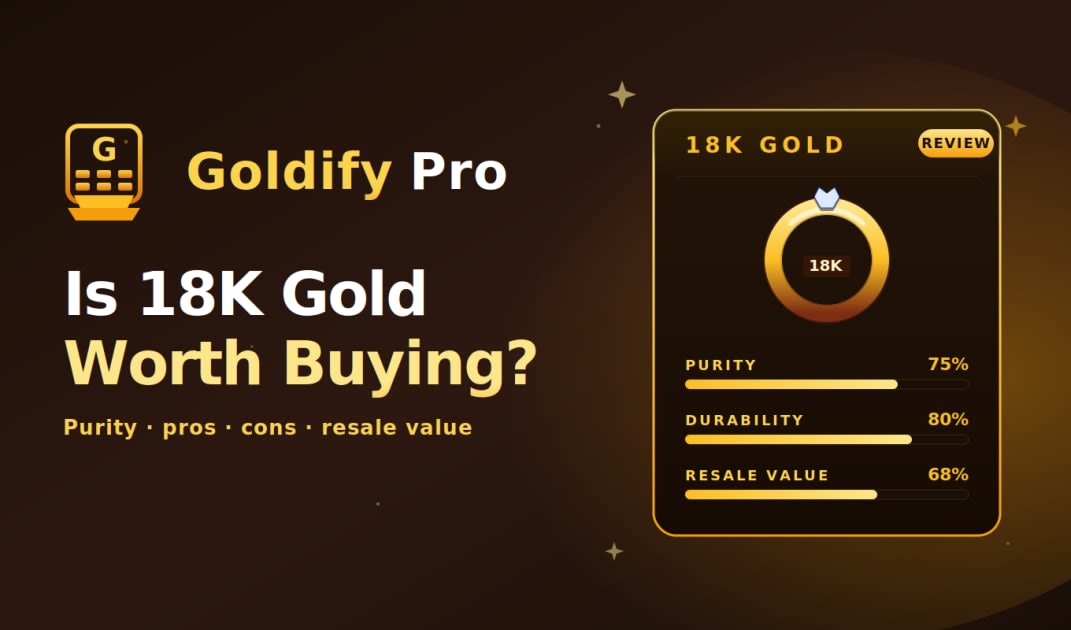
18K Gold: Is It Worth Buying? Purity, Pros & Cons, Resale Value Explained
18K gold is 75% pure — durable enough for daily wear, soft enough for fine designs, and the global standard for high-end Western jewellery. But is it actually worth buying compared to 22K or 14K? A complete guide to 18K's pros, cons, resale value and best uses.
Advertisement
Most gold-buying conversations focus on the two extremes — 24K (the purest) and 22K (the South Asian wedding standard). 18K gets quietly skipped over, even though it is the most popular karat in the entire Western world. If you are buying engagement rings, designer pieces, white gold, or anything Italian, French, American or British, you are almost certainly looking at 18K. So is 18K actually worth buying — or is it the compromise karat that does nothing well? This guide answers it honestly, with the physics behind the metal, the resale maths, and the situations where 18K genuinely is the right choice.
Quick verdict
TL;DR
18K gold is 75% pure. It is the global standard for fine designer jewellery, engagement rings, white gold and luxury watches because it is hard enough to hold gemstones securely, fine enough for intricate design, and elegant enough for every-day wear. It loses on resale per gram compared to 22K but wins on durability and craftsmanship. For wearable jewellery (not investment), 18K is a strong choice.
Advertisement
What does 18K actually mean?
18K stands for 18 karat — 18 parts pure gold out of 24 parts total. That works out to 75% pure gold, with the remaining 25% being a mix of other metals (copper, silver, palladium, zinc) added for hardness and colour. The international hallmark stamp for 18K is 750, which represents 750 parts of gold per 1,000 parts of metal. Anywhere in the world, a piece stamped 750 is officially 18K.
18K = (18 ÷ 24) × 100 = 75% pure goldHallmark stamp: 750 (representing 750/1000 parts gold).
Why 75% is the magic number
The 75% figure is not arbitrary — it is the precise sweet spot where gold becomes hard enough to wear daily, hold stones securely in fine prong settings, and survive scratches, but still soft enough to be sculpted into intricate designs. 24K gold (99.9% pure) is too soft for any setting; a diamond solitaire set in 24K would loosen within months. 22K (91.6%) is durable enough for chains and bangles but still too soft for fine prong work. 18K is the karat where high-end Western jewellery design lives — and that is no accident.
18K vs 22K vs 14K — the real comparison
| Property | 22K (916) | 18K (750) | 14K (585) |
|---|---|---|---|
| Pure gold % | 91.67% | 75% | 58.5% |
| Hardness | Soft (Vickers ~50) | Medium (Vickers ~125) | Harder (Vickers ~150) |
| Colour intensity | Rich warm yellow | Slightly paler yellow | Notably paler |
| Stone-setting suitability | Limited (loose stones risk) | Excellent | Excellent |
| Tarnish resistance | Very high | High | Moderate |
| Daily-wear durability | Bends/dents over time | Strong all-around | Strongest |
| Resale per gram | Highest of the three | Middle | Lowest of the three |
| Cultural fit | South Asia, Gulf | Western world, designer pieces | US mass market, fashion |
Advertisement
18K colours — yellow, white and rose gold all start at 18K
One of the strengths of 18K is that the alloy mix can be tuned to produce different colours, all while keeping 75% pure gold content. Yellow 18K uses copper and silver in a balance that holds gold's natural warmth. White 18K uses palladium or nickel (with rhodium plating on top) for the silver-platinum look. Rose 18K leans heavier on copper for the pink hue. All three carry the same 750 hallmark and the same gold content — the colour is purely about the alloy choice, not the purity.
| Colour | Pure gold | Typical alloy mix |
|---|---|---|
| Yellow 18K | 75% | 12.5% silver + 12.5% copper |
| White 18K (palladium) | 75% | Palladium + small amounts of silver/zinc; usually rhodium-plated |
| White 18K (nickel-based) | 75% | Nickel + zinc + copper; rhodium-plated (less common in Europe due to allergy concerns) |
| Rose 18K | 75% | 20% copper + 5% silver |
| Green 18K (rare) | 75% | Higher silver, almost no copper |
Where 18K shines — the use-cases that beat every other karat
- 1.Engagement rings and wedding bands — 18K's hardness keeps diamond settings secure for decades.
- 2.Designer and high-end jewellery — intricate filigree, pavé settings, and detailed engraving need 18K's structural integrity.
- 3.Luxury watches — almost every Swiss luxury watch (Rolex, Patek Philippe, Audemars Piguet) using gold uses 18K, not 22K.
- 4.White gold pieces — 18K is the de facto standard for white gold worldwide.
- 5.Daily-wear rings for active people — survives gym, gardening, dishes far better than 22K or 24K.
- 6.European, American and Italian jewellery — almost all is 18K (and some is 14K).
- 7.Pieces with gemstone settings — sapphires, emeralds, rubies all need 18K-or-stronger to hold securely.
Advertisement
Where 18K loses — the situations where another karat wins
- South Asian wedding sets — culturally and resale-wise, 22K dominates.
- Pure-investment savings — bars and coins should be 24K, not 18K.
- Maximum gold-per-dollar — 22K and 24K give more pure gold per unit of money.
- Strong yellow colour preference — 18K is slightly paler than 22K's rich yellow.
- Very-high-impact daily wear (heavy manual work) — 14K may be more durable than 18K.
18K resale value — the maths most articles get wrong
Resale value of 18K depends on three things: the underlying gold weight, the local market's preference for that karat, and the design value. The first factor is fixed — 75% of the piece's weight is pure gold, recoverable at the day's spot rate. The second factor is regional — Western markets value 18K highly, South Asian markets prefer 22K and discount 18K resale. The third factor is the design itself — branded designer pieces and luxury-watch gold can command premiums far above scrap value, while generic 18K resells closer to scrap minus a refining margin.
Scrap Value = Weight × 0.75 × 24K Spot Rate − Refining MarginRefining margin typically 5–15% depending on dealer, location and quantity. Designer or branded pieces may sell above scrap; generic pieces often sell at or near scrap.
The cultural resale gap
Selling 18K back to a South Asian jeweller often produces a lower offer than selling the same piece in the US, UK or Europe, simply because local demand for 18K is lower. If you bought 18K abroad and are selling it in South Asia, factor this in before assuming you will recover full karat-equivalent value.
Is 18K gold a good investment?
For pure investment — meaning savings you may sell back for cash years later — 18K is rarely the most efficient form. The 25% non-gold content means every gram of 18K contains less recoverable gold than a gram of 22K or 24K. For investment purposes, 24K bars or coins from recognised refiners are the cleanest choice. 18K shines as wearable jewellery — pieces you actually use, where the cost of making and craftsmanship is part of the value, not pure investment recovery. The honest framing: buy 18K to wear, buy 24K (or SGBs / ETFs) to save.
How to spot fake 18K — and verify a real one
- 1.Check the hallmark — the piece must be stamped 750 (not 18K alone in some countries) plus a maker's mark or assay-office stamp.
- 2.Verify the stamp is clear and centred, not blurred or asymmetric.
- 3.Test density — 18K density should be roughly 15.2–15.6 g/cm³.
- 4.Magnet test — real 18K (yellow or rose) is non-magnetic. White 18K with high nickel content may show very slight attraction; not a definitive disqualifier.
- 5.Professional XRF test — for high-value pieces or anything with a designer brand claim, get a non-destructive XRF reading from a recognised jeweller.
- 6.Skin test — 18K rarely produces black marks on skin; if it does, low-quality plating or alloy issues are likely.
18K and skin sensitivity — the nickel issue
Older or lower-cost 18K white gold sometimes uses nickel as the whitening alloy. Nickel is one of the most common contact-allergens in the world — about 10–17% of women and 1–3% of men are sensitised to it. If you experience redness, itching or rash where 18K white gold touches your skin, the alloy is likely nickel-based. Modern European 18K white gold is typically palladium-based and nickel-free; high-quality designer brands switched to palladium years ago. Always ask whether a white-gold piece is nickel-free if you have known sensitivity.
How 18K is priced compared to 24K and 22K
18K Rate = 24K Rate × (18 ÷ 24) = 24K Rate × 0.75Multiply by weight, then add making charges and tax for the final retail price.
Worked example: if today's 24K rate is illustrative USD 75 per gram, then 18K is roughly 75 × 0.75 = USD 56.25 per gram for raw metal. Add 15–25% making charges for designer pieces (much higher for luxury brands), then any applicable VAT or sales tax for the final price.
Frequently asked questions
Is 18K real gold?
Yes — 100% real gold. 18K means 75% of the metal is pure gold; the remaining 25% is alloy. The piece is genuine gold, just not pure. Anyone calling 18K 'fake' is using the term loosely; it is real gold, simply alloyed for durability.
Will 18K gold tarnish?
Generally no — pure gold does not tarnish, and at 75% gold content 18K resists tarnish very well. The 25% alloy can react with sweat, chemicals or sulfur-rich environments over very long periods, especially in 18K white gold where the rhodium plating eventually wears thin. Regular cleaning with mild soap and water keeps 18K looking good for decades.
Is 18K worth more than 14K?
On a per-gram metal basis, yes — 18K contains 75% gold versus 14K's 58.5%, so 18K is worth roughly 28% more per gram in pure-gold value. The trade-off is that 14K is harder and may suit very high-impact wear better. For most fine jewellery uses, 18K's combination of durability and gold value is the better choice.
Should I buy 18K or 22K for an engagement ring?
Almost always 18K. 22K is too soft for prong settings holding a diamond or coloured stone — over years of wear, the prongs bend and the stone risks loosening. 18K's 25% alloy gives the metal the structural integrity needed to keep stones secure for a lifetime. Almost every reputable engagement-ring brand uses 18K (or sometimes 14K) for exactly this reason.
Common myths — busted
| Myth | Reality |
|---|---|
| 18K is fake gold | It is 75% real gold; just alloyed for durability. |
| 18K is the same in every country | The 750 standard is global, but local taxes and making charges create different retail prices. |
| White gold is a different metal from yellow gold | Both are 18K (or another karat) — the difference is the alloy mix and rhodium plating. |
| 18K cannot be melted and refined | It can — recovered gold value is 75% of weight at spot rate, minus refining margin. |
| Branded 18K is always overpriced | Designer pieces command branding premium that may or may not hold value at resale; generic 18K returns near scrap. |
Buy 18K to wear, buy 22K for tradition, buy 24K to save. The right karat is the one that fits the job — not the one with the highest number.
The bottom line
18K gold is genuinely worth buying — but only for the right job. It is the global standard for fine designer jewellery, engagement rings, white gold, luxury watches and stone-set pieces because its 75% gold content delivers the perfect balance of durability and craftsmanship. It is not the right choice for pure investment savings (24K bars win there) or South Asian wedding sets (22K dominates culturally). Match the karat to your actual goal — daily-wear designer jewellery deserves 18K, savings deserves 24K, and tradition deserves 22K. Once you know the difference, the karat decision stops feeling like a gamble.
Stay informed
Use Goldify Quick Rates for live 18K, 22K, 21K and 24K gold prices in your local currency, refreshed every minute. Use the Goldify converters to verify any 18K quote at the counter.
Advertisement
Disclaimer
Editorial & content disclaimer
This article is original, human-written content created exclusively for Goldify by our editorial team. It is intended for general educational and informational purposes only and does not constitute financial, investment, jewellery-grading, gemmological or appraisal advice. Karat conventions, hallmarking systems, alloy formulations and resale value vary by country, jeweller and time; specific tax treatment, hallmark requirements and refining margins also vary. References to brands and authorities (Rolex, Patek Philippe, Audemars Piguet, BIS, London Assay Office, etc.) describe widely reported public information. Goldify is not affiliated with any brand, government body, refiner, jeweller or platform mentioned. Always confirm specific product details and current market prices with a recognised professional. We do our best to keep information accurate but make no warranty of completeness or fitness for any purpose. By reading this article you agree that Goldify is not liable for any decision you take based on its contents.
Originality & AI policy
This article was written and edited by humans on the Goldify editorial team. Research, examples and analysis were prepared in-house. We do not republish or scrape content from other websites. If you believe any portion of this article infringes a copyright, please contact us at gold@goldify.pro and we will review it promptly.
Advertisement
Tools mentioned in this article
Advertisement


